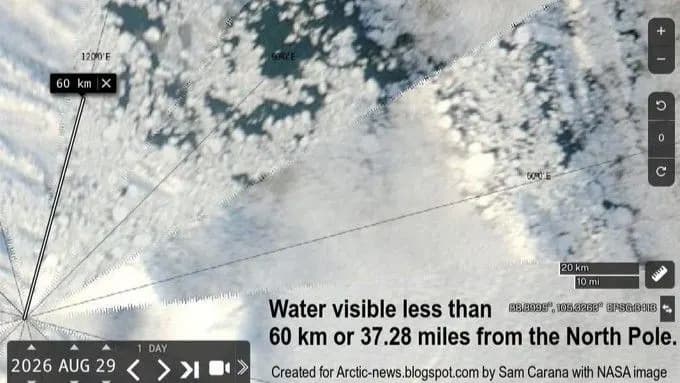
The Arctic recorded its warmest year on record from October 2024 to September 2025, with surface air temperatures the highest since at least 1900 and warming at more than twice the global average. The NOAA Arctic Report Card 2025 documents extreme heat, record precipitation, and accelerating ice loss — including a >95% drop in multi-year sea ice and a 129 billion tonne loss from Greenland in 2025. Scientists warn these shifts are reshaping ecosystems, threatening local livelihoods and amplifying global climate and sea-level impacts.
Arctic Warms More Than Twice as Fast as the Globe — 2024–25 Is The Hottest Year on Record

Arctic warms at more than twice global rate in hottest year on record
The Arctic recorded its warmest 12-month period on record between October 2024 and September 2025, according to the NOAA Arctic Report Card 2025. Surface air temperatures for that interval were the highest since at least 1900, and the region is now warming at more than twice the global average, with nine of the ten warmest Arctic years occurring in the past decade.
Key Findings
The report links extreme heat, record precipitation and accelerating ice loss to sweeping changes across Arctic ecosystems, coastal communities and global climate systems. Autumn 2024 was the warmest on record for the Arctic, while winter 2025 ranked second warmest; total precipitation between October 2024 and September 2025 reached a record high, with several seasons among the five wettest since 1950.
'The Arctic is warming several times faster than Earth as a whole, reshaping the northern landscapes, ecosystems, and livelihoods of Arctic peoples,' the report's executive summary says. 'Also transforming are the roles the Arctic plays in the global climate, economic, and societal systems.'
Sea Ice and Ocean Changes
In March 2025 — when winter sea ice typically peaks — Arctic sea-ice extent was the smallest observed in the 47-year satellite record. By September, summer sea ice retreated to the 10th-lowest minimum on record. The oldest, thickest multi-year sea ice has declined by more than 95% since the 1980s and is now largely confined to waters north of Greenland and the Canadian Arctic Archipelago.
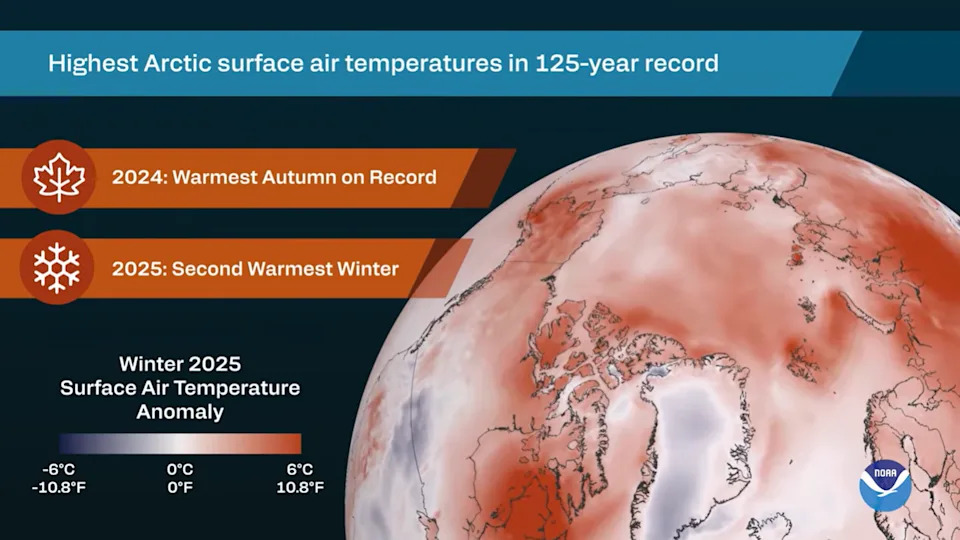
Surface air temperatures across the Arctic between October 2024 and September 2025 were the warmest recorded since 1900 (NOAA)
Parts of the Arctic Ocean's Atlantic sector experienced sea surface temperatures up to about 7°C above the 1991–2020 average in August, a dramatic anomaly linked to northward penetration of warmer Atlantic waters — a process known as Atlantification.
Life in a Changing Arctic
Warming seas and longer open-water seasons have driven major biological shifts. Phytoplankton productivity in the Eurasian Arctic has increased by roughly 80% since 2003, with substantial gains in the Barents Sea and Hudson Bay. While this can boost some food-web productivity, scientists warn it is already reconfiguring ecosystems, altering fisheries and threatening Indigenous subsistence practices that depend on predictable seasonal cycles.
On land, glaciers across Arctic Scandinavia and Svalbard recorded their largest annual losses between 2023 and 2024. The Greenland Ice Sheet lost an estimated 129 billion tonnes in 2025, continuing a long-term contribution to global sea-level rise even though that year's loss was below the longer-term annual average.
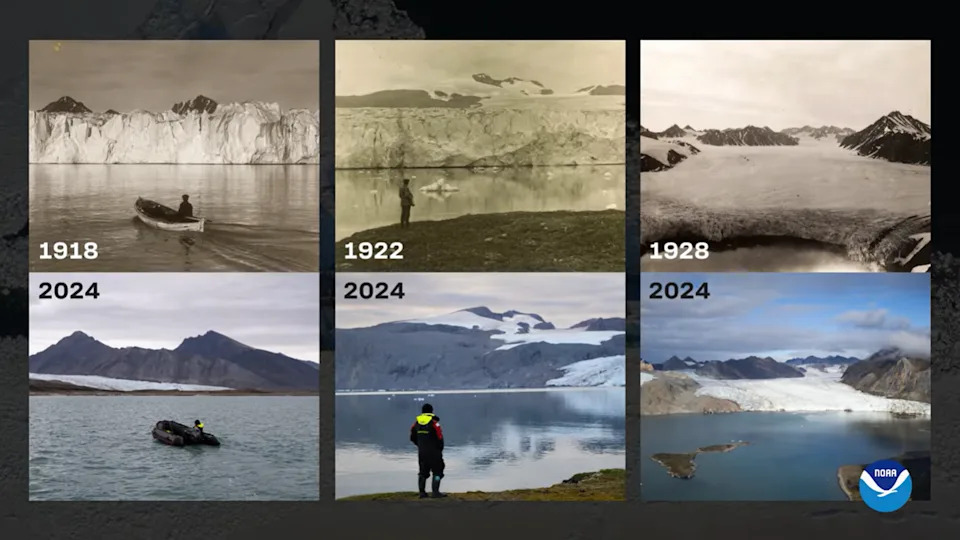
Photos show rapid loss of glaciers in the Arctic (Noaa)
Novel Hazards: Rusting Rivers and Permafrost Thaw
Permafrost thaw has triggered a striking new phenomenon in Arctic Alaska: more than 200 watersheds now show so-called "rusting rivers," where iron and other metals released from thawing soils turn streams orange and increase acidity and toxic metal concentrations. This threatens drinking-water supplies, fish stocks and freshwater biodiversity for remote communities.
Global Consequences
Arctic changes amplify global climate impacts. Loss of bright ice exposes darker ocean and land surfaces that absorb more heat (Arctic amplification). Warming and freshening of Arctic waters can weaken major ocean circulation systems and influence weather patterns across Europe and North America. Some researchers also link rapid Arctic warming to shifts in atmospheric circulation that can increase variance in mid-latitude winter weather.
Hydrology and Monitoring
The Arctic’s hydrological cycle is intensifying: more precipitation falls as rain rather than snow, and June snow cover across the Arctic is now roughly half of what it was about six decades ago — reducing the region’s reflectivity and accelerating local warming. The 2025 Arctic Report Card marks 20 years of continuous monitoring, offering an increasingly clear picture of long-term systemic change. However, major observational gaps remain in remote areas, limiting our ability to track impacts on water availability, infrastructure stability and food security.
Conclusion: The Arctic is undergoing rapid, interconnected transformations with direct implications for northern communities and cascading effects on global climate and sea-level rise. Continued monitoring and mitigation efforts are critical to understand and manage these accelerating changes.
Help us improve.