The article examines growing anger in New Delhi after senior officials downplayed the severity of air pollution, citing 200 'good' days and proposing water-spraying or cloud seeding as fixes. Experts warn that sparse monitoring and laxer national standards — weaker than WHO guidelines — can hide hazardous pollution. A 2019 national program has focused heavily on dust control while neglecting vehicle and industrial emissions; a Lancet study links long-term pollution exposure to about 1.5 million excess deaths annually in India.
Unseen Smog: How Weak Monitoring and Political Denial Hide India's Air Quality Crisis

FILE - People walk through smog in New Delhi, India, Dec. 15, 2025. (AP Photo/Piyush Nagpal, File)(ASSOCIATED PRESS)
Recent statements from senior officials and persistent gaps in monitoring have deepened public frustration in New Delhi, where residents say policymakers are downplaying a worsening air-pollution emergency.
Officials' Remarks and Public Backlash
Environment Minister Bhupender Yadav told Parliament that New Delhi recorded 200 days of 'good' air quality this year. Pollution experts and opposition leaders say that figure ignores the seasonal spikes and the worst months, and that it misrepresents residents' lived experience. Days later, Delhi Chief Minister Rekha Gupta compared the air quality index (AQI) to a temperature reading and suggested spraying water could help — remarks that provoked public jeers and chants of 'AQI' at a subsequent event.
Faulty Fixes: Cloud Seeding and Cosmetic Measures
Gupta also approved a controversial cloud-seeding program earlier in the year, saying it might induce rain to clear pollutants despite little credible evidence that such interventions reliably reduce urban air pollution. Residents say measures like water-spraying and headline-grabbing projects are cosmetic, rather than aimed at the main pollution sources.
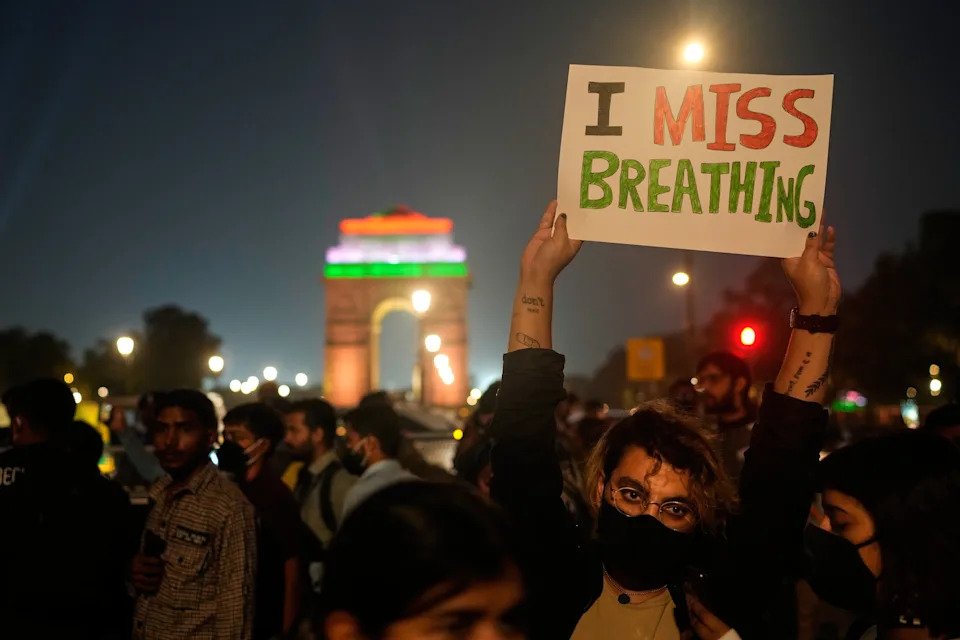
FILE - A person holds a sign during a protest against what they called the government's lack of action to combat air pollution in New Delhi, India, Nov. 9, 2025. (AP Photo/Manish Swarup, File)(ASSOCIATED PRESS)
"Instead of doing cloud seeding, I hope the government will wake up and take some real action," said Anita, a 73-year-old New Delhi resident who uses one name. "It's a shame."
Monitoring Gaps and Weaker Standards
India measures air quality using a network of ground monitors, sensors and satellite data. Where monitors exist they produce robust readings, but experts say there are too few stations to capture neighborhood-level pollution. Data specialists also point out that India’s official air-quality thresholds are looser than those used in countries such as the United States and are less stringent than World Health Organization guidelines, so 'moderate' official readings can obscure dangerous pollution levels.
"We are making huge investments in air quality monitoring. And so when we are expanding, then it also becomes an imperative that we should be focusing on the quality," said Anumita Roychowdhury, executive director at the Centre for Science and Environment.
Policy Priorities and Funding Imbalance
Launched in 2019, the National Clean Air Program aims to cut pollution by as much as 40% in 131 cities by 2026. The program has funded monitors and dust-control measures, including water-spraying machines intended to reduce road and construction dust and sand blown from deserts.
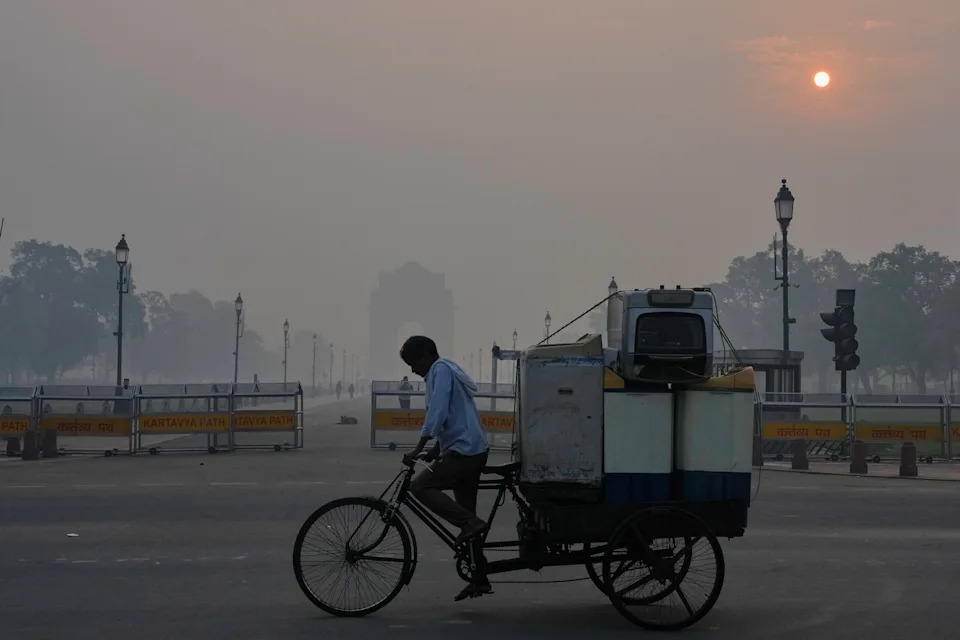
FILE - A cyclist pedals through morning smog near the India Gate monument as he transports used home appliances in New Delhi, India, Oct. 21, 2025. (AP Photo/Manish Swarup, File)(ASSOCIATED PRESS)
However, experts say the initiative has done little to curb emissions from major sources such as industry and vehicles. A 2024 report by the Centre for Science and Environment found that 64% of program funds went to dust-control measures, 12% to vehicle-related measures and under 1% to industrial emissions reduction.
Health Consequences and Data Gaps
A 2024 Lancet study estimated that long-term exposure to polluted air is linked to about 1.5 million additional deaths in India each year compared with a scenario meeting WHO guidelines. Yet India’s junior health minister, Prataprao Jadhav, recently said there is no conclusive national data proving a direct, exclusive link between pollution and specific deaths — a gap public-health advocates say reflects missing systematic mechanisms to count pollution-related mortality.
Shweta Narayan of the Global Climate and Health Alliance warned that polluted air causes lifelong harm, particularly for pregnant women, young children and the elderly, contributing to preterm births, low birth weight and other chronic conditions.

FILE - People walk through an overhead bridge amidst morning smog in New Delhi, India, Oct. 21, 2025. (AP Photo/Manish Swarup, File)(ASSOCIATED PRESS)
Public Response and Political Will
Protests in New Delhi this month saw citizens demand immediate, substantive government action — a sign of growing public impatience. Environmentalist Vimlendu Jha said political leaders have normalized high pollution levels and prioritized image management over meaningful pollution control.
"The first thing the government needs to do is be honest about the problem. The right diagnosis is extremely critical," Jha said.
The human toll is visible on city streets. "Everyone feels the pollution. People are not able to work or even breathe," said Satish Sharma, a 60-year-old auto rickshaw driver who has reduced his working hours as his health has worsened.
Without stronger monitoring, clearer reporting and targeted policy action to cut vehicle and industrial emissions, experts warn the public-health and economic consequences will deepen.
Reporting contributed by journalists across India. The Associated Press' climate and environmental coverage receives some philanthropic support; AP retains editorial control of content.
Help us improve.