The U.S. Southwest has experienced about 25 years of exceptional dryness, with Colorado River reservoirs at record lows. A new Nature study analyzing 572 simulations from 12 climate models finds the Pacific Decadal Oscillation (PDO) has been unusually stuck in a negative phase since the late 1990s and attributes roughly half of its decade-to-decade variability to human influences: rising greenhouse gases and falling aerosols. If these trends continue, the PDO is likely to remain negative and could prolong Southwest drought for another two decades, narrowing precipitation projections and improving planning for water managers.
Human-driven Shift in Pacific Decadal Oscillation Could Extend Southwest Drought for Decades

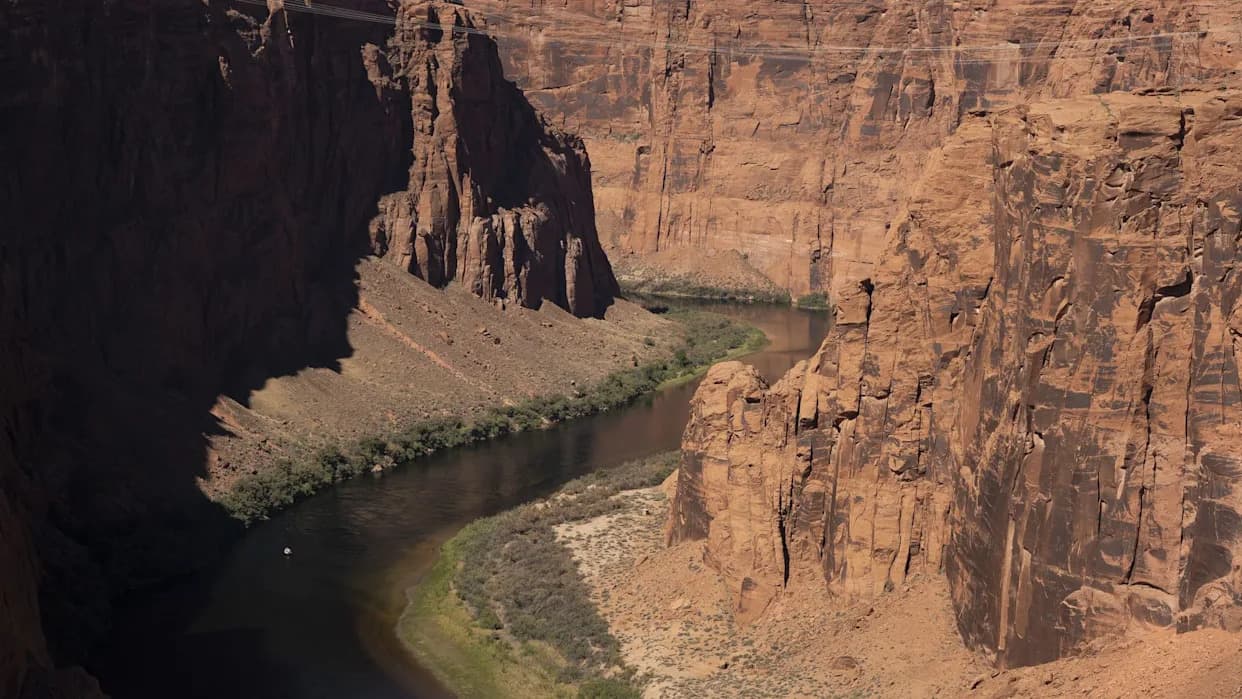
Reservoirs fed by the Colorado River — some of the nation’s most important water stores — are falling to record lows, revealing sunken boats, exposed remains and parched soils. This decline is the latest phase of a drying trend that has gripped the U.S. Southwest for roughly 25 years, the driest stretch the region has seen in about 1,200 years. Even powerful atmospheric rivers in recent winters have done little to reverse the overall decline.
New research published in Nature finds that this prolonged dry spell could plausibly continue for many more years, potentially persisting another two decades. The study reexamines the Pacific Decadal Oscillation (PDO), a major climate pattern in the North Pacific, and finds that human-caused changes in the atmosphere are altering the PDO’s natural behavior in ways that favor drier conditions over the western United States.
What the PDO is and why it matters
The Pacific Decadal Oscillation is a long-lived pattern of warmer and cooler sea-surface temperatures in the North Pacific that helps steer rainfall patterns across the Pacific basin. Historically, the PDO has alternated between positive and negative phases: a positive phase tends to bring wetter conditions to the U.S. West, while a negative phase tends to suppress rainfall.
Since the PDO was characterized in the 1990s, scientists treated its swings as largely natural variability. But the PDO has been persistently negative since the late 1990s, with July recently recorded as the most negative month in the observational record maintained by the National Oceanic and Atmospheric Administration (NOAA). That long ``stuck'' state prompted researchers to ask whether something beyond random chance was at work.
How the study was done
Lead author Jeremy Klavans, a climate scientist at the University of Colorado Boulder, and his colleagues analyzed output from 572 simulations produced by 12 state-of-the-art climate models. They computed a multi-model average of the PDO index across those runs. While individual simulations show wide variability, the ensemble mean closely mirrors the observed negative trend — a surprising result if the PDO were driven solely by natural fluctuations.
The authors conclude that the common signal remaining after averaging is linked to human activities: rising greenhouse-gas concentrations that warm the atmosphere and a concurrent decline in aerosols — tiny particles from sources such as industrial emissions that historically exerted a cooling influence. The study estimates that roughly half of decade-to-decade variability in the PDO can be attributed to these human influences.
"If aerosol reductions and greenhouse-gas increases proceed together," Klavans said, "we would expect the PDO to continue trending negative."
That continued negative trend in the PDO makes a prolonged drought in the Southwest — possibly lasting another two decades or more — a more likely outcome than older projections suggested.
What this means for forecasts and planning
Previously, projections for rainfall across the western United States were highly uncertain: some model runs suggested relief, while others forecast deeper drying. When models are adjusted to reflect the study’s findings, the PDO’s sensitivity to human-induced changes increases and the spread of precipitation outcomes narrows. In short, the most probable scenario becomes continued drought, rather than a near-term return to wetter conditions.
Outside experts praised the work’s implications for understanding climate variability. Young-Oh Kwon of the Woods Hole Oceanographic Institution, who was not involved in the study, said, "It's very well done work. It's definitely changing our view on what the Pacific Decadal Oscillation is." Scientists must now reckon with the pronounced influence that human emissions and aerosol changes exert on regional climate patterns such as the PDO, El Niño/Southern Oscillation and the North Atlantic Oscillation.
Although the prospect of multi-decade drought is sobering, a more accurate understanding of the drivers behind the PDO can reduce uncertainty and give policymakers and water managers clearer guidance for long-term planning and adaptation.
Help us improve.