Researchers discovered a colossal communal web in a cavern on the Albania–Greece border built by more than 110,000 spiders and covering about 1,140 sq ft, sustained by swarms of midges. Scientists now view webs as "extended" organs: they detect vibrations, protect eggs, transmit signals and can be decorated with stabilimenta that change vibration propagation. Studies document spiders that build giant decoys (notably Cyclosa) to deter predators, experiments that reinforce silk with nanomaterials, and AI-driven research into web structure, highlighting silk’s remarkable biochemical and functional diversity.
What Scientists Are Learning From the Planet’s Strangest Spider Webs

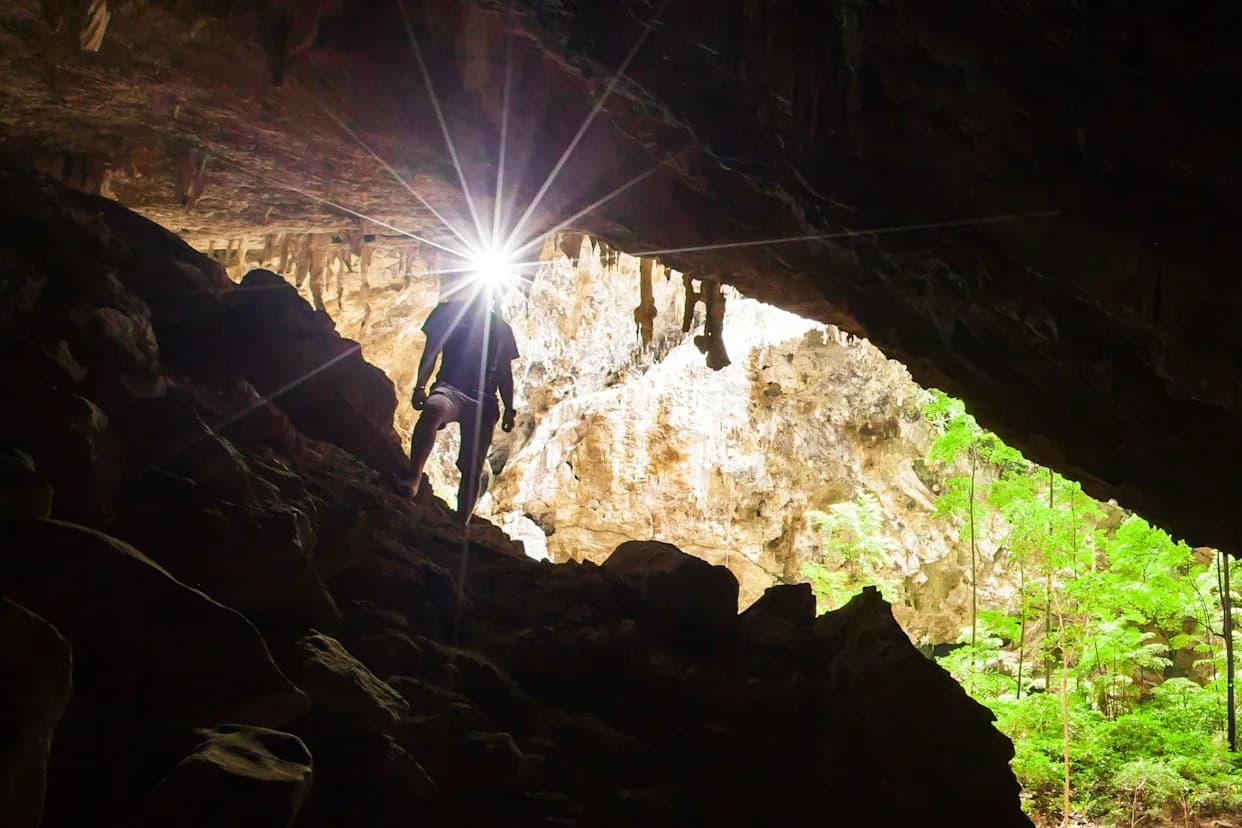
Deep inside a narrow passage of a cavern along the Albania–Greece border, researchers waded through waist-deep black water and clung to ropes to reach an astonishing sight: a shimmering wall of silk stretching as far as their headlamps could reveal. The communal web, found in what researchers call the Sulfur Cave, was built by more than 110,000 spiders from two species and spanned roughly 1,140 square feet. In places the mat of silk was so heavy it sagged and collapsed under its own weight.
The colony is sustained by a steady influx of tiny flies called midges, and the researchers described the assemblage in a recent paper as "an extraordinary colonial spider community." That remarkable discovery underscores how spider silk and web architecture vary dramatically across species and environments.
Webs as living extensions of the spider
Biologists increasingly view webs as more than passive traps. A web can act like an extra organ—an "extended phenotype" produced by the spider that reflects its genome and behavior. "It's almost like having another hair or limb," says Gabriele Greco, a postdoctoral researcher at the University of Pavia. The web enlarges a spider's sensory world: a 2022 study found orb-weaving spiders can use their webs like giant ears, extending their ability to sense vibrations by as much as 10,000 times.
Decoration, vibration control and trade-offs
Many spiders add visible ornaments—zig-zag threads called stabilimenta—to their webs. The function of these decorations has long been debated. Greco's recent paper in PLOS One shows that stabilimenta can alter how vibrations travel through a web after prey becomes trapped, potentially changing how easily a spider detects or localizes prey. But decorations also add mass and may reduce structural stability or require extra energy to build, so their benefits are balanced by costs. "Nobody knows exactly why spiders decorate their webs," Greco admits, but emerging experiments are clarifying the trade-offs.
Decoys, camouflage and surprising behavior
Field researchers have also documented spiders that construct lifelike decoys in their webs. While walking in the Philippines, Larry Reeves spotted what looked like a large spider only to find it was a spider-shaped structure woven from silk and plant fragments. After collaborating with Phil Torres and others, Reeves published research showing Cyclosa spiders build oversized, spider-shaped decoys from silk, debris and prey parts. These fake spiders often exceed the actual spider's size and likely serve as anti-predator defenses by deterring visually hunting predators.
"They’ll notice a larger spider there that probably is not on their menu, and they'll kind of avoid the web," Reeves explains.
Silk chemistry, engineering and AI
Spider silk is a biochemical marvel: it contains more than 2,200 different proteins and displays a range of mechanical properties across species. Researchers are exploring ways to understand and even enhance silk. In experiments, Greco fed spiders nanomaterials such as carbon nanotubes; the spiders then produced naturally reinforced silk. Scientists are also applying artificial intelligence and machine-learning methods to map web architecture and predict how structural changes affect performance.
Why this matters
These discoveries illuminate how spiders adapt their silk and web-building strategies to different environments, body sizes and food supplies. As Cheryl Hayashi, a biologist at the American Museum of Natural History, puts it: "The evolution of silk is one of the most amazing things that has happened in the history of life. Spiders keep finding new ways to use it." From cave-spanning colonies to deceptive decoys and engineered silk, the study of webs is revealing new possibilities for biology, materials science and sensor design.
Help us improve.