Climbers on Monte Cònero discovered a set of parallel flipper marks preserved in limestone that researchers believe record a mass exodus across an ancient seabed about 83 million years ago. Paleontologists used on-site surveys and drone imagery to analyze the pattern and concluded the traces most likely come from multiple sea turtles or similar marine reptiles. The marks were rapidly buried by a carbonate-rich sediment flow—likely triggered by an earthquake—preserving this rare behavioral fossil. The finding highlights how casual field photos can lead to major scientific discoveries.
Climbers Find 83-Million-Year-Old Flipper Tracks — Evidence of an Ancient Sea Turtle Panic

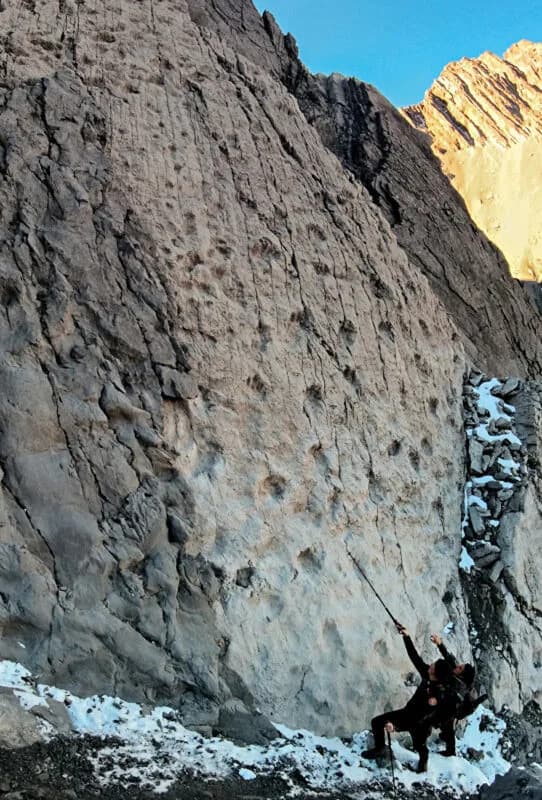
While scaling the limestone slopes of Monte Cònero in spring 2019, a group of climbers photographed a startling series of shallow impressions etched across a cliff face above La Vela Beach. Those images prompted a formal investigation by paleontologists, who now interpret the marks as a rare snapshot of frantic movement across an ancient seabed roughly 83 million years ago.
After receiving the climbers' photos, Alessandro Montanari and his team at the Geological Observatory of Coldigioco surveyed the site on foot and used drones to capture panoramic imagery of the exposed slabs. The trackways lie on a cliff that today stands more than 100 meters above sea level but preserves sediment deposited when the area was a submerged Late Cretaceous seafloor.
Montanari compared the newly discovered traces with nearby ichnofossils—trace fossils that record activity rather than body remains, including a slab previously examined by Luca Natali and attributed to an ichnotaxon named Coneroichnus marinus. The pattern of many parallel, repeated marks suggested several medium-sized animals paddling in the same direction across soft, oozy sediment.
Because fish do not typically make repetitive flipper-like scratches in sediment, the researchers considered marine reptiles known from the period, including mosasaurs, plesiosaurs, and extinct sea turtles in the Protostegidae lineage. No skeletal remains of these animals have been found at Monte Cònero, so the team relied on the morphology of the traces and comparisons with both fossil and living species to narrow possibilities.
Modern sea turtles provided a helpful behavioral analogue. Females of many living sea-turtle species move in groups to feed or nest, and some reef-associated turtles—such as the Hawaiian green turtle (Chelonia mydas) and the hawksbill (Eretmochelys imbricata)—sometimes swim close enough to the seafloor that their fore-flippers brush the sediment. The researchers argue that a similar behavior by an extinct lineage could explain the many parallel flipper gouges.
“The prevalence of sea-turtle–like behavior in comparable environments leads us to hypothesize that the myriad trace fossils of the La Vela slabs represent a mass displacement of a very large number of these animals,” Montanari and colleagues write, proposing that the animals were likely foraging when they were spooked.
The team proposes that a sudden seismic event—an earthquake—provoked the animals to stampede toward deeper water. Individuals swimming close to the seafloor would have left parallel flipper impressions that, under normal conditions, would be quickly erased by currents. In this case, however, a rapid carbonate-rich sediment flow (a calcilutitic fluxoturbidite) appears to have buried and sealed the soft substrate almost immediately, preserving the fleeting tracks in limestone.
The timing of local seismic activity coincides with the Early Campanian Event, a period of climatic change that some researchers link to an asteroid impact. While the attribution to sea turtles remains a hypothesis—based on trace morphology, environmental reconstruction, and modern analogues—the La Vela slabs offer a rare behavioral glimpse into how marine animals reacted to sudden disturbance tens of millions of years ago.
Beyond scientific interest, the discovery is a practical reminder: photographs taken by climbers and outdoor enthusiasts can reveal scientifically valuable material. Field images can prompt targeted surveys and new research into Earth's deep past.
Help us improve.