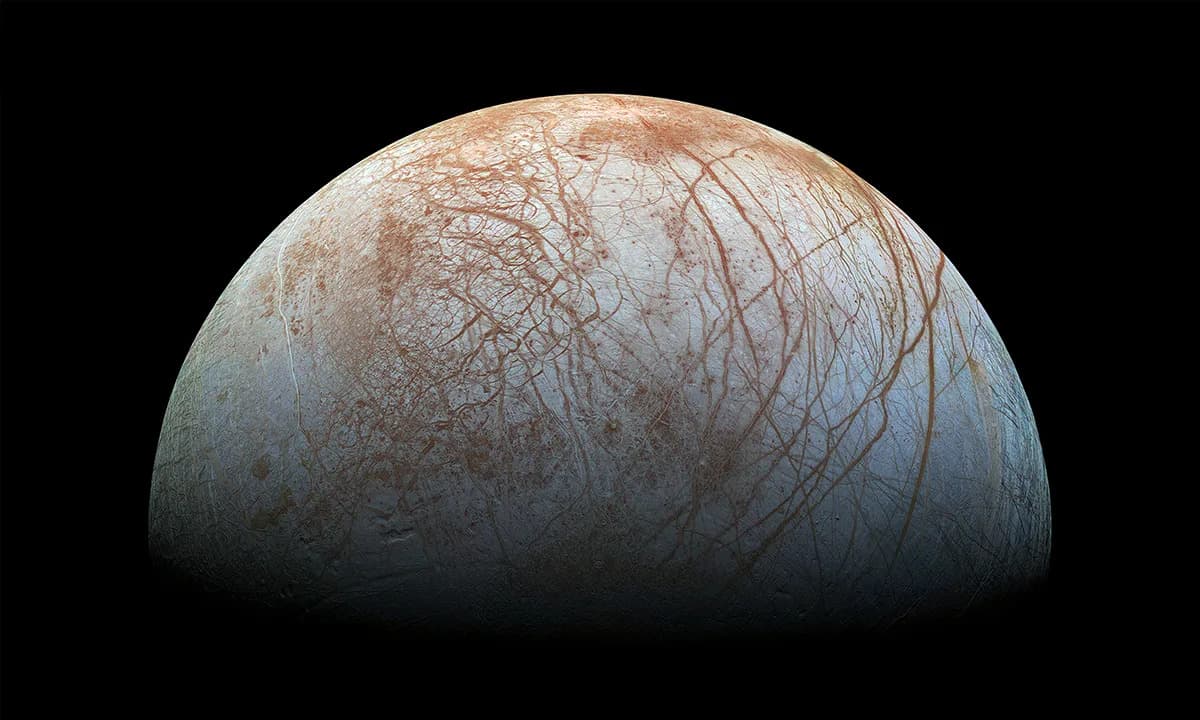
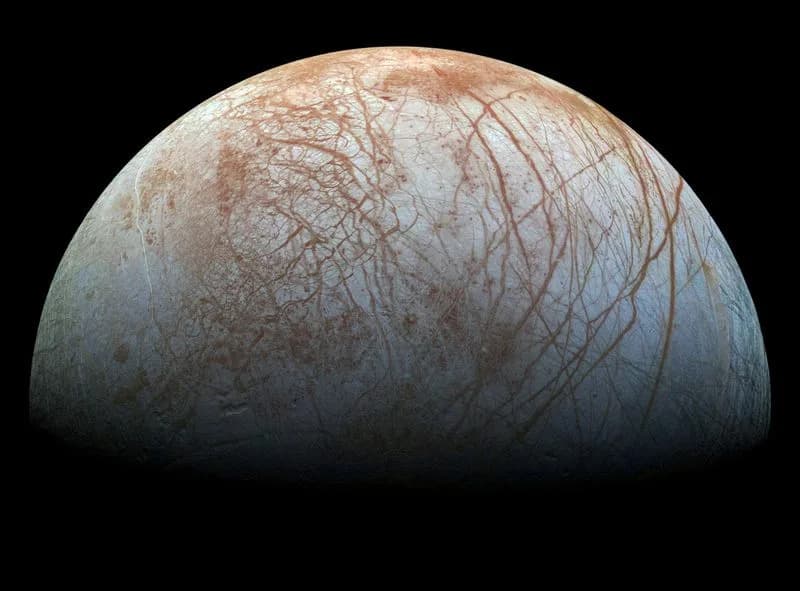
The study in Nature Astronomy models how water and ice interact beneath the crusts of small outer-planet moons and finds that pressure–temperature effects can drive melting, vaporization and turbulent fluid flow. Moons with radii under about 186 miles (≈300 km)—such as Enceladus, Mimas and Miranda—can preserve thin ice shells during pressure drops, enabling boiling-like circulation. That circulation can carry minerals and potential nutrients upward, raising the astrobiological potential of these small satellites. The findings suggest small icy moons are promising targets in the search for life.
Small Icy Moons May Hide Boiling, Turbulent Oceans — and Better Chances for Life

New modeling published in Nature Astronomy suggests several small icy moons at the outer edges of the solar system are far more active beneath their frozen shells than previously thought. The study shows that the unusual pressure–temperature behavior of water inside these bodies can trigger melting, vaporization and vigorous fluid motion beneath thin ice crusts.
Unlike Earth, where tectonics are driven by molten rock, many outer-planet satellites experience internal heating from tidal forces: repeated gravitational tugs from their parent planet and neighboring moons periodically compress and stretch them, producing heat. The researchers find that, in addition to this tidal heating, phase changes in subsurface water layers themselves can generate strong mechanical effects on overlying ice.
"Not all of these satellites are known to have oceans, but we know that some do," said lead author Max Rudolph of the University of California, Davis. "We’re interested in the processes that shape their evolution over millions of years and this allows us to think about what the surface expression of an ocean world would be."
Water behaves differently from most materials: hydrogen bonding makes ice less dense than liquid water, so ice occupies more volume than the liquid that produced it. When an ice shell around a subsurface liquid layer melts, the pressure at the liquid–ice interface can fall sharply. Because freezing and boiling depend on both temperature and pressure, a sudden pressure drop can let liquid water flash to vapor even without a large temperature increase—behavior related to the water "triple point" on a pressure–temperature diagram.
The models indicate this turbulent, boiling-like regime is strongly size-dependent. Satellites with radii below roughly 186 miles (≈300 km)—for example Enceladus, Mimas and Miranda—can maintain the integrity of a thin ice shell as internal pressure falls, allowing melting, vaporization and fluid circulation beneath the crust. Larger bodies such as Titania and Iapetus are more likely to have their ice shells buckle under the same conditions, preventing sustained turbulent circulation.
Why this matters
Circulation beneath an ice shell can transport heat, dissolved minerals and potential nutrients from a rocky core upward toward the ice and occasionally to the surface. That transport increases the astrobiological potential of these small moons by mixing chemical ingredients needed for life and by creating dynamic environments where chemical gradients can persist.
Rather than inert, frozen spheres, some small outer-planet moons may host active, ocean-driven processes that make them compelling targets for future observations and missions. The study reframes how scientists prioritize moons in the search for habitable environments beyond Earth.
Source: Modeling study reported in Nature Astronomy; lead author Max Rudolph (University of California, Davis).
Help us improve.