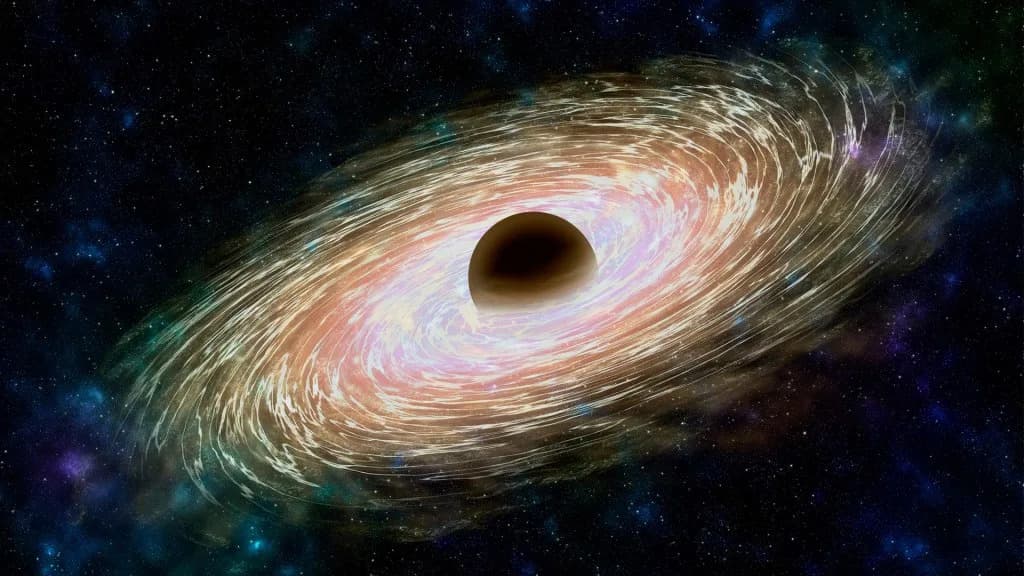
Physicist Robert Scherrer explores what would happen if a tiny black hole passed through a person. A black hole of about 100 billion tons (≈1014 kg) might cause less immediate damage than a .22‑calibre bullet because of its tiny size and rapid transit. However, a primordial black hole could produce a supersonic shock wave and intense tidal forces that tear cells apart—especially in the brain—and a large one could be fatal. Primordial black holes are also studied as a possible contributor to dark matter.
What Would Happen If a Tiny Black Hole Passed Through Your Body?

Space enthusiasts often imagine extreme scenarios — but could a black hole really pass through a person? Physicist Robert Scherrer of Vanderbilt University has examined this hypothetical and provides a useful way to think about the effects.
A surprising comparison
Scherrer estimates that a very small black hole weighing about 100 billion tons (≈1014 kg) would, in some respects, cause less immediate damage than a .22‑calibre bullet. The reasoning is that such a tiny black hole would be extremely compact and would traverse the body almost instantaneously, interacting with matter over a very small cross‑section.
Shock waves and tidal forces
However, not all tiny black holes would be harmless. Scherrer explains that a primordial black hole — a relic from the early universe — could generate a supersonic shock wave along its path as it moves through matter, destroying tissue in its wake. In addition, the black hole would exert intense tidal forces near its trajectory.
“As the PBH passes through the human body, it will exert strong tidal forces in its vicinity. These will produce a tensile force on nearby human cells, and a sufficiently strong force would tear the cells apart. The cells most sensitive to this dissociation are likely to be those in the human brain,” Scherrer said.
In short: a sufficiently large primordial black hole passing through a person could cause severe injury or death and might behave, in practical terms, like a high‑energy penetrating wound.
Cosmological context
Primordial black holes are also of interest to cosmologists because they are a proposed candidate for at least part of dark matter. Such black holes could have formed from extreme overdensities in the very early universe, shortly after the Big Bang, and would be difficult to detect except by their gravitational effects.
Note: This discussion is theoretical and based on models and estimates. Tiny black holes of the kind described remain hypothetical and have not been observed passing through matter in this way.
Help us improve.