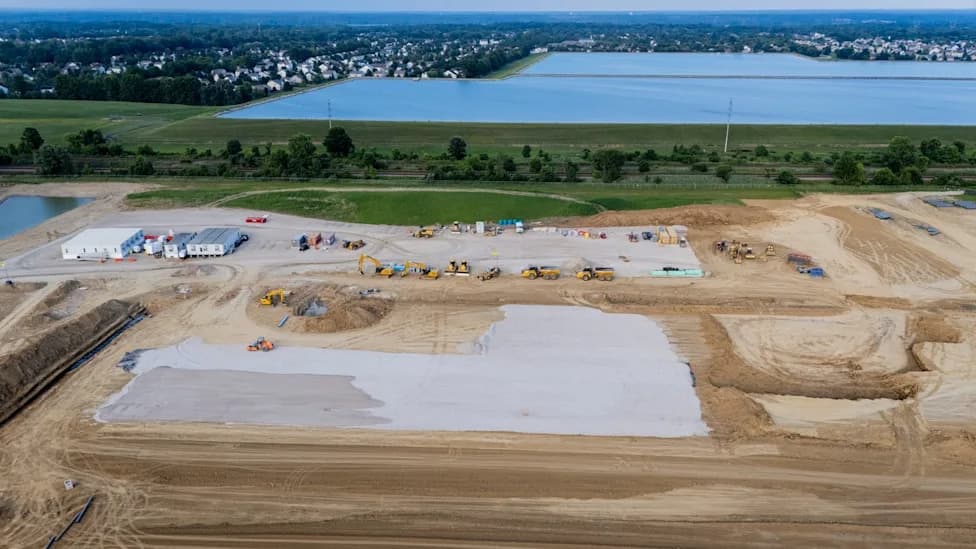
AI-fueled data centers are creating a new interstate political clash: states eager for jobs and tax revenue face the reality of surging electricity demand, higher utility bills and environmental strain. Shared grids like PJM amplify the consequences, forcing policymakers to weigh local economic gains against regional costs. Lawmakers are pushing for stronger local input and mechanisms to make tech firms cover spillover costs, but solutions will differ community by community.
AI Data Centers Ignite Interstate Fight Over Power, Bills and Jobs

As artificial intelligence drives demand for massive computing capacity, data centers are transforming local economies — and straining regional power systems. What looks like a race to attract jobs and tax revenue has produced a thorny tradeoff: communities welcome investment, but utilities, ratepayers and local leaders are confronting higher electricity demand, rising bills and environmental concerns.
Politics and anecdotes
In the run-up to this fall’s elections, New Jersey Gov.-elect Mikie Sherrill criticized neighboring Virginia for its booming data center market, saying, “Right now, we need to produce power here in our state … because Virginia has a million data centers which are sucking all the power out of our market.” That claim was an exaggeration: the Data Center Map lists roughly 666 data centers in Virginia and 82 in New Jersey. When Virginia Gov.-elect Abigail Spanberger — a longtime friend of Sherrill’s — was told the comment, she quipped, “Mikie! Go ahead. We’ll take the revenue,” while stressing that tech companies must expand sustainably and cover their fair share of costs.
Shared grids, shared headaches
Across much of the eastern United States, states are linked by regional transmission organizations such as PJM, which spans 13 states plus the District of Columbia. That shared infrastructure means data center growth in one state can affect power supply and prices across many others. Officials point to rising utility bills and water usage, and to the difficulty of turning down large investments that could simply move to neighboring states with looser rules.
“We are, by the nature of the grid, connected to our neighboring states,” said Raúl Torrez, the attorney general of New Mexico, which has far fewer data centers than Texas. “It is very difficult to be right next to a state that takes a less aggressive approach in terms of protecting consumers.”
Economic gains, practical limits
States tout the economic benefits of data centers. A review by the Virginia General Assembly estimated the industry contributes about $9.1 billion to the state’s GDP. Tech companies promise jobs and community investments — Microsoft, for example, has highlighted development initiatives tied to its campuses in parts of Virginia.
Yet the same reviews show limits to what data centers themselves can do to reduce energy demand. The Virginia report noted that encouraging renewable generation, demand-response participation and efficiency would likely only marginally lower the overall energy footprint of large-scale data center operations.
Local tensions and rising rates
Utilities and consumers are already feeling impacts. Dominion Energy, Virginia’s largest utility, has proposed rate increases in the neighborhood of 9%. New Jersey residents saw utility bills spike by more than 20% in a recent period. In Pennsylvania, statewide rates rose roughly 5% to 12% this summer. Communities have organized protests and asked for stronger local input on project approvals and cost sharing.
Candidates and local officials express the dilemma plainly: welcome the jobs and tax base, but not at the expense of households paying higher bills or strained public services. Mitchell Berman, a candidate in Wisconsin, warned that some campuses can demand as much electricity as entire cities. Other officials call for clearer rules so tech firms internalize the costs they impose on power systems and water supplies.
Policy options and tradeoffs
Proposed responses range from requiring data centers to contract additional clean generation or participate in demand-response programs, to imposing impact fees or stricter permitting tied to community benefits. Lawmakers emphasize that solutions need local nuance: what works for a rural county may not suit a suburban grid hub. Representative Jake Auchincloss urged strong local input and said, “As a general rule … the tech companies need to pay for the cost spillovers, particularly power and water.”
At the same time, governors and economic leaders warn that overly restrictive policies could drive investment across state lines. The result is a policy standoff: governors and legislators must balance job creation, public affordability and climate priorities while competing in a marketplace where capital is mobile.
Conclusion
The expansion of AI-driven data centers poses a clear choice for regional policymakers: foster rapid economic growth and risk higher costs for consumers and the environment, or impose tighter controls that may shift investment to neighboring states. The debate is intensifying as demand for compute grows, and solutions will likely be a mix of local regulations, state-level policies and regional grid investments aimed at ensuring that benefits and burdens are shared more equitably.
Help us improve.