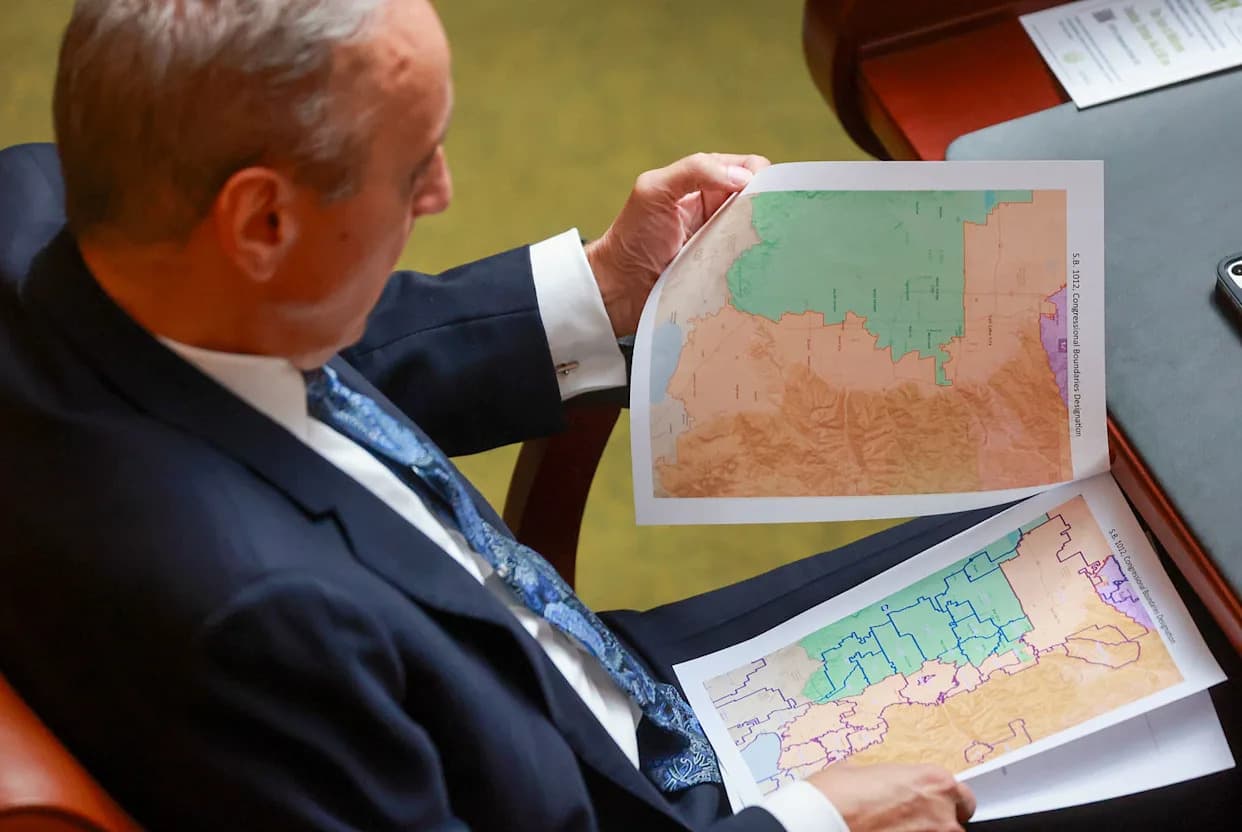
The Wisconsin Supreme Court ordered two lawsuits challenging the state’s 2011 congressional map to be heard first by separate three‑judge panels, a 5‑2 procedural ruling that advances the cases but does not decide their merits. Justice Brian Hagedorn joined the majority while protesting the method used to assign judges. Plaintiffs include a bipartisan business coalition and the Elias Law Group; Democrats hope new maps could make at least two GOP‑held seats competitive before the 2026 midterms.
Wisconsin Supreme Court Orders Three‑Judge Panels to Hear Redistricting Challenges, Raising Stakes for 2026

The Wisconsin Supreme Court on Tuesday directed that two separate lawsuits challenging the state's congressional map be heard first by three‑judge panels, advancing procedural steps in claims that the current boundaries unduly favor Republicans. The 5‑2 ruling does not resolve the constitutional merits of the suits but sends them to lower‑court panels whose decisions can be appealed back to the state Supreme Court.
What the court ruled
The court decided, in a 5‑2 vote, that the challenges must proceed before three‑judge circuit‑court panels as provided under a 2011 state law. Conservative Justice Brian Hagedorn joined the four liberal justices in concluding the panels were the proper forum, but he objected to how the Supreme Court assigned the individual judges to those panels.
“I am not suggesting the judicial panel will fail to do its job with integrity and impartiality,” Hagedorn wrote. “But this approach is an odd choice in the face of a statute so clearly designed to deter litigants from selecting their preferred venue and judge.”
Panel assignments and controversy
The court assigned one case to judges from Dane, Portage and Marathon counties and the other to judges from Dane, Milwaukee and Outagamie counties. Several of the assigned judges publicly endorsed Justice Susan Crawford in this year’s Supreme Court race, and some were appointed by Democratic Gov. Tony Evers — details that drew sharp criticism from the two dissenting conservative justices.
Justice Annette Ziegler wrote that “hand picking circuit court judges to perform political maneuvering is unimaginable,” accusing her colleagues of actions that could create a partisan advantage for Democrats. Supporters of the assignments say the selections follow existing law and that appeals remain possible up to the state Supreme Court.
The lawsuits
Both suits argue the 2011 congressional map — which currently results in six of Wisconsin’s eight U.S. House seats being held by Republicans — amounts to an unconstitutional partisan gerrymander and should be redrawn. One suit was filed by a bipartisan coalition of business leaders and is represented by Law Forward; the other was brought on behalf of voters by the Elias Law Group.
Abha Khanna, a partner at Elias Law Group, called the decision a “positive development” for efforts to secure new maps before the 2026 midterms. Doug Poland, an attorney with Law Forward, said he looks forward to “delivering competitive congressional maps for the voters of Wisconsin,” but offered no timetable.
Recusal requests and political context
Republican members of Wisconsin’s congressional delegation sought to disqualify two liberal justices — Susan Crawford and Janet Protasiewicz — citing large campaign donations they received from the state Democratic Party; both justices declined to recuse themselves. The Supreme Court’s procedural order did not address these recusal requests or the underlying constitutional claims.
Potential impact and timeline
Democrats say redrawn lines could make at least two currently Republican‑held districts competitive again, naming the western 3rd District (held by Rep. Derrick Van Orden) and the 1st District in southeastern Wisconsin (held by Rep. Bryan Steil) as targets. Whether any new maps could be finalized and implemented in time for the 2026 midterm elections remains uncertain.
Next steps
The three‑judge panels will now take up the cases at the circuit level. Any rulings from those panels can be appealed to the Wisconsin Supreme Court. The process could move quickly if courts prioritize the cases, but multiple appeals and timing constraints make the 2026 calendar an open question.
Help us improve.