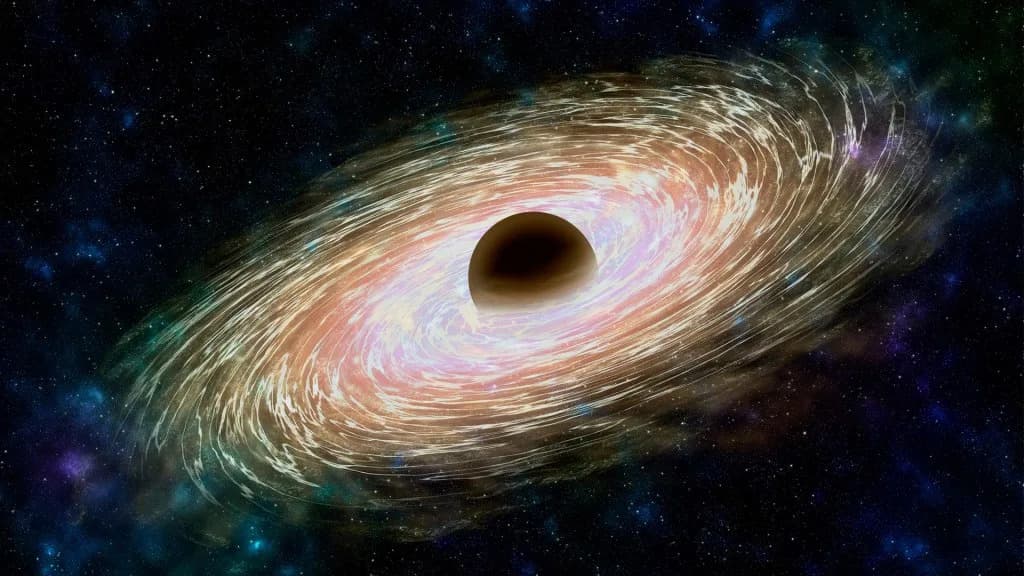
Physicist Robert Scherrer calculated the effects of a microscopic primordial black hole passing through a person and found that damage would usually be limited. The main hazard is a supersonic wake that can act like the ballistic shock of a bullet for masses on the order of 10^11–10^14 metric tons (Scherrer cites ≈140 billion metric tons). Tidal forces that could seriously damage sensitive tissue such as the brain require far larger masses (≈7 trillion metric tons). The chance of any human being hit is effectively zero — roughly once every quintillion years.
If a Tiny Black Hole Passed Through You — What a Physicist’s Numbers Say

What would happen if a microscopic black hole zipped straight through a human body? Physicist Robert Scherrer of Vanderbilt University ran the numbers and came up with an answer that is at once surprising and reassuring: in nearly all realistic scenarios, the damage would be limited and not the stuff of science‑fiction horror.
Scherrer’s analysis focuses on so‑called primordial black holes — hypothetical compact objects that might have formed from extreme density fluctuations in the first moments after the Big Bang. Although they remain speculative and are unlikely to explain all dark matter, they are a useful theoretical case for estimating risks if one ever crossed paths with a person.
"Recent observations of gravitational radiation from black hole mergers, as well as new images of black holes, have revived interest in the subject of black holes in general," Scherrer says. "I remembered reading a science‑fiction story where someone dies after a black hole passes through them — I wanted to see whether that could actually happen."
Scherrer’s calculations identify two main mechanisms of harm when a tiny black hole traverses the body:
- Supersonic shock (wake) effects: If a small black hole moves extremely fast — on the order of 200 km/s (~124 miles per second) — it would interact only weakly with matter, but its supersonic passage would create a shock wave in tissue. For a black hole with a mass on the order of 10^11–10^14 metric tons, that shock could amount to roughly the ballistic shock of a small firearm round. Scherrer cites a representative figure of about 1.4×10^14 grams (≈140 billion metric tons) as the rough threshold where wake damage becomes significant; a somewhat smaller object (of order 100 billion tons) would produce less damage than a .22‑caliber bullet.
- Tidal forces (spaghettification): Differential gravity — the part of the black hole’s pull that is stronger on near-side tissue than far-side tissue — can stretch and tear matter. Gravity is very weak on human scales, so tidal damage requires much larger masses. Scherrer finds that tidal forces strong enough to seriously harm especially sensitive organs (for example, the brain) require a mass of roughly 7×10^18 grams (≈7 trillion metric tons), comparable to a modest asteroid. By that point, the supersonic wake would likely already have caused severe injury.
To offer a feel for scale: even a primordial black hole heavy enough to do substantial damage would be vanishingly small in size. A 140‑billion‑ton black hole has a Schwarzschild diameter of only about 0.4 picometers — many orders of magnitude smaller than an atom (a hydrogen atom is roughly 106 picometers across).
Crucially, these tiny black holes would not "eat you from the inside" the way stellar black holes can tear apart stars. The dominant harms are the shock wave and tidal stress as it passes through, not wholesale swallowing of tissue.
And for anyone still worrying about an improbable cosmic accident: the encounter rate is essentially zero on human and cosmic time scales. Scherrer estimates the odds of a human being struck by a primordial black hole at about once every 10^18 years — a quintillion years — far longer than the Universe’s current age (≈1.38×10^10 years).
Bottom line: A very large primordial black hole could cause severe injury via a supersonic shock or tidal forces, but such objects are either extremely rare or may not exist at all. For practical purposes, you do not need to lose any sleep over microscopic black holes.
Source: Robert Scherrer; analysis published in the International Journal of Modern Physics D.
Help us improve.