The universe began about 14 billion years ago in the Big Bang and has been evolving ever since, forming stars and galaxies from primordial particles. Over time star formation will stop, galaxies will merge into larger elliptical systems, and light will redden as stars age. Observations indicate cosmic expansion is accelerating — likely driven by dark energy — so distant galaxies may recede beyond our view, leaving isolated, slowly cooling islands over trillions of years. This is a gradual fading rather than a sudden end, and future discoveries could revise this picture.
How Will the Universe End? A Clear, Kid-Friendly Guide to the Cosmic Future

A nine-year-old reader asked: How will the universe end? While we can't be absolutely certain that the cosmos will have a final "end," current evidence suggests it will remain our home for an extremely long time and will change slowly over time.
The universe — all space, time, matter and energy — began roughly 14 billion years ago in a rapid expansion called the Big Bang. In its earliest phases it contained a diffuse gas of particles — protons, neutrons and electrons — that later combined into atoms. Over time, this gas condensed into stars and galaxies.
How scientists predict the future
Astrophysicists study objects and processes we can observe today — like distant galaxies and dying stars — and use those observations to build models that extend current trends forward. This process, called extrapolation, can give good predictions for the next few billion years, but becomes less certain the farther we look. By contrast, interpolation (filling in points between known data) is usually more reliable. Think of having photos of yourself at age 5 and 7: guessing how you looked at 6 is safer than trying to predict age 15.
What will happen to stars and galaxies?
One reassuring fact: our Sun, a medium-sized yellow star, will keep shining for about 5 billion more years. It's roughly halfway through a ~10-billion-year lifetime. A star's lifetime depends mainly on its mass: massive, hot blue stars burn quickly and die young, while small, cool red dwarfs can live for trillions of years.
Today some galaxies still form new stars, while others have used up the cold gas needed for star formation. When star formation stops, the short-lived bright blue stars explode as supernovae within millions of years; yellow stars like the Sun eventually shed their outer layers and become white dwarfs. Long-lived red stars will persist far longer, but in time they too will fade. As star formation winds down across the universe, the overall starlight will redden and grow dim.
Galaxies will collide and merge
Galaxies grow by merging with and accreting smaller systems — like adding buckets of sand to a sandcastle. In dense clusters, hundreds of galaxies fall toward a common center and often collide. These interactions tend to turn orderly spiral galaxies into rounder, less structured elliptical galaxies. In a few billion years the Milky Way and the nearby Andromeda galaxy are expected to merge; although many dramatic images depict the collision, individual stars are so far apart that most will pass by each other without colliding, creating a spectacular view for any future observers.
Cosmic expansion and dark energy
The Big Bang set the universe expanding. Gravity from matter — stars, gas and dark matter — acts to slow the expansion, but observations since the late 1990s show the expansion is actually accelerating. This acceleration is attributed to a poorly understood component called dark energy. If dark energy continues to drive acceleration, galaxies beyond our local neighborhood will recede faster and faster, eventually moving beyond our ability to see them — like raisins slipping farther apart in rising cookie dough.
The long, slow future
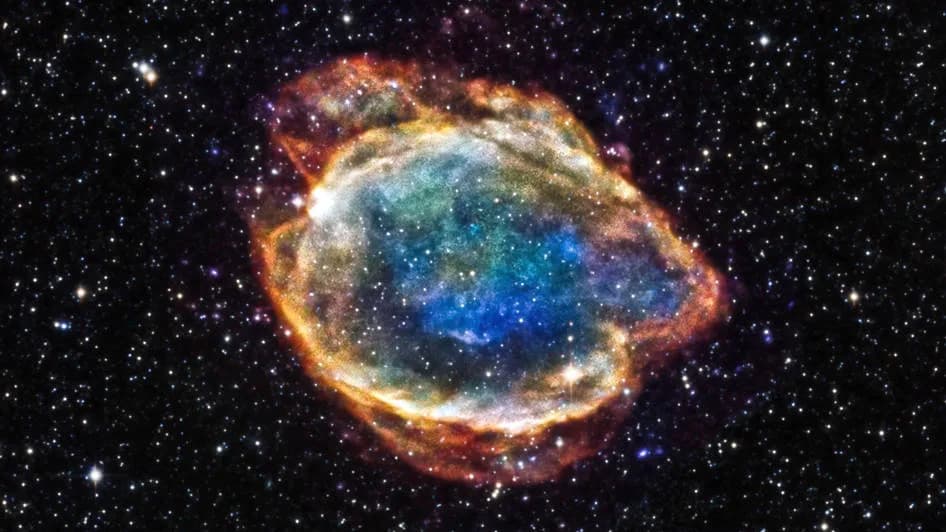
Putting these elements together gives the best current picture: star formation will cease, galaxies within groups and clusters will merge into single, massive ellipticals, and accelerated expansion will isolate these island universes from one another. Over trillions of years, stars will cool and fade, and the cosmos will become darker and colder. This describes a slow winding down rather than an abrupt end.
That said, our picture depends on the nature of dark energy and other physics we may not yet understand. New discoveries could change this story — perhaps in surprising ways. Even if the universe's appearance becomes very different, it is hard to imagine everything simply vanishing.
What to feel about it
Some people find this future wistful; others find it awe-inspiring. A helpful thought is that we live in a remarkable and luminous epoch filled with stars and galaxies to study. The cosmos can support human curiosity and civilization for billions of years more, leaving plenty of time to explore and learn.
Author: Stephen DiKerby, Michigan State University
Have a question? If you're curious, ask an adult to email your question with your name, age and city to CuriousKidsUS@theconversation.com.
Help us improve.