New 3D simulations show that rapidly rotating, magnetized stellar cores can form accretion disks whose magnetic winds eject mass, producing black holes inside the 70–140 M☉ "mass gap." The models predict a mass–spin correlation: stronger magnetic activity strips more mass and angular momentum, yielding lighter, slower remnants. These results explain the properties of GW231123 and offer testable signatures for future gravitational-wave detections.
How 'Impossible' Black Holes Formed: New Simulations Explain the GW231123 Collision

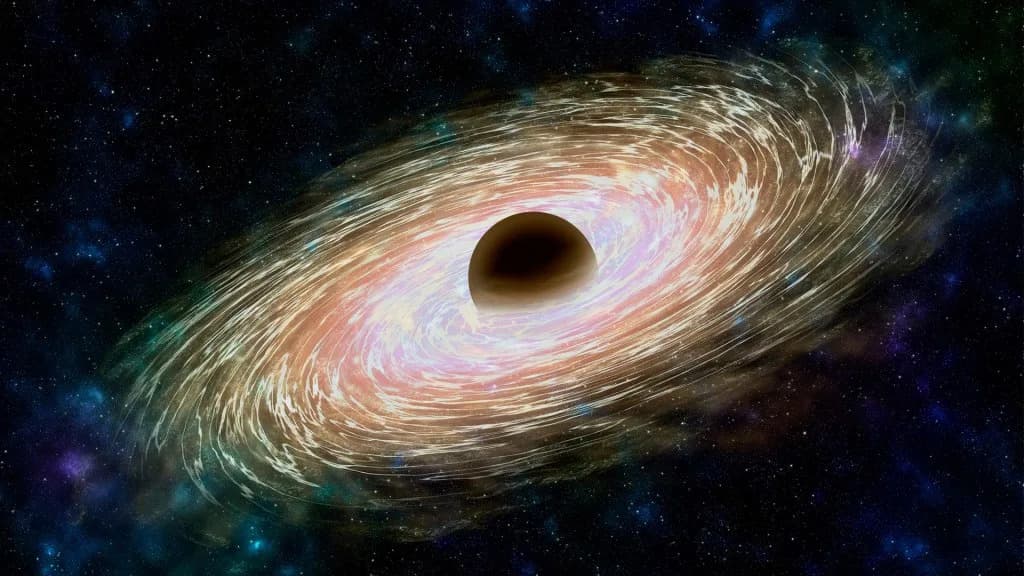
Scientists have identified a plausible origin for the largest black hole merger recorded so far, explaining how two objects once considered "forbidden" could form and later collide. The binary event, catalogued as GW231123, surprised astronomers because both components lie in a long-predicted "mass gap" — roughly 70–140 times the mass of the Sun — where standard stellar theory said black holes should not exist.
Why the mass gap matters
Conventional models predict that stars whose cores fall into this mass range undergo pair-instability supernovae that completely disrupt the star, leaving no remnant to collapse into a black hole. Yet the GW231123 signal indicated two black holes of about 100 and 130 solar masses, both showing evidence of rapid spin. That unexpected pairing motivated a team led by Ore Gottlieb at the Center for Computational Astrophysics to search for a formation pathway consistent with both mass and spin.
Rotation, disks and magnetic winds: a new pathway
The researchers ran detailed three-dimensional simulations of an extremely massive star's late life, beginning with a helium core of roughly 250 solar masses. Earlier theories assumed such a core would collapse almost intact, producing a black hole as massive as the original core. The new simulations show a different outcome when the star rotates rapidly.
Rapid rotation causes the collapsing core to form an accretion disk around the nascent black hole. Within that disk, magnetic fields can grow strong and launch powerful outflows. These magnetic winds eject a significant fraction of the stellar material before it can fall into the hole, reducing the final remnant mass and allowing black holes to appear inside the previously forbidden mass gap.
“If the star rotates rapidly, it forms an accretion disk around the newly born black hole,” Gottlieb explained. “Strong magnetic fields generated within this disk can drive powerful outflows that expel part of the stellar material, preventing it from falling into the black hole.”
Mass–spin connection and the GW231123 signal
The simulations naturally produce a correlation between final mass and spin. Stronger magnetic activity extracts angular momentum and ejects more mass, producing a lighter, more slowly rotating black hole. Weaker magnetic fields allow more mass to be accreted, leaving a heavier, faster-spinning remnant. This predicted mass–spin relationship closely matches the properties inferred from GW231123: one component likely formed in a star with moderate magnetic fields and the other in a star with weaker fields, accounting for their differing masses and spins.
Broader implications
Events like GW231123 probe general relativity in an extreme regime: the intense curvature of space–time during such mergers tests Einstein's equations where gravity is strongest. If the formation channel highlighted by these simulations operated frequently in the early universe, it could mean that massive black holes formed more efficiently than current stellar models suggest, with implications for how the first stars and black holes seeded the supermassive black holes we observe in galaxy centers today.
The study also predicts observational signatures — principally the mass–spin correlation — that future gravitational-wave detections can test. As detectors gather more massive black hole binaries, researchers will be able to determine whether GW231123 is a rare outlier or the first clear sign of a hidden population of massive, rapidly spinning black holes.
Looking ahead: Ongoing and future gravitational-wave observations will be key to confirming this pathway. If the predicted patterns appear repeatedly in new events, astronomers will gain a deeper understanding of both stellar death in the most massive stars and the early growth of black holes across cosmic time.
Help us improve.