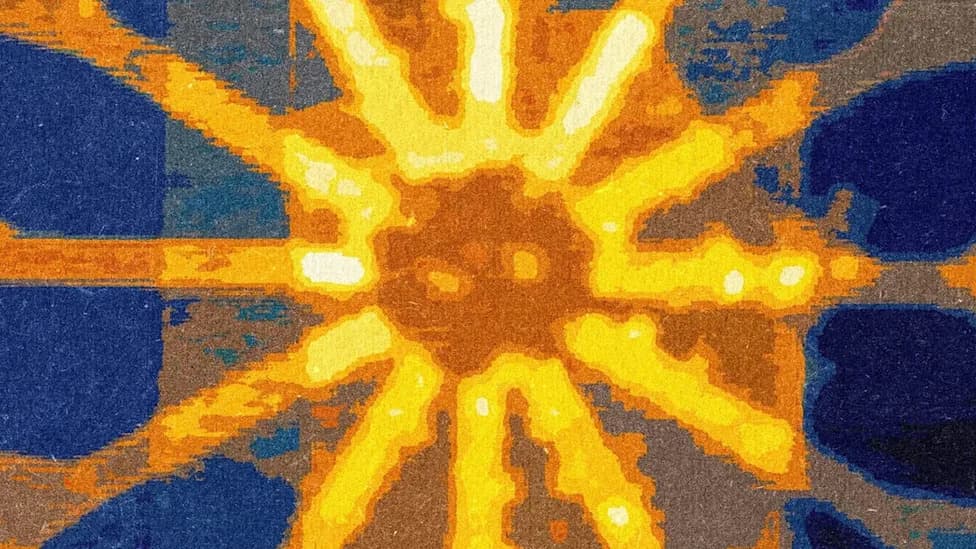
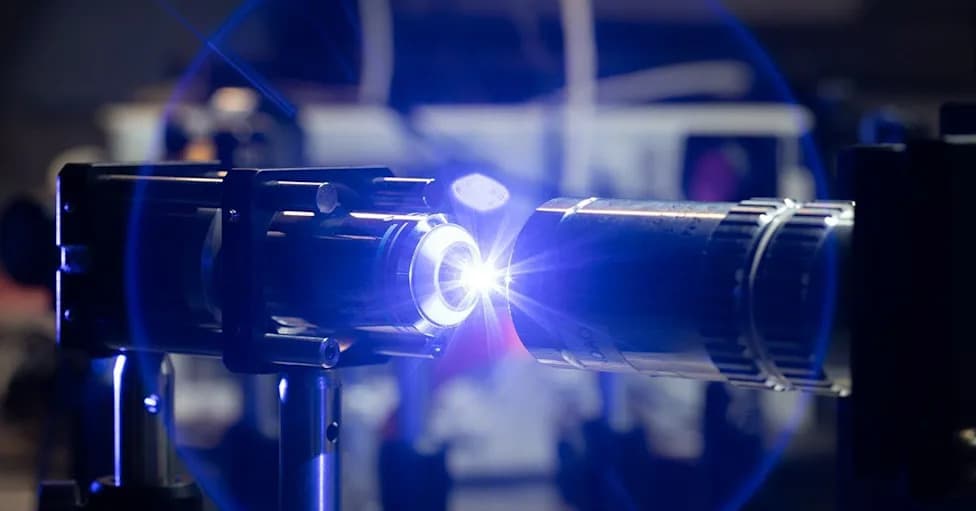
UCF researchers present strong experimental evidence that Co1/4TaSe2 is an altermagnet, showing momentum-dependent spin splitting and sign-changing spin polarization despite zero net magnetization. ARPES and spin-resolved ARPES measurements match density functional theory predictions and reveal a g-wave pattern with polarization flipping from about -13% to +13%. The effect disappears above the 178 K transition and returns on cooling, linking it to magnetic order. While the layered structure makes the compound a useful platform for spintronics research, its low ordering temperature and device-integration challenges remain to be addressed.
UCF Team Confirms Altermagnetism in Layered Co<sub>1/4</sub>TaSe<sub>2</sub>: Momentum-Dependent Spin Splitting Offers New Spintronics Platform
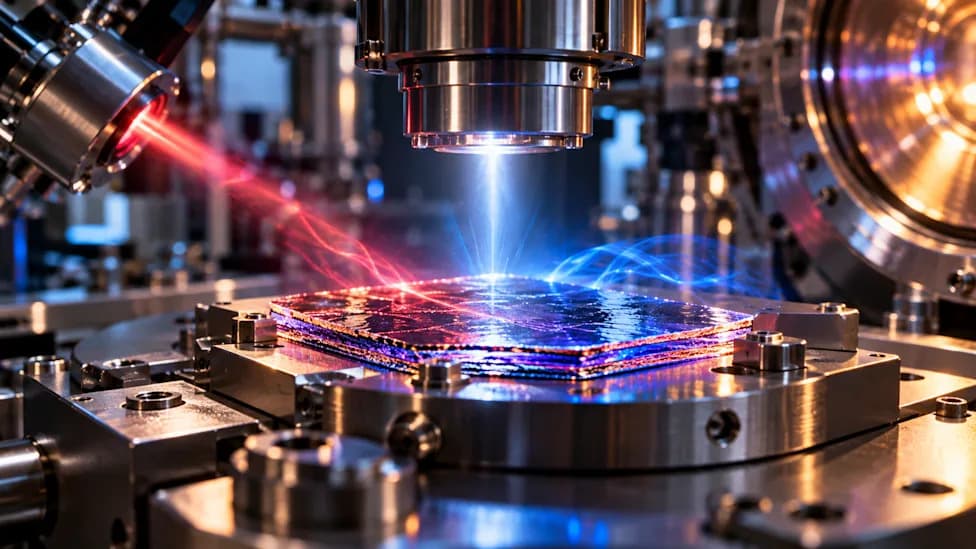
Scientists directly observed altermagnetic spin splitting in a layered material that could become a platform for future spintronics. (CREDIT: Shutterstock)
Researchers at the University of Central Florida report clear experimental evidence that the layered compound Co1/4TaSe2 hosts an unusual magnetic state called altermagnetism. Using high-resolution angle-resolved photoemission spectroscopy (ARPES) and spin-resolved ARPES, the team directly observed momentum-dependent spin splitting: electronic bands separate by spin and the dominant spin polarization flips sign as momentum changes, even though the crystal shows essentially no net magnetization.
What Is Altermagnetism?
Altermagnets combine traits of ferromagnets and antiferromagnets. Like antiferromagnets, they produce little or no macroscopic stray field because local moments compensate, but crystal symmetry produces strong, momentum-dependent splitting of spin-resolved electronic states — a behavior normally associated with ferromagnets. This unique mix could enable spin-based currents and fast spin dynamics with minimal interference from stray fields.
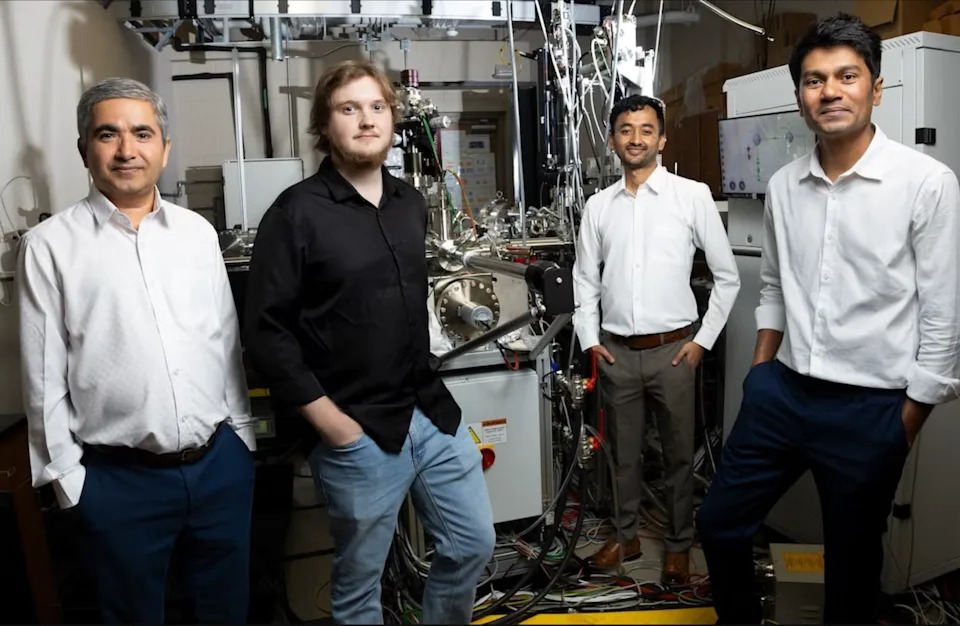
From left, UCF Professor Madhab Neupane, doctoral candidates Milo Sprague, Arun K. Kumay, and Mazharul Islam Mondal conducted research on altermagnetic materials. Their work is helping reveal new electronic properties that could advance future technologies. (CREDIT: Antoine Hart)
How The Team Measured It
The group led by UCF physicist Madhab Neupane performed ARPES and spin-resolved ARPES at national synchrotron facilities, including the Advanced Light Source (ALS) and the Stanford Synchrotron Radiation Lightsource (SSRL). Measurements were taken well below the material's magnetic transition temperature (178 K). At low temperature the cobalt moments order so spins align within each layer but alternate between neighboring layers, creating the conditions for momentum-dependent splitting.
Initial, spin-insensitive ARPES revealed band splitting whose magnitude and angular dependence matched density functional theory (DFT) calculations. Spin-resolved ARPES then confirmed the bands carried distinct spins: across a prominent electronic feature the measured spin polarization reversed from approximately -13% to +13% as momentum changed — a definitive signature of altermagnetism.
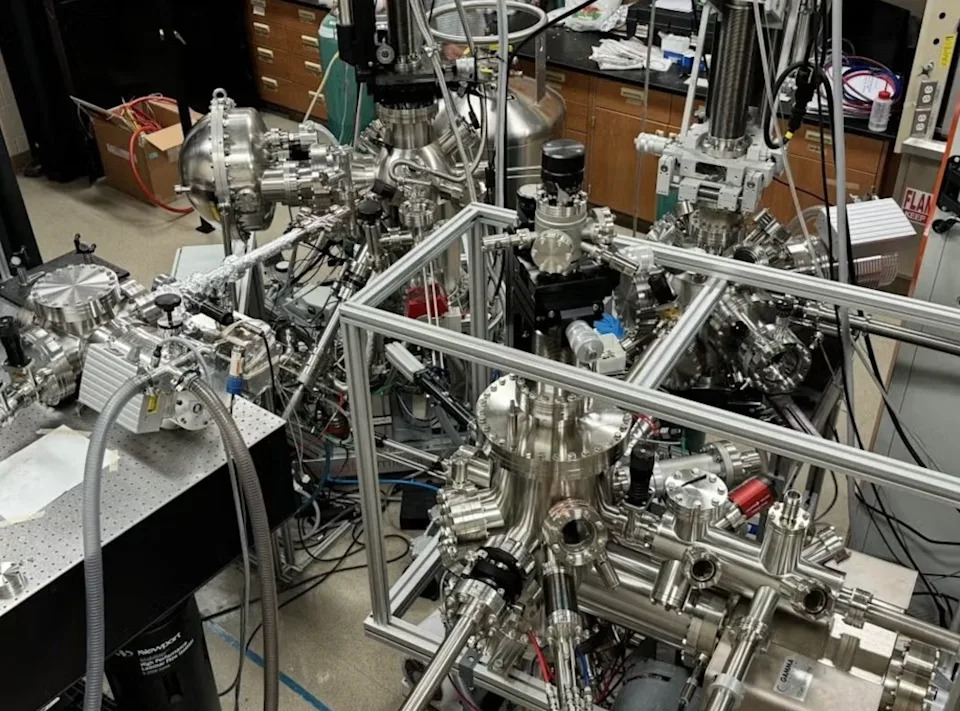
Madhab Neupane's UCF lab includes molecular beam epitaxy (MBE), angle-resolved photoemission spectroscopy (ARPES) and time-resolved ARPES systems. The Neupane group also conducts measurements at national synchrotron facilities. Measurements for this project were performed at the Advanced Light Source at Lawrence Berkeley National Laboratory and the Stanford Synchrotron Radiation Lightsource. (CREDIT: Madhab Neupane)
"These materials are distinguished from more conventional antiferromagnets by their ability to generate and detect spin currents without the negative effect of producing stray fields,"
— Madhab Neupane.
Electronic Symmetry: G-Wave Splitting
The electronic reconstruction corresponds to g-wave altermagnetic splitting, where the spin character alternates multiple times around Fermi-surface features (sixfold alternation around certain pockets). Some symmetry directions remain spin-degenerate, while others show pronounced splitting, consistent with theoretical symmetry analysis.
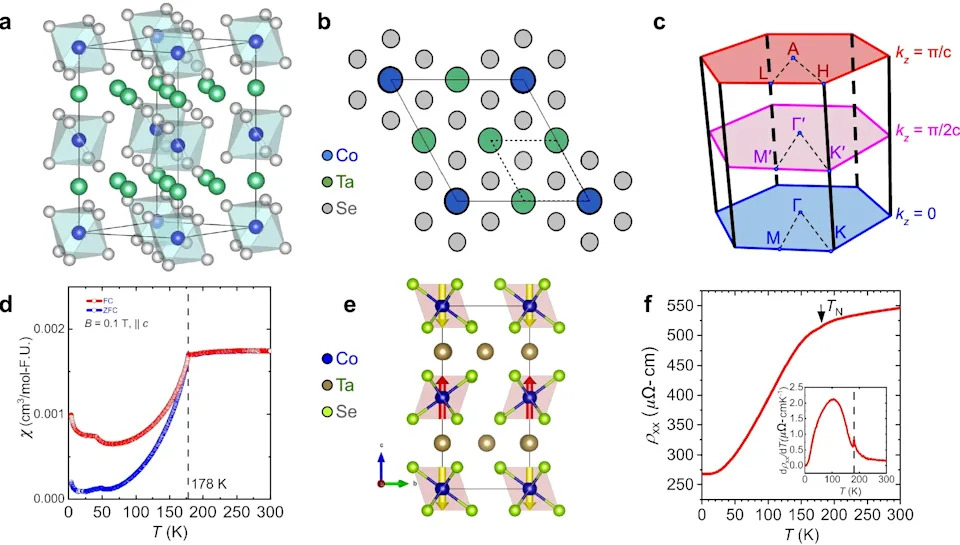
Establishment of Altermagnetic Crystal and Magnetic Structure in Co1/4TaSe2. (CREDIT: Madhab Neupane et al, Nature Communications 2026)
Temperature Dependence and Magnetic Origin
Temperature-dependent measurements provided additional evidence that the spectral reconstruction is magnetic in origin: the characteristic split bands and momentum-dependent spin reversals are prominent at 7 K (deep in the ordered phase), largely disappear at 200 K (above the 178 K transition), and reappear after cooling. This behavior links the effect to magnetic ordering rather than a purely structural feature.
Material Context and Opportunities
Co1/4TaSe2 is an intercalated transition-metal dichalcogenide (TMD). Its van der Waals-bonded layers make it attractive for exfoliation and heterostructure engineering. Cobalt atoms occupy interlayer sites and both provide magnetism and hybridize with conduction electrons; the magnetic character appears intermediate between fully localized and fully itinerant, with significant Co-derived spectral weight near the Fermi level.
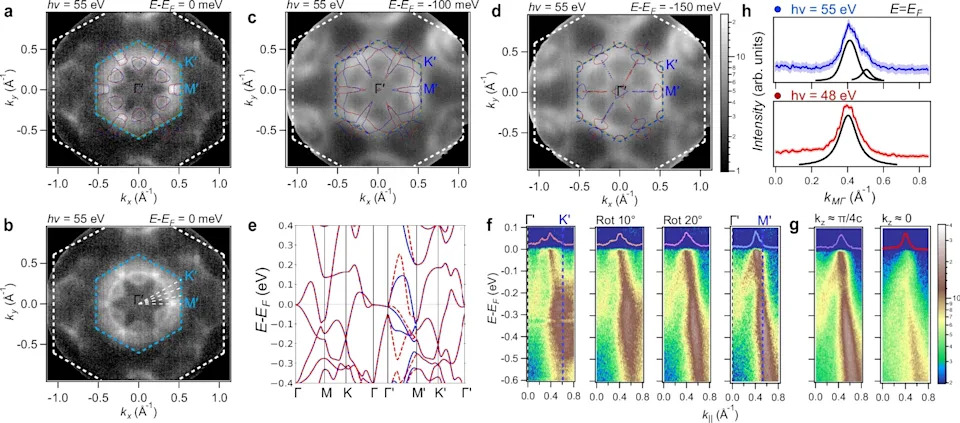
Observation of altermagnetic spin-splitting in Co1/4TaSe2. (CREDIT: Madhab Neupane et al, Nature Communications 2026)
Because layered TMDs can be thinned and stacked with other quantum materials, Co1/4TaSe2 offers a flexible experimental platform to study how altermagnetism interacts with superconductivity, topological states, and engineered interfaces.
Limitations And Next Steps
Despite the clear scientific advance, Co1/4TaSe2 is not yet a device-ready material. Its magnetic ordering temperature (178 K) is well below room temperature, and researchers must still demonstrate reliable switching, readout, and control in thin flakes and heterostructures. Key next steps include studying few-layer behavior, electrical control of the magnetic state, robustness of altermagnetic signatures in device-like geometries, and possible routes to raise the ordering temperature.
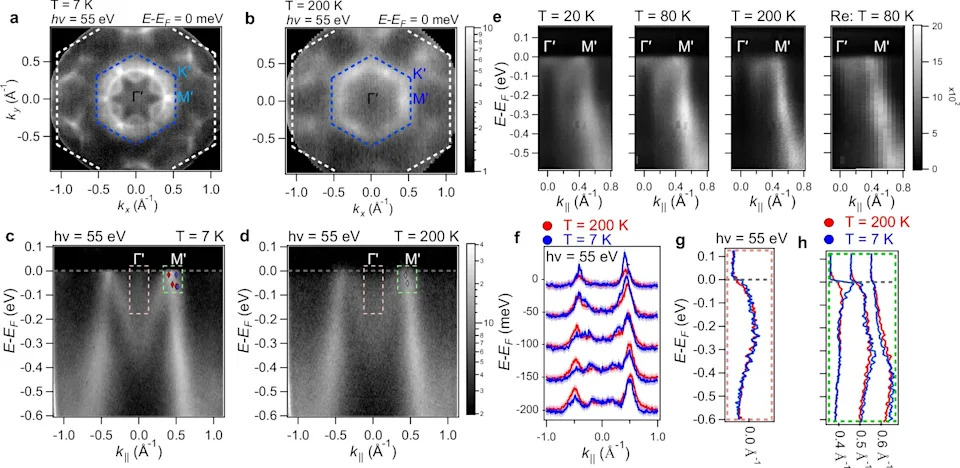
Temperature evolution of the Electronic Structure across TN. (CREDIT: Madhab Neupane et al, Nature Communications 2026)
Publication and Credits
The results appear in Nature Communications (2026). Measurements were carried out using UCF lab facilities (MBE and ARPES) and at national synchrotron sources (ALS and SSRL). The work was led by Professor Madhab Neupane and collaborators at UCF; experimental images and figures accompany the published paper.
Bottom line: The study provides one of the clearest experimental demonstrations of altermagnetism in a layered TMD, establishing Co1/4TaSe2 as a promising, tunable testbed for future spintronic research — while also highlighting practical challenges to real-world applications.
Help us improve.