Physicists report that single crystals of ytterbium diantimonide (YbSb2) form a type I superconductor that spontaneously breaks time‑reversal symmetry — a behavior previously seen only in unconventional, typically type II, systems. The work, led by researchers at the Indian Institute of Science Education and Research (IISER) Bhopal and published in Physical Review Letters, combines transport, thermodynamic, muon spectroscopy, and microscopic modeling to reveal an unexpected quantum state with possible implications for topological quantum information.
Materials and Key Measurements
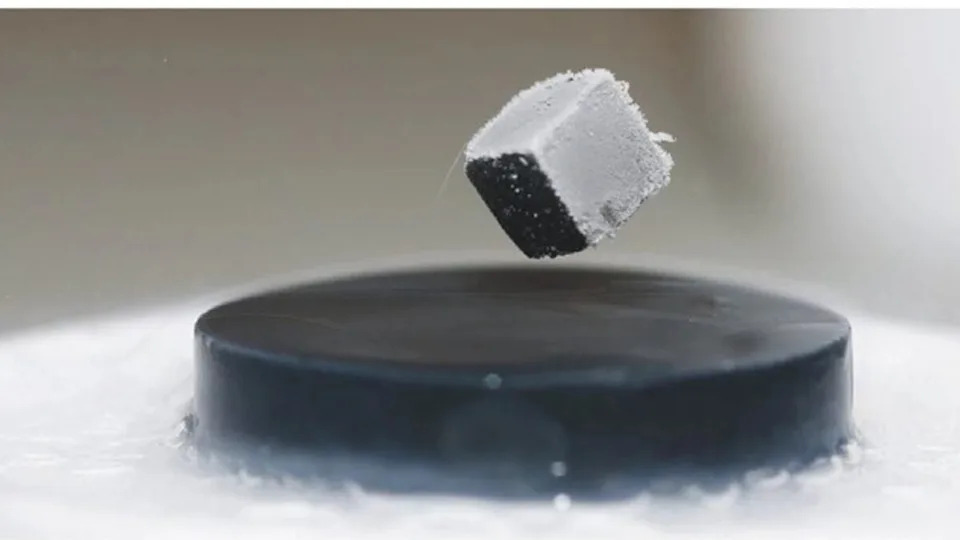
The team synthesized high-quality single crystals of YbSb2 and verified composition and lattice structure with X-ray diffraction. Electrical transport data show the material becomes superconducting at roughly -272 degrees Celsius (-457.6 degrees Fahrenheit), just above absolute zero. Specific-heat measurements indicate the superconducting state is fully gapped and the bulk behavior matches the thermodynamic signatures of a type I superconductor.
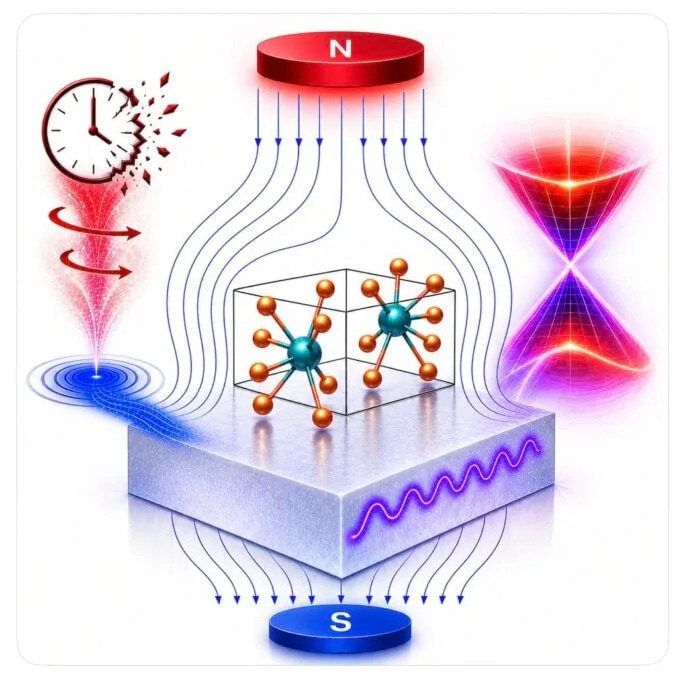
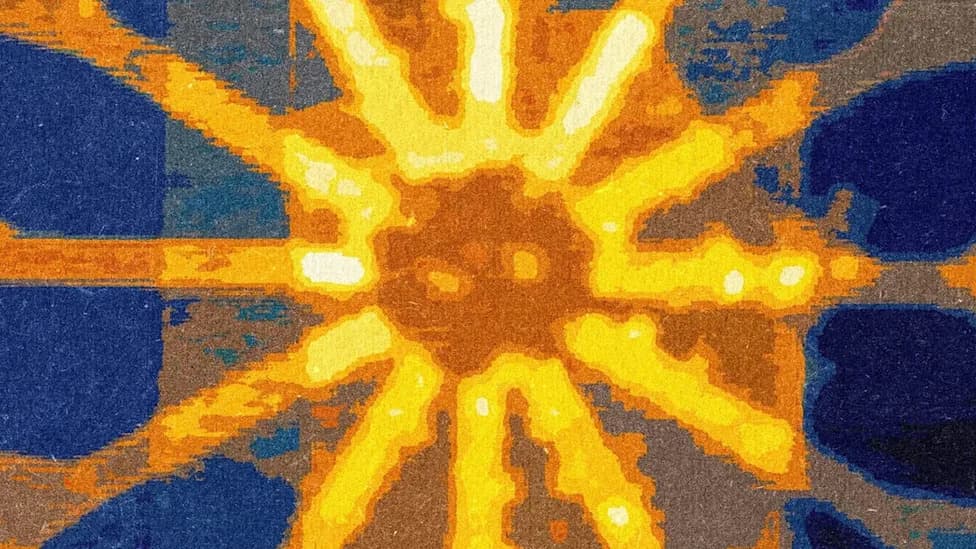
A graphical abstract of this work. At center, the teal spheres represent the element ytterbium (Yb) and the bronze spheres represent antimony (Sb).(IISER Bhopal)
Muon Spectroscopy Reveals Spontaneous Magnetism
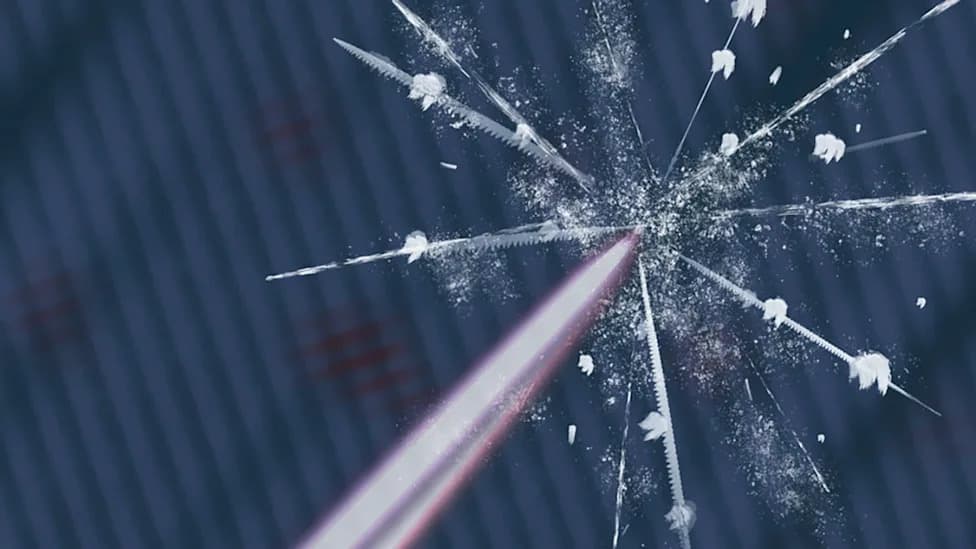
To probe internal magnetic behavior, the researchers used muon spin spectroscopy (muSR). In zero applied field they observed tiny, spontaneous internal magnetic fields that appear when the sample enters the superconducting state. Because magnetic fields reverse sign under a mathematical reversal of time, these persistent internal fields provide direct evidence that the superconducting state breaks time‑reversal symmetry (TRS).
Unconventional Pairing: An INT Spin Triplet
Complementary muSR measurements with applied fields, together with other data, show that electrons in the bulk do not form ordinary spin-singlet Cooper pairs. Instead, they form an unconventional spin triplet described as an internally antisymmetric non-unitary triplet (INT) state. This pairing carries a net magnetic moment because the component spins do not cancel, allowing the superconducting condensate to produce intrinsic magnetism and break TRS without an external field.
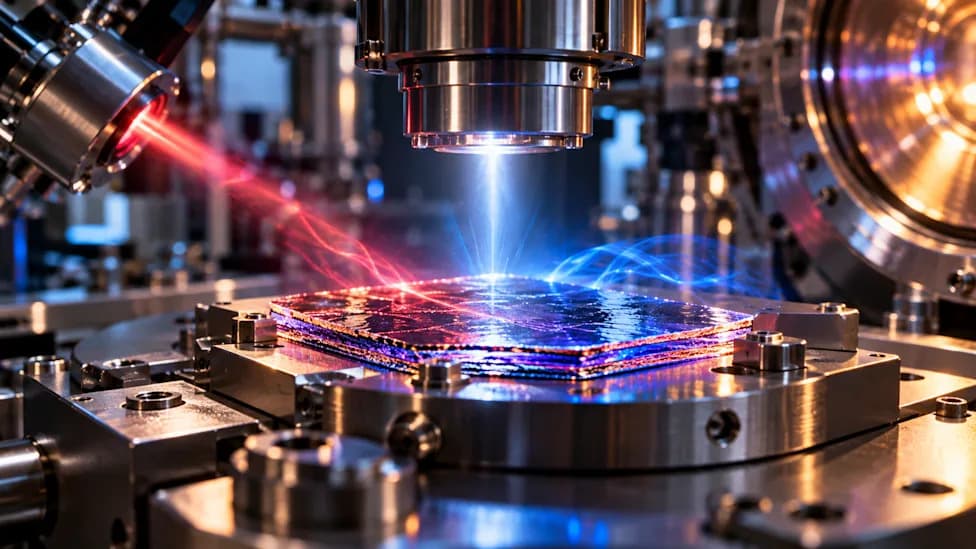
(Oak Ridge National Laboratory)
Microscopic Picture and Topological Potential
Modeling of the electronic structure indicates that the two electrons in each Cooper pair originate from different orbital states. That combination of orbital character and non-unitary triplet pairing raises the possibility that YbSb2 could host gapless Majorana surface modes — exotic quasiparticles that are their own antiparticles and are sought for robust topological quantum information schemes. If confirmed, such surface states would make YbSb2 a candidate topological superconductor where quantum information could be more resistant to environmental decoherence.
Why This Matters
This discovery expands the known landscape of superconducting behavior by demonstrating TRS breaking in a type I, fully gapped material. Beyond its fundamental interest to condensed-matter physics, YbSb2 may offer a new materials platform for exploring topological superconductivity and designs for error-resilient quantum devices. The experiments included measurements at muon facilities associated with laboratories such as Oak Ridge National Laboratory.
Reference: S. et al., Physical Review Letters (IISER Bhopal-led collaboration)