A Carnegie Mellon-led team demonstrates that the anomalous Hall effect can arise from in-plane magnetization in a 2D TaIrTe4/Cr2Ge2Te6 heterostructure, challenging the long-held idea that Hall responses require perpendicular magnetization. Experiments plus theoretical modeling implicate spin-orbit coupling and magnetic exchange interactions at the interface. The finding could enable single-layer, multi-axis magnetic sensors and inform spintronic device design, though current results were obtained at cryogenic temperatures and must be extended to other materials and higher temperatures.
Century-Old Hall Effect Rewritten: In-Plane Magnetization Can Produce Anomalous Hall Signals
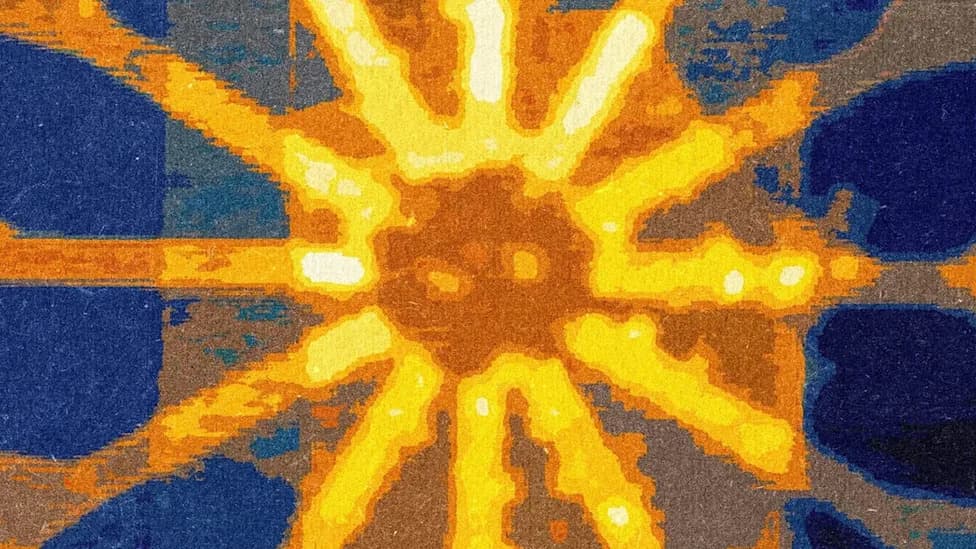
An atomic force microscopy scan of one of the experimental devices. (Carnegie Mellon University)
The Hall effect, first measured by physicist Edwin Hall in 1879, describes how electric currents respond to magnetic fields in materials and underpins many magnetic sensing technologies. A new study led by researchers at Carnegie Mellon University, published in Nature Materials, shows that a magnetic variant of the effect — the anomalous Hall effect — can arise even when magnetization lies in the plane of an ultrathin film, overturning a long-standing assumption that it requires perpendicular magnetization.
To demonstrate the phenomenon, the team built an atomically precise two-dimensional heterostructure: an ultrathin layer of tantalum iridium telluride (TaIrTe4) placed in contact with a magnetic layer of chromium germanium telluride (Cr2Ge2Te6, commonly called CGT). The interface both induced magnetism into the nominally nonmagnetic TaIrTe4 and reduced crystal symmetries that would otherwise limit Hall responses.
YouTube Thumbnail
Optical image from the study showing TaIrTe4 (red dashes), Cr2Ge2Te6 (blue dashes), and electrodes (yellow dashes). (Kao et al., Nat. Mater., 2026)
“For a long time, people thought the Hall effect only worked when the magnetic field was applied perpendicular to the plane of the film,” says Simranjeet Singh of Carnegie Mellon. “We’ve shown that that’s not true — you can also get a response when the field is in-plane.”
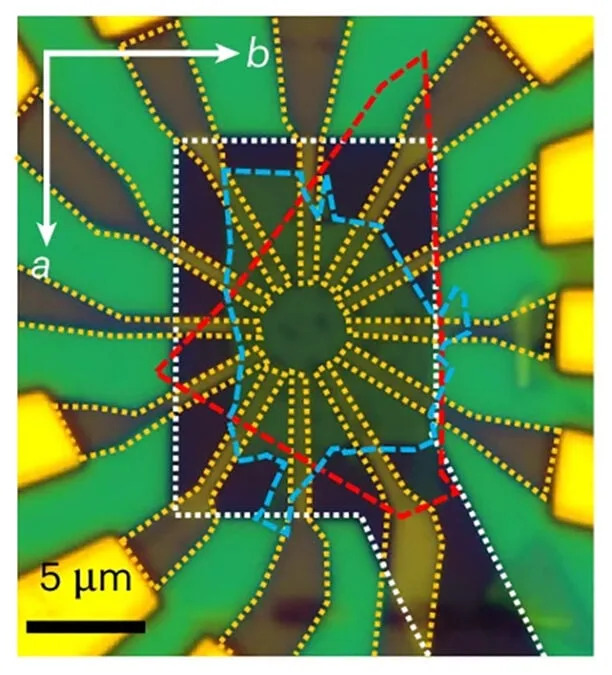
Optical image of one of the study devices, showing TaIrTe4(red dashes), Cr2Ge2Te6(blue dashes), and electrodes (yellow dashes). (Kao et al.,Nat. Mater., 2026)
Why This Matters
This result changes how physicists think about a fundamental transport phenomenon and opens practical possibilities. An ultrathin device that produces an anomalous Hall response from in-plane magnetization could detect magnetic fields along multiple axes, simplifying sensor designs that now require several components or more complex architectures.
What Explains the Effect?
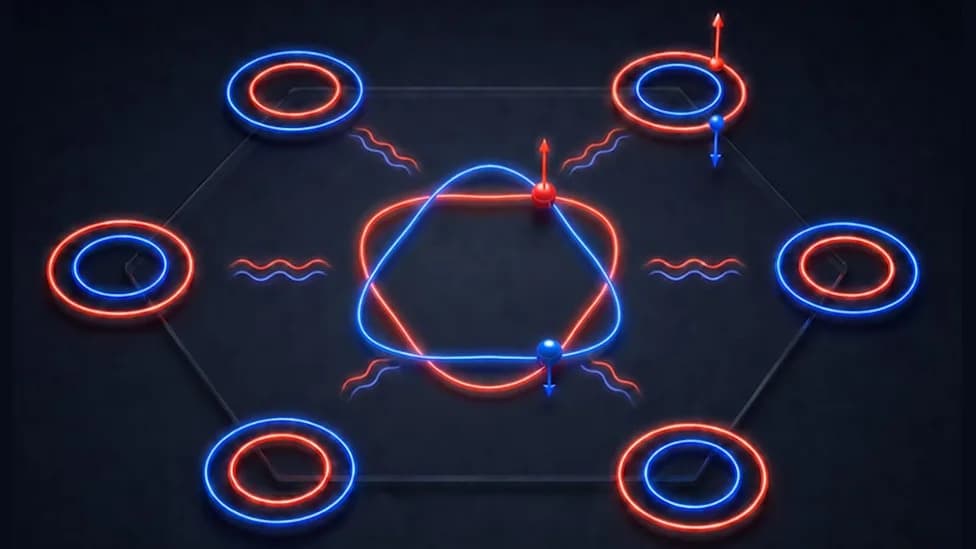
Alongside experiments, the team used theoretical modeling to identify likely mechanisms. The models point to a combination of spin-orbit coupling (an electron’s motion interacting with its spin) and magnetic exchange interactions at the interface as drivers of the in-plane Hall response. The authors caution, however, that further studies are needed to fully confirm the microscopic details.

Subscribe to ScienceAlert's free fact-checked newsletter
“This truly demonstrates the power of building atomically precise heterostructures of emergent two-dimensional quantum materials to obtain on-demand electronic and magnetic properties,” says Jyoti Katoch of Carnegie Mellon.
The work also highlights a broader principle: carefully chosen material pairings at interfaces can break or modify intrinsic crystal symmetries in useful ways. That tunability could be relevant to future spintronic devices, advanced magnetic sensors, and possibly quantum computing components that rely on engineered electronic and magnetic behavior.
Limitations and Next Steps: The experiments were performed on a specific TaIrTe4/CGT heterostructure and at cryogenic temperatures. The next steps are to reproduce the effect in a wider range of materials and to push performance toward higher, ideally room, temperatures so the phenomenon can be exploited in practical devices.
The research appears in Nature Materials (2026).
Help us improve.