The U.S. Air Force has ordered four MH-139A Grey Wolf helicopters in the program's first full-rate production contract, worth roughly $85 million, with deliveries expected in 2028–2029. The type reached Initial Operational Capability on Aug. 10 and will begin replacing the UH-1N Huey at Malmstrom, F.E. Warren and Minot Air Force Bases for ICBM security. Program delays, budget trims and Nunn‑McCurdy cost pressures reshaped procurement quantities, but recent acquisition decisions raised the planned buy to at least 56 aircraft.
Boeing Wins First Full-Rate MH-139A Grey Wolf Order as Program Reaches IOC
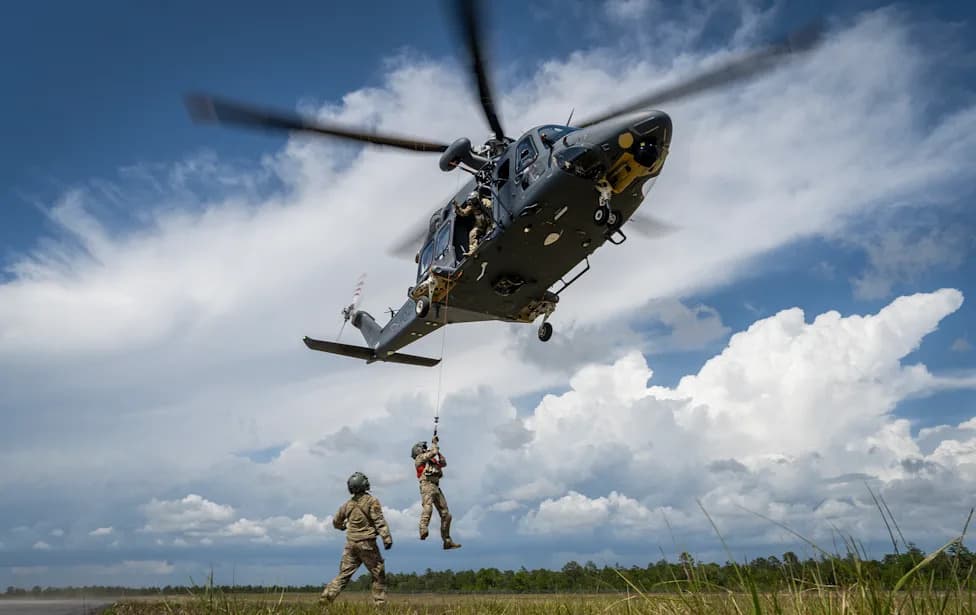
A U.S. Air Force MH-139A Grey Wolf lifts an Air Force Global Strike Command Detachment 7 special mission aviator into the air at Eglin Air Force Base, Florida, April 2023. (Samuel King Jr./U.S. Air Force)
Boeing announced that the U.S. Air Force has ordered four additional MH-139A Grey Wolf helicopters — the first procurement under the program's full-rate production decision. Boeing said the roughly $85 million contract, which includes some sustainment work, was awarded Sept. 25 and that the four aircraft are expected to be delivered in 2028 or 2029.
The announcement arrived during a busy week for Boeing, which also won a Navy development contract for the F/A-XX sixth‑generation carrier fighter valued at more than $20 billion and shipped 22 additional F-15EX Eagle II fighters to the Air Force under a $2.38 billion order.
Operational Milestone
Air Force Global Strike Command declared the MH-139A Initial Operational Capability (IOC) on Aug. 10, a milestone announced publicly on Aug. 31. IOC clears the first crews and aircraft to perform real-world ICBM security missions, allowing the Grey Wolf to begin replacing the aging UH-1N Huey at Malmstrom AFB (Mont.), F.E. Warren AFB (Wyo.) and Minot AFB (N.D.).
The MH-139A is a militarized variant of Leonardo's AW139. Global Strike Command says the Grey Wolf is nearly 50% faster than the Huey, carries about twice as many troops and includes upgraded defensive systems.
Operational Use And Early Flights
Two MH-139As from the 40th Helicopter Squadron flew the Grey Wolf's first operational mission on Jan. 8 out of Malmstrom. On the roughly six-hour sortie they escorted missile maintenance personnel and armored security vehicles to and from a launch facility more than 100 miles from base without refueling.
"This milestone validates key readiness levels for Grey Wolf and supports the service's fielding plans to secure vital national assets across the country's strategic missile fields," said Kathleen Jolivette, Vice President and General Manager of Vertical Lift Programs at Boeing Defense, Space & Security.
Program History And Budget Context
Boeing originally won the Air Force Huey-replacement contract in September 2018 under a roughly $2.4 billion agreement; officials had expected IOC as early as 2021. Testing delays, FAA certification issues and systems-integration challenges pushed timelines back.
The program’s planned buy has also changed. The Air Force at one point considered purchasing as many as 84 MH-139As, including aircraft for VIP transport. Spending caps in the 2023 debt-ceiling deal removed the VIP requirement and reduced the planned buy to 42 airframes. That reduction increased unit costs past the Nunn-McCurdy critical threshold, prompting Pentagon review. A Selected Acquisition Report published in August 2024 said the Pentagon later raised the planned buy to at least 56, which brought unit costs back below the critical threshold.
As of the latest announcement, 42 MH-139As are under contract and 27 have been delivered — six of those were test aircraft and the remainder were produced from earlier production lots. For fiscal 2027 the Air Force requested four additional Grey Wolves. House and Senate drafts of defense legislation have differed on quantities: some versions would permit up to eight aircraft, but appropriations currently cover four.
Separately, the Air Force plans to assign the VIP/transport mission to HH-60W combat rescue helicopters rather than the MH-139A; officials say HH-60Ws better meet the speed, range and lift requirements for cost-effective VIP support.
What This Means
The first full-rate Grey Wolf order marks a maturation point for the program: IOC clearance plus a full-rate contract signal that the Air Force and Boeing are transitioning from test and low-rate production into steady fielding for ICBM security missions. Continued delivery cadence, funding decisions and any remaining integration or certification tasks will determine how quickly Grey Wolves supplant Hueys across missile fields.
Help us improve.