Researchers used anaerobic time-lapse microscopy to film living Asgard archaea extending and retracting membrane protrusions that can pull whole cells across surfaces. Fluorescent labelling and drug tests implicate a Lokiactin-based cytoskeleton and associated regulators (gelsolin/profilin relatives), indicating a dynamically controlled actin-like system. Protrusion growth reached ~1.5 µm/min in L. ossiferum and ~4.8 µm/min in a second lineage, with whole-cell speeds near 1.6 and 3.4 µm/min respectively. These live observations suggest actin-driven motility may have existed before the first eukaryotic cells and provide an experimental model for studying eukaryogenesis.
Live Footage Shows Asgard Archaea Crawling with Actin-Like Machinery — New Clues to the Origin of Complex Cells
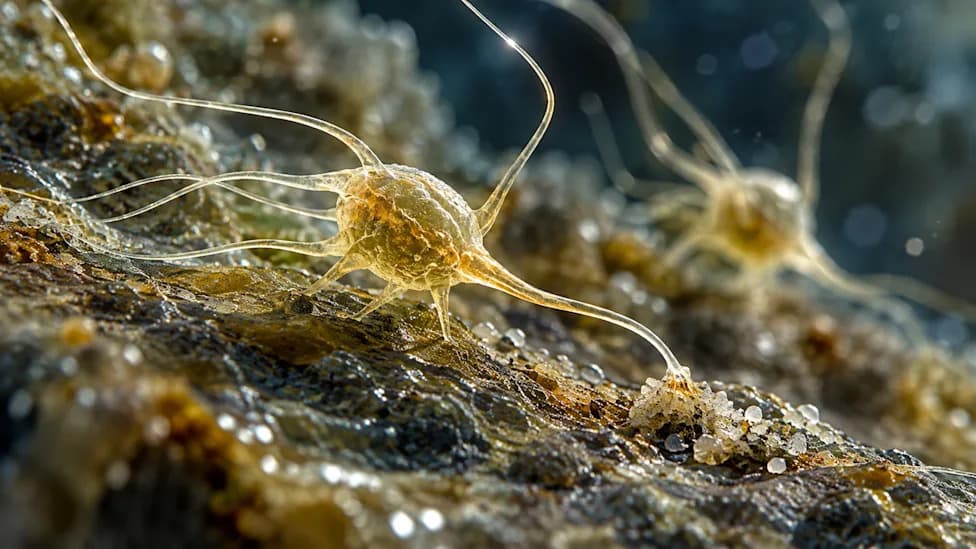
Living Asgard archaea use actin-based protrusions to crawl across surfaces, revealing possible roots of complex cell movement. (CREDIT: Shutterstock)
Researchers have captured the first live images of Asgard archaea actively extending and retracting flexible membrane protrusions to crawl across surfaces, driven by an actin-like internal skeleton. The experiments, conducted under strictly oxygen-free conditions, reveal dynamic behaviors that resemble eukaryotic actin-driven motility and offer a new experimental window on how cellular complexity may have arisen nearly two billion years ago.
How the Study Was Done
Philipp Radler and colleagues built an anaerobic time-lapse microscopy system that kept oxygen-sensitive microbes alive while recording their behaviour. The team examined two cultivated Asgard lineages: Candidatus Lokiarchaeum ossiferum (grown in Vienna) and Candidatus Margulisarchaeum peptidophilum (provided by collaborators in Japan). The results were published in Nature.
Asgard archaea, our closest known microbial relatives, play a key role in current models of the origin of more complex organisms, known as eukaryotes (all animals, plants, protists and fungi). (CREDIT: University of Vienna)
Dynamic Protrusions and Whole-Cell Movement
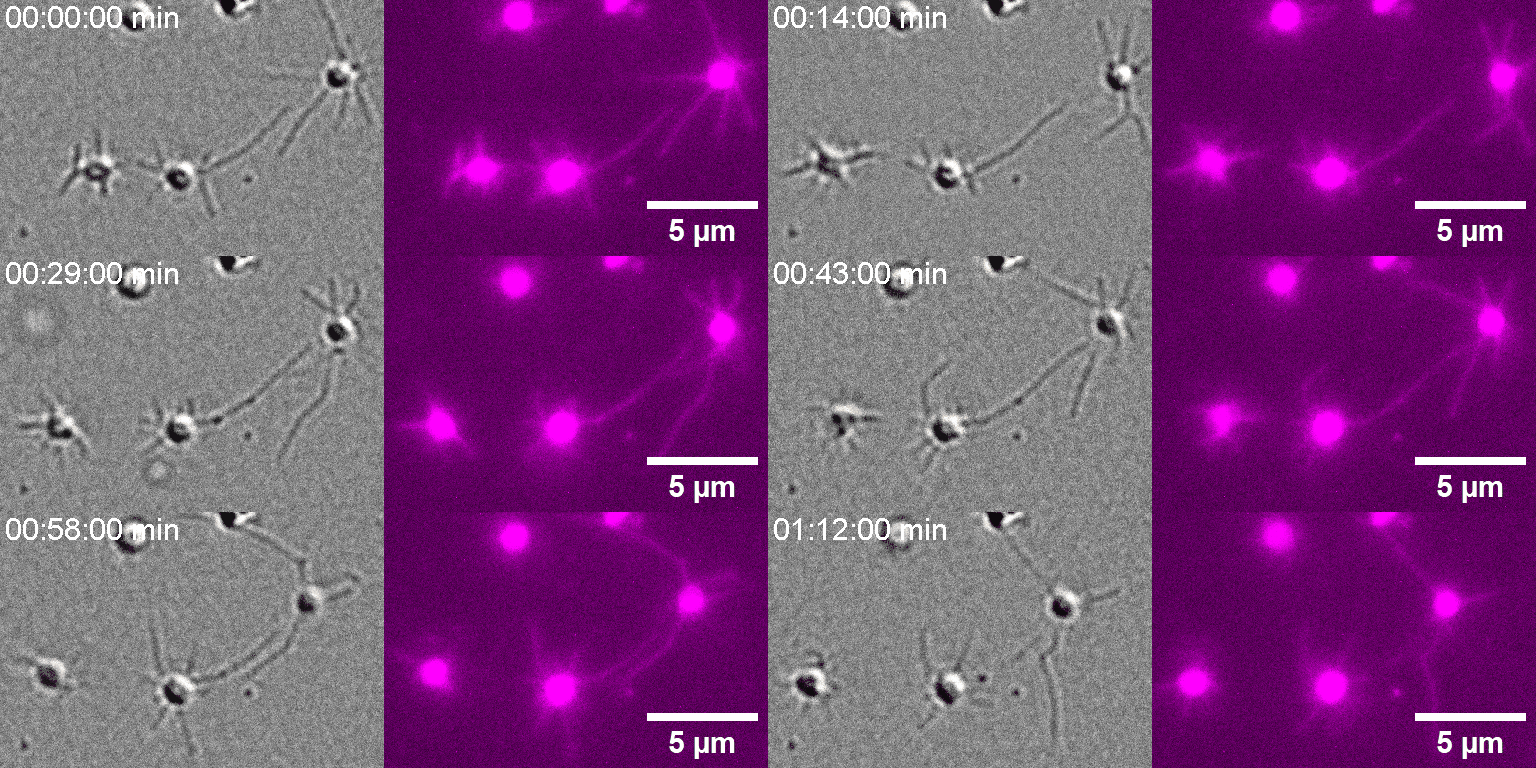
Both species continuously reshaped their cell bodies and thin, branching membrane protrusions. In L. ossiferum, protrusions grew at roughly 1.5 µm/min and sometimes reached lengths up to ~15 µm before retracting; some retractions snapped back more than five times faster than growth. The second lineage extended protrusions at about 4.8 µm/min. Individual cells typically bore multiple protrusions—often around five—greatly increasing surface area for interaction.
These protrusions did more than change shape: they could move the entire cell. About half of observed L. ossiferum cells translated across glass surfaces (median speed ~1.6 µm/min), while M. peptidophilum cells moved at ~3.4 µm/min. Movement modes included tip attachment followed by protrusion shortening that pulled the cell forward, and smoother gliding with a protrusion maintained ahead of the cell.
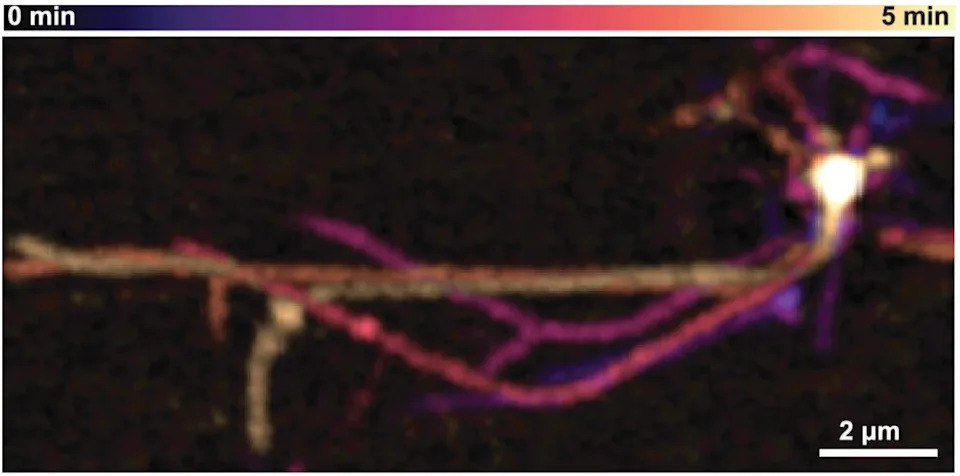
A temporal projection of L. ossiferum, illustrating the rearrangement of protrusions over time. (CREDIT: Philipp Radler et al, Nature 2026)
Evidence for an Actin-Like Motility System
Fluorescent staining revealed filaments of Lokiactin—an archaeal homologue of eukaryotic actin—inside the dynamic protrusions. The team also identified proteins related to gelsolins and profilins that appear to interact with Lokiactin; in eukaryotes these families regulate assembly and disassembly of actin filaments. Together the data indicate that Asgard archaea possess a regulated actin-like system capable of reshaping membrane and generating motile force.
Pharmacological Tests
To probe mechanism, researchers exposed cells to actin-disrupting compounds used in eukaryotic studies. Swinholide A strongly suppressed protrusion growth at concentrations as low as 50 ng/mL. At higher concentrations, cells ceased crawling and remaining protrusions lost stiffness and began moving passively with Brownian motion rather than controlled extension and retraction—supporting a direct role for Lokiactin-based filaments in motility.
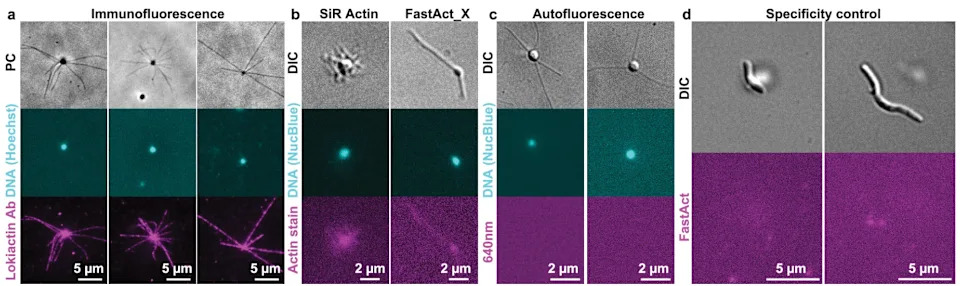
Controls for fluorescent imaging and actin inhibitor effects on L. ossiferum. (CREDIT: Philipp Radler et al, Nature 2026)
Implications for Eukaryogenesis
Asgard archaea have been central to recent models of eukaryotic origins because their genomes encode many eukaryote-like proteins. Previous structural studies (including cryo-EM mapping of a Lokiactin cytoskeleton and reports of Asgard tubulin relatives forming microtubule-like structures) suggested complex internal architecture; the new live observations add behavior to those findings. Actin-based membrane remodelling and motility may therefore have predated the emergence of the first true eukaryotic cells.
Caveats and Context
Modern Asgard archaea are not unchanged ancestors of eukaryotes. They have continued to evolve for roughly two billion years, and competing models differ on the precise sequence of events that produced eukaryotes—such as how an archaeal host and a bacterial partner combined to form the mitochondrion. Nonetheless, having living, manipulable Asgard cells gives researchers an unprecedented experimental system for testing hypotheses about the origin of cellular complexity.
Conclusion
By directly observing Asgard cells stretch, attach, pull and crawl, scientists now have experimental access to dynamic processes that may have been important during early eukaryotic evolution. The study strengthens the view that some core components of eukaryotic cell biology—an actin-like cytoskeleton and its regulators—have deep archaeal roots.
Source: Radler et al., Nature (2026). Live imaging of Lokiarchaeum and related Asgard lineages under anaerobic conditions.
Help us improve.