The Supreme Court temporarily stayed a lower court order and allowed the Trump administration to continue rapid deportations to third countries while the Court prepares to hear the case in December. Three justices—Sotomayor, Kagan and Jackson—dissented from the stay. A First Circuit panel found migrants were not given meaningful notice before being sent to countries where they have no ties, and advocates estimate about 25,000 people have been removed under the program. Challengers argue the policy raises serious due process and torture‑protection concerns.
Supreme Court Pauses Ruling, Allows Rapid Third‑Country Deportations While Agreeing To Hear Case In December

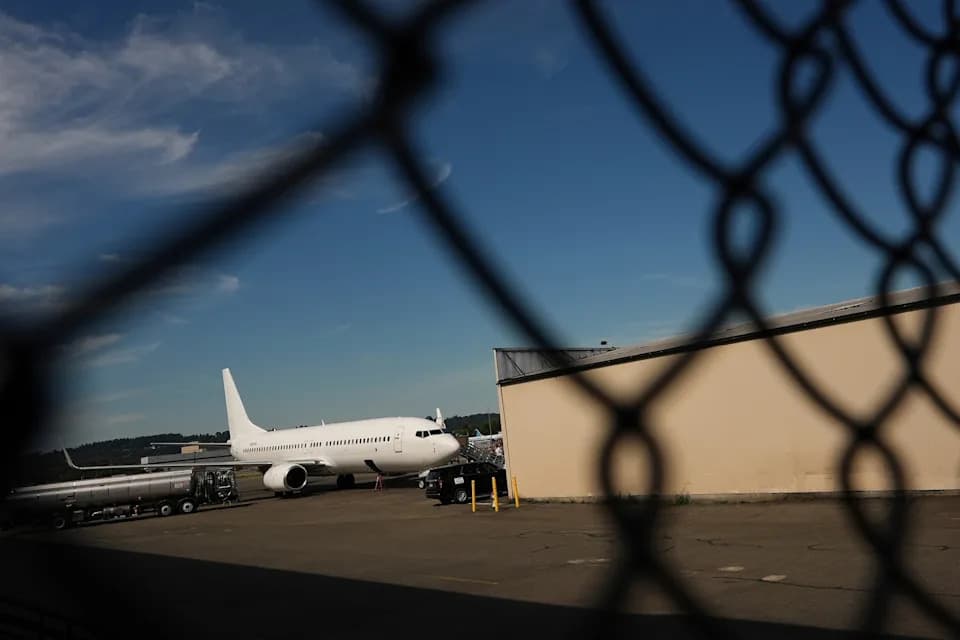
Annalise Kaylor/NurPhoto via Getty Images, FILE - PHOTO: In this Jan. 9, 2026, file photo, a detainee of Immigration and Customs Enforcement (ICE) boards a Global X aircraft at the Minneapolis/St. Paul Airport in Minnesota.
The U.S. Supreme Court on Tuesday temporarily stayed a lower court order that had blocked the Trump administration's policy of quickly deporting migrants to third countries without prior notice, clearing the way for federal officials to resume the practice while the high court prepares to hear the case during its December term.
By granting the government's request for a stay, the Court allowed rapid third‑country removals to continue for now. Justices Sonia Sotomayor, Elena Kagan and Ketanji Brown Jackson registered a public dissent from the order.
Earlier this month, a three‑judge panel of the U.S. Court of Appeals for the First Circuit concluded that migrants facing third‑country removals were not being given adequate notice or a meaningful opportunity to contest the destination before being sent to countries with which they have no ties.
"An individual's right to contest removal to a country based on a fear of persecution in that country means little if one does not receive prior notice of the intended removal destination and a meaningful opportunity to contest that destination," Judge Seth Aframe wrote for the panel.
Advocates and immigrant‑rights groups, including Human Rights First and Refugees International, estimate that roughly 25,000 people have been removed to so‑called third countries as part of the administration’s intensified immigration enforcement campaign.
FILE PHOTO: Annalise Kaylor/NurPhoto via Getty Images — In a Jan. 9, 2026, file photo, an Immigration and Customs Enforcement (ICE) detainee boards a Global X aircraft at the Minneapolis–St. Paul Airport in Minnesota.
What Are Third‑Country Removals?
Immigration lawyers and advocates say third‑country removals — sending migrants to a country other than their home nation or the United States — are not entirely new, but historically they have been rare. In recent months, the administration has expanded the practice after negotiating agreements with nearly three dozen countries to accept deported asylum seekers, refugees, and migrants with criminal records, often with little or no advance notice to those being removed.
Legal Challenge and Concerns
The attorney who sued to block the administration’s third‑country removal program called the Supreme Court’s temporary stay "a devastating result for people who may be put on a plane before they ever have notice or an opportunity to raise a fear claim." Attorney Trina Realmuto, who brought the challenge, told ABC News that the Court's order does not resolve whether the policy is lawful and that the justices will consider whether it violates federal statute, due process protections, and safeguards against torture.
Critics argue the policy raises serious legal and humanitarian concerns: migrants may be sent to countries where they face persecution, lack any ties or ability to safely remain, or have no meaningful opportunity to present fears of harm before removal.
Voices From Those Affected
ABC News previously interviewed a group of Latin American men who said they were deported to the Central African Republic and only learned of their destination several hours into the flight. "I feel kidnapped," said Aristides Fernandez Garcia. "They have violated all the rights that exist in life, because we are human beings."
"I feel kidnapped. They have violated all the rights that exist in life, because we are human beings." — Aristides Fernandez Garcia, deported migrant
As the Supreme Court prepares for oral argument in December, the temporary stay leaves open the immediate question of whether the government may continue rapid third‑country removals without prior notice, and sets up a high‑stakes review of the policy's legality, constitutional implications, and humanitarian impact.
Help us improve.