The study used tissue from 375 historic largetooth sawfish specimens (mostly museum rostra) and recovered usable DNA from 95 samples spanning ~140 years. Of 35 historical haplotypes, only six remain in modern populations, revealing a dramatic global loss of genetic diversity. Australia has retained relatively stable diversity, while Brazil may be a vital reservoir. Researchers recommend treating major population groups as distinct ESUs and broadening recovery goals beyond headcounts to preserve evolutionary potential.
Museum 'Time Capsules' Reveal Massive Genetic Loss in Largetooth Sawfish
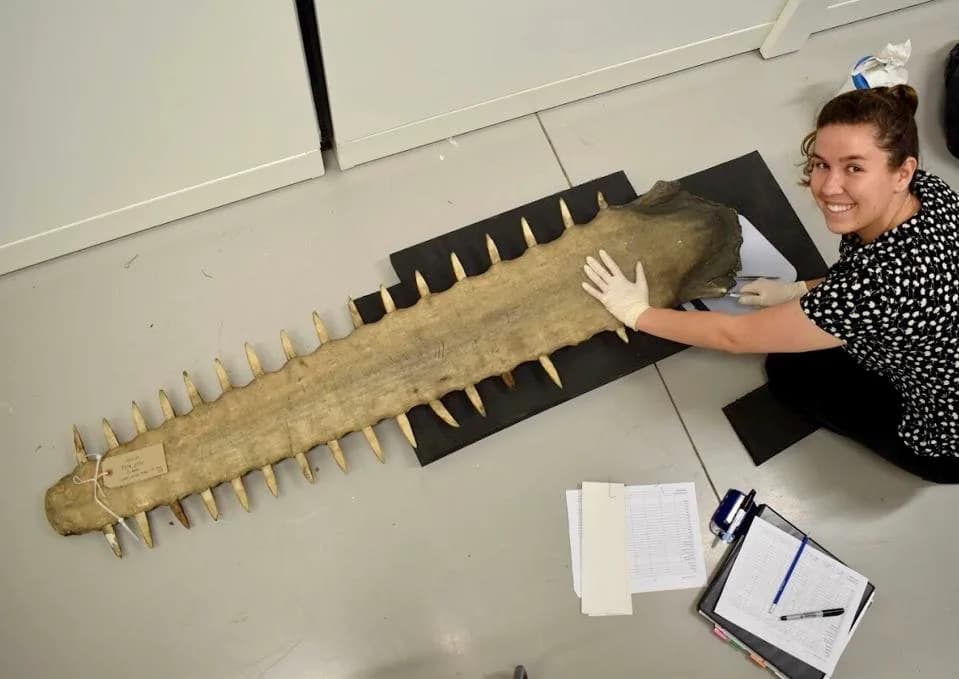
Author Annmarie Fearing with a largetooth sawfish specimen for DNA testing.Kelcee Smith
There is something almost magical about walking through the stacks of a natural history collection. Rows of jars, labeled drawers and weathered cabinets hold specimens collected decades — sometimes centuries — ago. Far from mere curiosities, these objects are biological archives. Researchers have now used those archives to reveal a hidden and alarming crisis for one of the world’s most endangered marine animals: the largetooth sawfish.
Historic DNA Unlocks Lost Diversity
In a study published in Proceedings of the Royal Society B, an international team analyzed tissue from 375 historic largetooth sawfish (Pristis pristis) specimens, most of them dried rostra from museum collections and some from private owners. After selecting specimens with reliable dates and provenances, researchers used methods optimized for degraded historical DNA and recovered usable sequences from 95 specimens spanning nearly 140 years.
The comparison between historical and modern samples (collected in the 2000s) produced a stark result: researchers identified 35 haplotypes in older specimens but found only six of those haplotypes persisting in contemporary populations. In other words, much of the species' genetic legacy has vanished.
What Was Lost — And Why It Matters
Genetic diversity is the raw material that allows populations to adapt to disease, changing climates and new environmental pressures. The study found that historically largetooth sawfish harbored high genetic diversity with distinct regional signatures in the Eastern Pacific, Western Atlantic, Eastern Atlantic and Indo-West Pacific — a pattern shaped by long periods of genetic isolation and female philopatry (females returning to natal rivers to give birth).
'Once gone, genetic diversity does not bounce back quickly, even when the numbers of individuals increase,' says senior author Dr. Nicole Phillips. The loss of genetically distinct populations means the cumulative erosion of unique evolutionary potential across the species' range.
Regional Contrasts: A Ray of Hope — and Worry
Not all regions fared the same. Australian largetooth sawfish appear to have retained relatively stable genetic diversity since at least the 1960s. Co-author Dr. Peter Kyne attributes that stability to early legal protections, relatively intact northern river systems and low human population densities in much of northern Australia. Still, bycatch, agricultural expansion and proposals to divert freshwater continue to threaten nursery habitats.
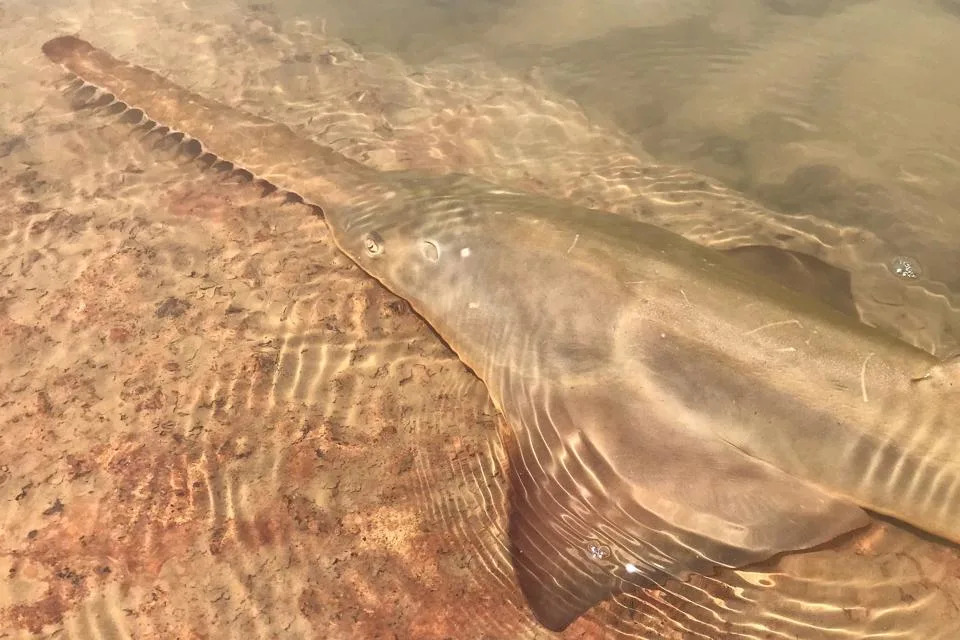
A Largetooth Sawfish in Australia.
Brazil may represent another critical stronghold outside Australia. Phillips warns that Brazil's remaining populations likely hold an important reservoir of genetic variation and should be a conservation priority, with stronger protection and enforcement needed to prevent further losses. Recent sightings in countries such as Panama and Costa Rica suggest additional remnant populations may persist, but their size and long-term viability remain uncertain.
Two Deep Lineages — Treat Them As ESUs
The study also showed that surviving largetooth sawfish fall into two deeply divergent evolutionary lineages: one centered in the Indo-West Pacific and the other including Atlantic and Eastern Pacific populations. Recognizing these as distinct Evolutionarily Significant Units (ESUs) helps conservationists prioritize protection of unique genetic variation and avoid 'putting all the eggs in one basket' genetically.
Conservation Implications
Conservation success is often measured by headcounts, but population recovery in numbers does not necessarily restore lost genetic diversity. A population can rebound in size yet retain only a fraction of its historical genetic toolkit, leaving it less resilient to future threats. The study therefore challenges conservationists to broaden recovery goals to include the preservation of evolutionary potential — not just the prevention of extinction.
Museums: From Curiosities to Conservation Tools
For lead author Dr. Annmarie Fearing, the project transformed how she sees museum collections: 'What were once remnants of the exploitation that contributed to the decline of sawfishes have now become valuable tools for conservation.' This work was only possible thanks to a global collaboration among researchers, museum staff, citizen scientists, aquarists and volunteers who combined specimens and expertise to reconstruct an evolutionary story that would otherwise have been lost.
Source: The study in Proceedings of the Royal Society B and coverage originally published on Forbes.com.
Help us improve.