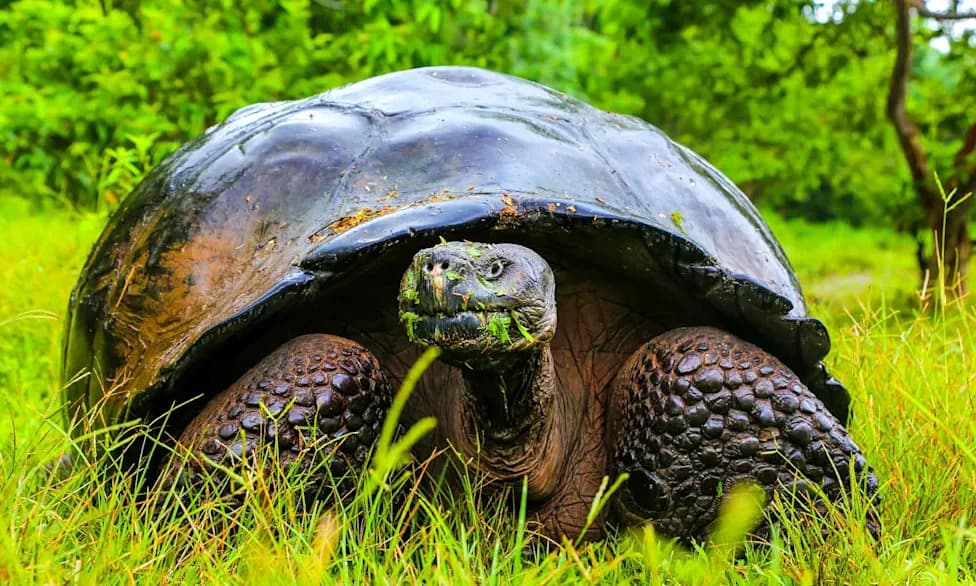
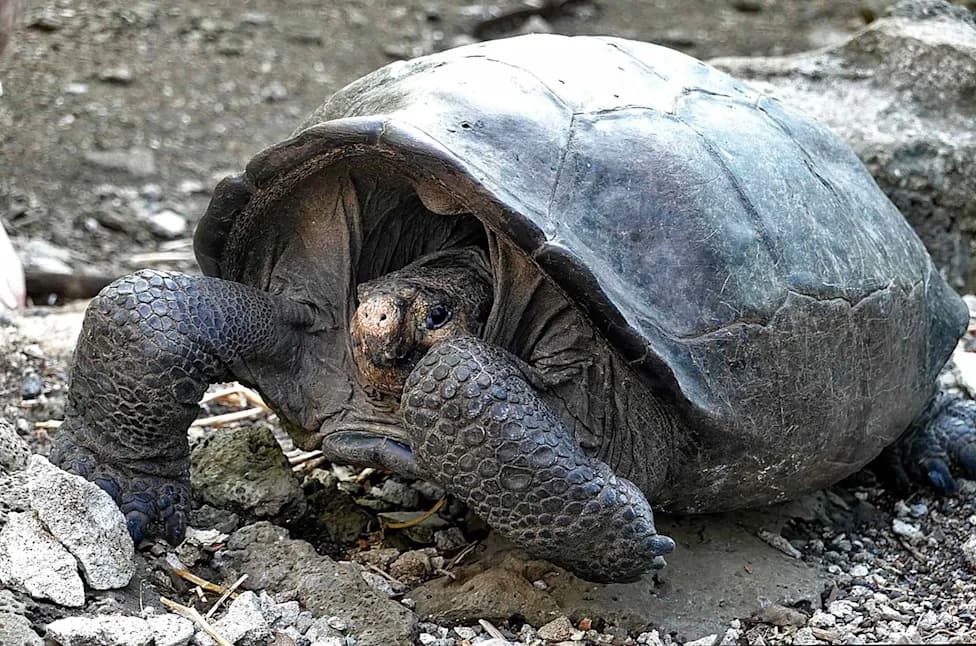
Key takeaway: Even extremely low-coverage DNA from museum tortoise bones—down to 0.008× genome coverage—can reveal meaningful evolutionary relationships when analyzed with a placement-first workflow and validated by independent population-genetic tests. Using EPA-ng placements (100 trials per specimen) against a reference tree of ~1.1 billion sites, researchers identified distinct extinct lineages from San Cristóbal and Santa Fe and linked ambiguous UGO museum specimens to the Historical San Cristóbal group. The approach reduces bias from missing data and offers practical conservation value by helping locate hybrid tortoises that carry ancestry from extinct populations.
Tiny Museum DNA Restores Two Lost Galápagos Tortoise Lineages
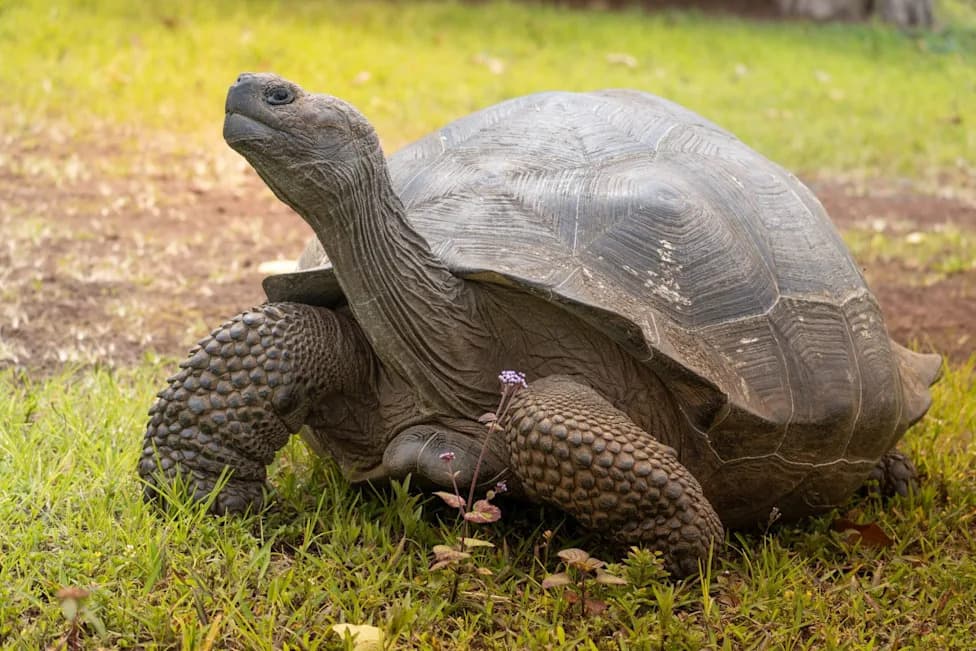
Museum bones holding tiny scraps of DNA were enough to rebuild two missing branches of the Galápagos tortoise family tree. (CREDIT: Shutterstock)
Scattered, heavily degraded fragments of DNA extracted from museum tortoise bones—even when they represent less than 1% of a genome—can still resolve deep evolutionary relationships that conventional approaches might miss. A Yale-led team used a careful, placement-first computational workflow to recover two extinct Galápagos giant tortoise lineages and to connect previously ambiguous museum specimens to the lost San Cristóbal population.
How ultra-low-coverage genomes were analyzed
Ancient and historical DNA fragments break down over time, and chemical damage or contamination can make sequencing noisy. The researchers worked with five focal museum specimens (three Historical San Cristóbal and two from Santa Fe) whose nuclear genome coverage ranged from just 0.008× to 0.139×; in one case only about 0.7% of sequenced material was authentic tortoise DNA. Despite that, individual low-coverage genomes yielded between 6.9 million and 153.2 million called genotypes after careful filtering.
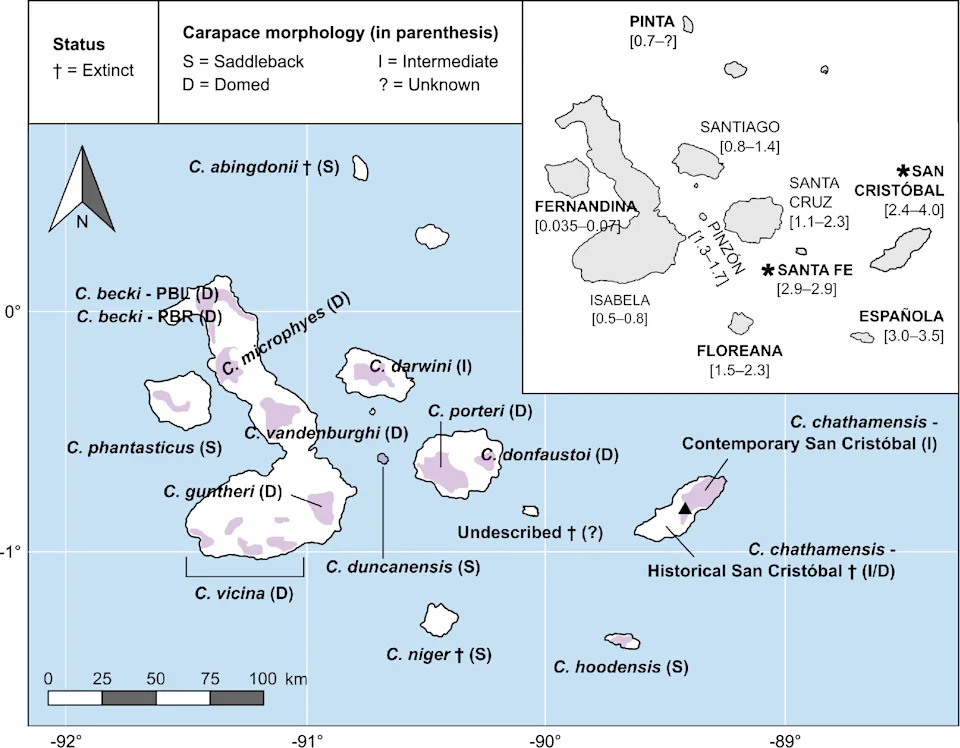
Geographical locations of 17 lineages of giant tortoises (Chelonoidis spp.). (CREDIT: Proceedings of the Royal Society B Biological Sciences)
Rather than combining these incomplete genomes directly with high-quality references—which can produce misleading long-branch artifacts—the team first built a robust reference tree from 39 contemporary tortoises, seven higher-coverage historical samples and roughly 1.1 billion genomic sites. They then used EPA-ng to place each ultra-low-coverage specimen onto that established tree. For each damaged sample the analysts repeatedly drew random subsets of the actually observed sites and ran 100 placement trials to evaluate consistency and uncertainty.
Consistent placements and independent validation
The placement-based strategy made a practical difference. When the incomplete genomes were naively combined with the reference dataset, some Historical San Cristóbal specimens clustered on long, anomalous branches that conflicted with the placement-based results—an illustration of how missing data can create artefactual similarity. To reduce bias, the researchers limited comparisons to observed sites and validated placements with independent population-genetic tests.
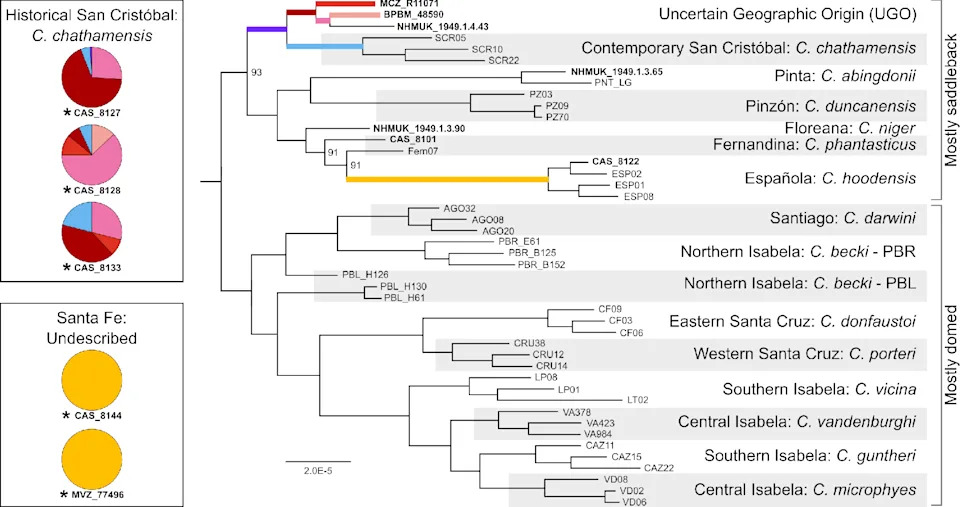
Maximum-likelihood nuclear phylogenomic tree (approx. 1.1 billion sites excluding transitions) of Galapagos giant tortoises rooted with a Chaco tortoise (the latter not shown). (CREDIT: Proceedings of the Royal Society B Biological Sciences)
Principal component analyses and assignment tools supported the placements. The three Historical San Cristóbal specimens repeatedly clustered with a set of previously unplaced museum samples labeled UGO (uncertain geographical origin). Using admixfrog, at least 99.86% of 500-kilobase genomic segments from each Historical San Cristóbal tortoise were assigned to the UGO group; NGSadmix attributed over 99.9% of their genomic variation to the same cluster. The authors therefore conclude that the UGO specimens most likely belong to the same extinct Historical San Cristóbal lineage.
San Cristóbal, Santa Fe and a complex genetic history
The Historical San Cristóbal lineage is genetically distinct from the tortoises now living on the island. Earlier mitochondrial estimates place the split between historical and contemporary San Cristóbal lineages at roughly 0.72 million years ago. One specimen, CAS_8133, showed discordant signals: its nuclear DNA aligned with the extinct Historical San Cristóbal/UGO group while its mitochondrial genome matched the contemporary San Cristóbal lineage—suggesting possible past contact or mitochondrial introgression between populations.
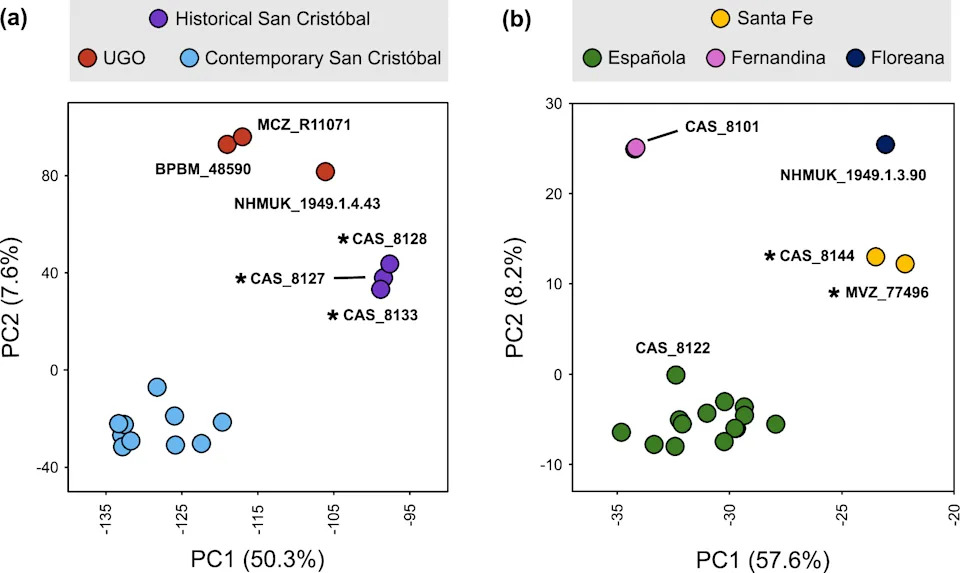
Principal component analyses performed with samples (a) from San Cristóbal (Historical and Contemporary) and of uncertain geographical origin (UGO) (82 718 transversions) and (b) from Santa Fe, Española, Fernandina and Floreana (4290 transversions). (CREDIT: Proceedings of the Royal Society B Biological Sciences)
Santa Fe presented a different puzzle. Because remains there are fragmentary and sometimes charred, researchers had considered whether sailors transported tortoises from other islands and butchered them on Santa Fe. Nuclear placements argued against simple translocation: all 100 placement trials for each Santa Fe specimen landed on the branch leading to Española tortoises, indicating close relationship, but principal component analysis placed Santa Fe samples in their own genetic cluster rather than nested among Española animals. The team interprets this as evidence that Santa Fe represented a distinct evolutionary lineage rather than recently transported Española individuals. Mitochondrial data for Santa Fe were more ambiguous—grouping loosely with Historical San Cristóbal, UGO and Pinta—indicating a potentially complex colonization or admixture history that would require higher-quality nuclear genomes to resolve.
Implications for taxonomy and conservation
Although the genomic placements strongly support distinct Historical San Cristóbal and Santa Fe lineages, the authors did not formally describe them as new species. Formal species delimitation requires dedicated taxonomic analyses beyond the scope of this genomic-placement study. The distinction is important because demonstrating evolutionary relationships does not automatically resolve formal taxonomy.
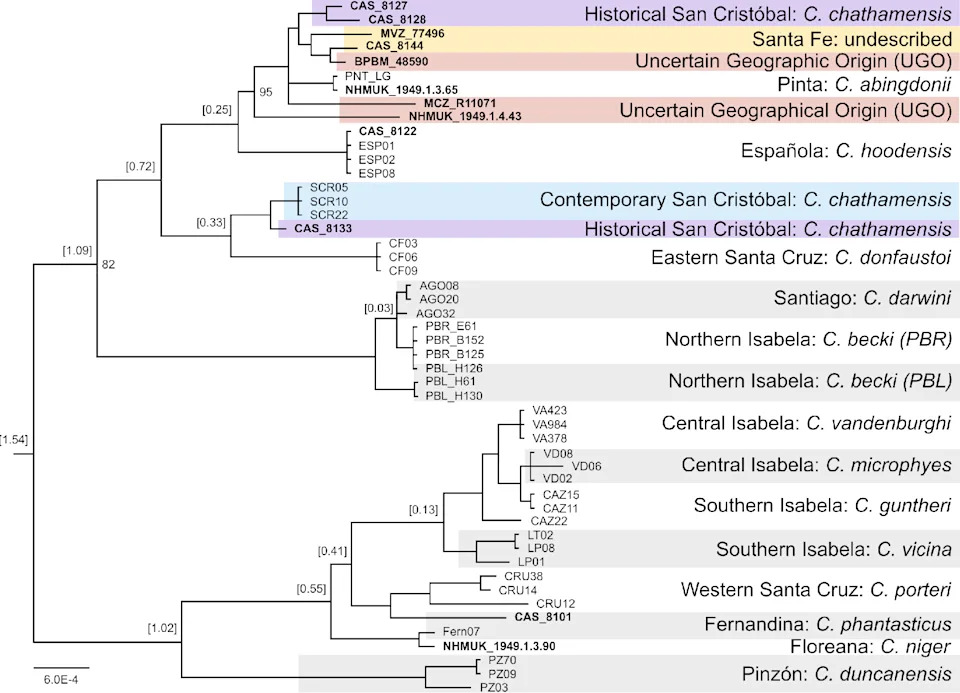
Bayesian mitochondrial DNA phylogenomic tree (15 522 sites) of Galapagos giant tortoises rooted with a Chaco tortoise (the latter not shown). (CREDIT: Proceedings of the Royal Society B Biological Sciences)
From a conservation perspective, the study offers a practical tool: sailors historically moved tortoises among islands, creating hybrids that can retain fragments of genomes from extinct island populations. By placing extinct lineages on a genomic tree, conservation programs can better target genetic screening to identify living hybrids that harbor ancestry from lost populations and guide captive-breeding pairings to increase that ancestry over generations. Lead author Alexander Ochoa notes that, with careful breeding, captive programs might recover substantial portions of extinct genomes in living descendants.
Broader lessons
The computational workflow goes beyond Galápagos tortoises: many museum specimens worldwide contain only trace, contaminated, or heavily fragmented DNA. By focusing on reliably observed positions, leveraging high-quality reference data, and using placement-based approaches with independent validation, researchers can extract meaningful evolutionary signals even from genomes with coverages as low as 0.008×. The new method helps unlock lost diversity stored in natural history collections and connects museum DNA with modern conservation genetics.
Publication: Proceedings of the Royal Society B Biological Sciences. Lead author: Alexander Ochoa. Related studies cited include historical mitochondrial work (Heredity, 2022), whole-genome comparisons that identified a living Fernandina tortoise lineage (Communications Biology, 2022), and a computational reference-genome improvement for Pinta tortoise (Ecology and Evolution, 2025).
Help us improve.