The Heidenau city council voted to ban new Stolpersteine — small brass plaques placed at the last known residences or workplaces of Holocaust victims — after a motion from the AfD and the local CDU branch. Artist Gunter Demnig, survivors and Jewish organizations condemned the decision, saying the plaques’ presence in everyday spaces is essential to remembrance. Critics warn the move reflects growing AfD influence and strains the CDU’s informal firewall against cooperating with the far right. The International Auschwitz Committee called the vote "scandalous," saying it risks erasing decentralized public remembrance.
Outcry in Germany After Heidenau Bans New 'Stolpersteine' Holocaust Memorial Plaques

A 'Stolperstein' commemorating Nazi victim Paul Gröger is embedded in front of Heidenau's city hall. Heidenau no longer permits new Stolpersteine to be installed on city streets - Robert Michael/picture alliance/Getty Images
The Heidenau city council in Saxony has voted to prohibit the installation of new "Stolpersteine" — small brass memorial plaques placed in pavements to mark the last known residences or workplaces of Jews and other victims of Nazi persecution. The motion was proposed jointly by the far-right Alternative for Germany (AfD) and the local branch of the centre-right Christian Democratic Union (CDU), and has provoked widespread condemnation from artists, survivors, Jewish groups and political opponents.
What Are Stolpersteine? The Stolpersteine project, created by German artist Gunter Demnig in the 1990s, installs 10cm brass cubes engraved with victims' names, dates of deportation and places of death at the locations where they last lived or worked. To date, roughly 116,000 plaques have been placed across 31 countries, the large majority in Germany.
The Heidenau motion argues that pedestrians "walk over or even step on the names of the victims," and proposes concentrating future Holocaust commemoration at the town's memorial site in the northern cemetery instead of in decentralized public spaces. CNN has contacted both parties for comment.

Artist Gunter Demnig, pictured laying 'Stolpesteine' in memory of Nazi victims, has condemned the recent development. - Jens Büttner/picture alliance/Getty Images
Opponents contend that the strength of the Stolpersteine lies in their integration into everyday life, where they prompt passersby to remember and reflect. Artist Gunter Demnig condemned the council's decision and told German media that the plaques must remain visible at the exact sites where victims lived or worked because that localized placement helps make history tangible for younger generations.
Gunter Demnig: "The blocks must be visible in the specific locations where people used to live or work — they help bring history to life for young people."
Political reactions were swift. Felix Banaszak, co-leader of the Green Party, called the decision "absurd" and a scandal, arguing that the plaques bring victims' names into daily life and encourage reflection. Charlotte Knobloch, president of a Jewish association in Bavaria and a Holocaust survivor, described the move as the "completely wrong path," while the International Auschwitz Committee denounced the CDU's backing of the motion as "scandalous." The committee's executive vice president said the decision amounted to an attempt to "drive Nazi victims out of the city once again" by consigning their memory to a cemetery.
The vote in Heidenau also highlights political tensions in Germany over cooperation with the AfD. The party has repeatedly challenged established forms of commemoration for the Nazi era and has been the subject of scrutiny by German domestic intelligence, which once designated it a suspected extremist organization; that designation is currently under review. Critics say the CDU's willingness to work with the AfD in Heidenau strains the informal "Brandmauer" or firewall that mainstream parties have maintained to avoid empowering the far right.
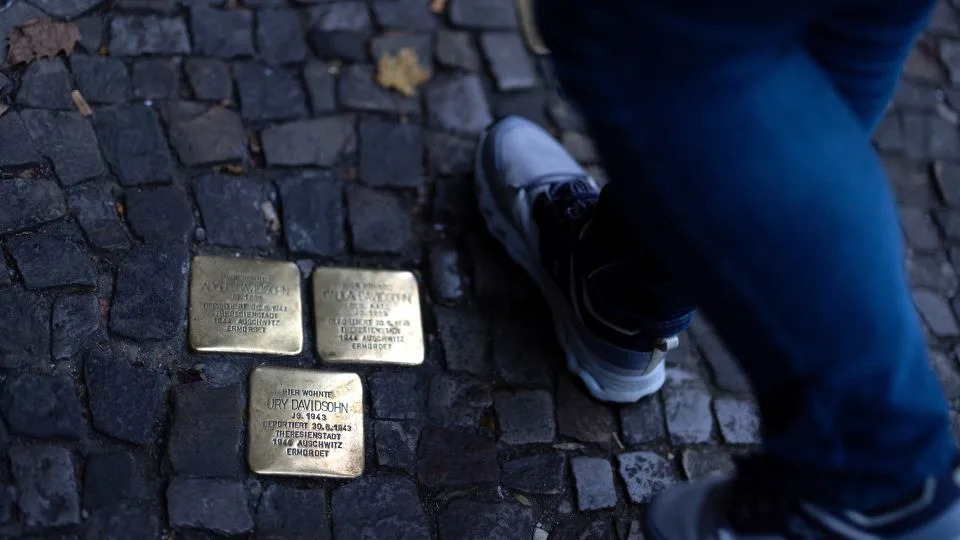
A person steps across 'Stolpersteine' at Scheunenviertel quarter in Berlin. - Lisi Niesner/Reuters
Supporters of the ban argue that memorials should avoid locations where people might unintentionally walk on victims' names and that a centralized memorial site can provide a dignified space for remembrance. Opponents counter that centralization risks erasing the everyday reminders that help societies confront and remember past atrocities.
The Heidenau decision adds to an ongoing national debate in Germany about how to remember the Holocaust: through decentralized, place-based memorials that interrupt daily life, or via consolidated sites such as cemeteries and museums. Whichever path is chosen, opponents warn that removing Stolpersteine from public spaces would undermine a widely recognized form of grassroots remembrance.
Note: The numbers and details in this article are based on reporting from German media and international outlets. CNN has reached out to the involved parties for comment.
Help us improve.