Recent investigations reveal deep divisions within India’s three-member Election Commission and a nationwide Special Intensive Revision (SIR) that has removed over 13 million names from voter rolls. Two commissioners formally objected repeatedly to unilateral actions by the chief, and critics say the centralised ECINet platform and documentary demands have disproportionately affected poorer, migrant and minority voters. The revelations have triggered legal challenges, nationwide protests and renewed concerns about institutional impartiality and the future of India’s electoral system.
Shaken Faith: How Voter-List Revisions Have Put India’s Election Commission Under Scrutiny

Indian opposition leader Rahul Gandhi speaks during a news conference to demand resignation of India's Chief Election Commissioner Gyanesh Kumar, in New Delhi, India, September 24, 2026 [Bhawika Chhabra/Reuters]
New Delhi — New reporting has exposed sharp divisions inside India’s Election Commission and raised fresh doubts about the integrity and transparency of the country’s voter-roll revision process. The disclosures, based on internal documents and interviews, allege that Chief Election Commissioner Gyanesh Kumar repeatedly overruled two fellow commissioners — Sukhbir Singh Sandhu and Vivek Joshi — who formally objected to several unilateral measures.
What the Reports Say
The Indian Express investigation says the Commission has removed more than 13 million names from electoral rolls since June last year during a state-by-state Special Intensive Revision (SIR). Sandhu and Joshi reportedly recorded at least 14 formal objections over the past ten months, calling some actions "unauthorised and illegal." The Commission maintains the process is lawful and secured, but critics say the changes disproportionately affect poorer, migrant and minority communities.
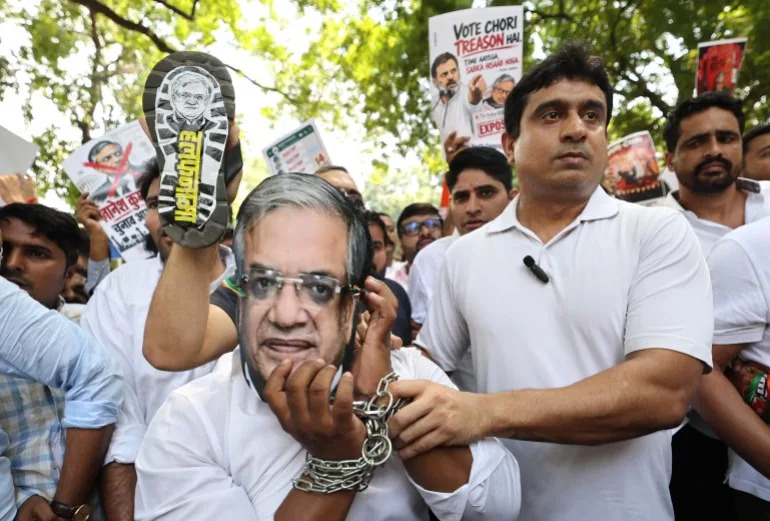
An Indian Youth Congress activist, wearing a mask depicting Chief Election Commissioner Gyanesh Kumar and handcuffed, takes part in a protest in New Delhi, India, September 25, 2026 [Rajat Gupta/EPA]
How SIR Works And Why It’s Controversial
The SIR places the burden on existing voters to prove their eligibility by producing often decades-old documents — birth certificates, land or school records and other archival papers. Minor mismatches (for example, spelling differences) can trigger a "logical discrepancy" flag and lead to deletion from the rolls. Civil-society groups and opposition parties warn that this shifts India’s longstanding, proactive approach to voter registration into one that forces voters to defend their right to be listed.
Centralised Technology: The Role Of ECINet
Investigations show the Commission increasingly relied on a centralised digital platform, ECINet, which logs nearly a billion voter entries. Critics say centralised editing privileges in New Delhi reduced local control. The probe cites an example from Goa where nearly 100 voters flagged by local officials were nevertheless removed after eight unanswered emails to central authorities before a deadline.
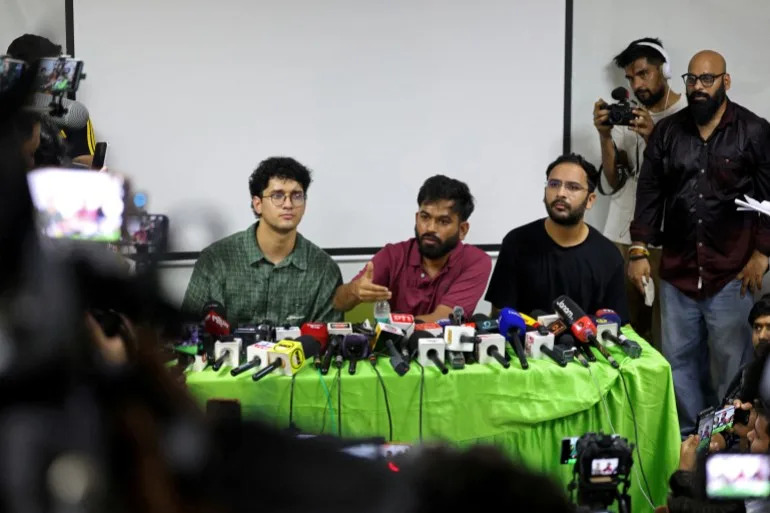
Abhijeet Dipke, head of the Cockroach Janta Party (CJP) speaks as the party's conveners Ashutosh Ranka and Saurav Das look on during a news conference to demand the resignation of India's Chief Election Commissioner Gyanesh Kumar, in New Delhi, India, September 24, 2026 [Bhawika Chhabra/Reuters]
Political And Social Fallout
Opposition leaders and activists have treated the revelations as evidence of politically motivated disenfranchisement aimed at benefiting Prime Minister Narendra Modi’s Bharatiya Janata Party (BJP). High-profile reactions include demands for resignations, legal challenges that reached India’s Supreme Court, and mass protests led by groups such as the Cockroach Janta Party (CJP). The Commission says dissent among commissioners reflected differing views rather than formal protest.
"Today, that faith [in the election process] has shaken. It is very shocking for the nation," said SY Quraishi, who led the Election Commission from 2010–12.
Examples And Reported Patterns
Al Jazeera earlier reported that roughly 9 million residents in West Bengal were removed from the rolls shortly before the state elections; about 34% of deletions there were reported to be Muslim voters, compared with roughly 27% of the state’s population. The SIR’s expansion has also produced embarrassing errors: notices asking top diplomats, judges and senior officials to prove their citizenship have been reported in New Delhi.
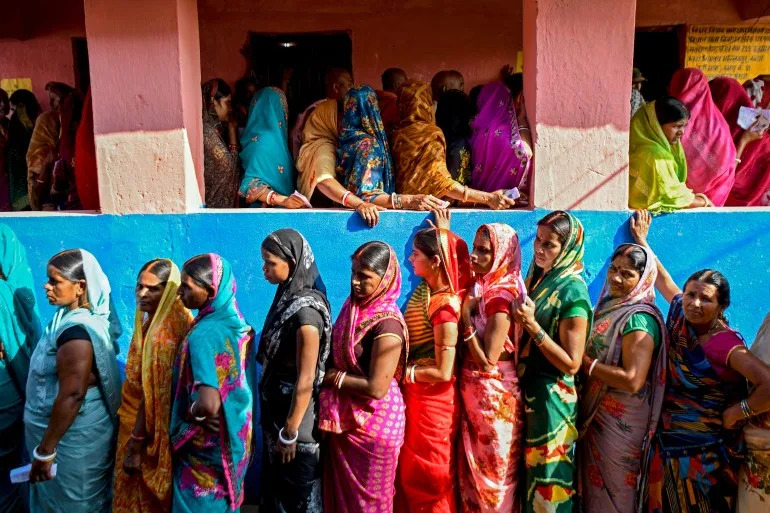
Women voters stand in queues to cast their ballots at a polling station during the first phase of voting for assembly elections on November 6, 2025, at the Raghopur constituency in the Vaishali district of the Indian state of Bihar [Sachin Kumar/AFP]
Why This Matters
Analysts warn the revisions could reshape electorates ahead of elections and undercut trust in institutions. Milan Vaishnav of the Carnegie Endowment argued the process risks reversing India’s long-standing commitment to ensuring broad voter registration by making voters prove they belong on the rolls. Observers say even the perception of a compromised electoral umpire can erode democratic norms.
What Comes Next
Legal reviews, parliamentary scrutiny and public protests are intensifying. Some opposition leaders have vowed accountability if they return to power. Restoring confidence will likely require greater transparency on ECINet, clearer, fairer procedures for resolving discrepancies, and demonstrable adherence to majority decision-making inside the Commission.
Key Takeaway: The controversy centers not only on the technical mechanics of voter-roll management, but on institutional trust: whether India’s Election Commission can remain perceived as an impartial guardian of the franchise in the world’s largest democracy.
Help us improve.