The CDC's provisional data show a small decline in U.S. births in 2025, with just over 3.6 million births reported — about 24,000 fewer than in 2024. Officials say the posted figures cover almost all 2025 births and that the final count may add only a few thousand more. Experts attribute the dip to later family formation and economic uncertainty and note fertility rates have continued a long-term decline even when raw birth counts fluctuate. Detailed demographic breakdowns and rates are not yet available.
U.S. Births Dip in 2025 — CDC Provisional Data Suggest 2024 Uptick Was Temporary
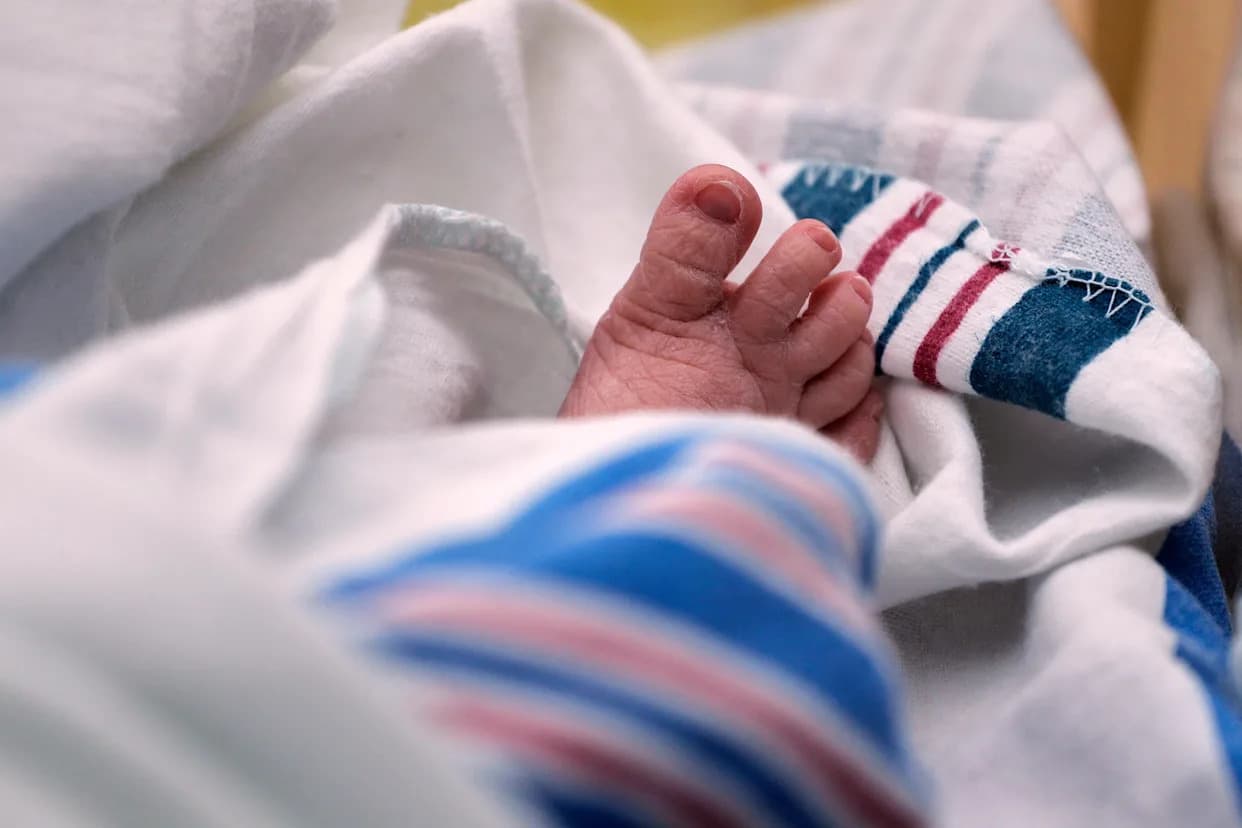
FILE - The toes of a baby are seen at a hospital in McAllen, Texas, on Wednesday, July 29, 2020. (AP Photo/Eric Gay, File)(ASSOCIATED PRESS)
NEW YORK (AP) — U.S. births edged down in 2025, according to newly posted provisional data from federal health officials.
Just over 3.6 million births have been reported via birth certificates, roughly 24,000 fewer than the total recorded in 2024. The Centers for Disease Control and Prevention updated its provisional counts late last week, filling in two months of previously missing data and offering the first clearer view of last year’s tally.
What the Numbers Mean
The CDC said the posted figures account for nearly all births in 2025 and that continued data processing and analysis are unlikely to add more than "a few thousand additional births," according to Robert Anderson, who oversees birth and death tracking at the agency's National Center for Health Statistics.
So far the agency has released only absolute birth counts. Detailed measures such as age-specific birth rates, fertility rates and demographic breakdowns are not yet available and will be needed to understand which groups saw the biggest changes.
Why Births Are Falling
Demographers point to social and economic factors that have encouraged many Americans to delay or forgo parenthood: later marriage, worries about the cost of living, concerns about access to health care and the expense of raising children.
"I wouldn’t expect birth or fertility rates to have risen in 2025; I would expect them to fall because childbearing is highly related to economic conditions and uncertainty," said Karen Guzzo, a family demographer at the University of North Carolina.
Guzzo also noted that most infants born in 2025 were conceived in 2024, a year when affordability and political polarization weighed on many people’s family-planning decisions.
Although the absolute number of births rose slightly in 2024 compared with 2023, experts have pointed out that the fertility rate — the average number of children per woman — actually declined. The fertility rate is the measure used to judge whether a generation is replacing itself (roughly 2.1 children per woman) and has been sliding in the U.S. for nearly two decades.
Recent Trends
U.S. births fell sharply in 2020, then rose for two years as some pregnancies postponed during the early COVID-19 pandemic were carried to term. A 2% drop in 2023 pushed the annual total below 3.6 million, the lowest single-year tally since 1979.
Policy efforts aimed at encouraging higher birth numbers have included executive actions intended to expand access to and reduce the cost of in vitro fertilization, as well as public discussion of financial incentives such as so-called "baby bonuses." Whether such measures change long-term trends remains uncertain.
The AP's Health and Science Department receives support from the Howard Hughes Medical Institute’s Department of Science Education and the Robert Wood Johnson Foundation. The AP is solely responsible for all content.
Help us improve.