Immigrant-rights groups filed a federal lawsuit in Boston challenging an ICE policy that allows agents to enter homes without judicial warrants, relying instead on internal administrative warrants (Form I-205). The complaint, from the Greater Boston Latino Network and the Brazilian Worker Center, argues the practice violates the Fourth Amendment. The policy—described in a May 12 memo from Acting ICE Director Todd Lyons—was disclosed after a whistleblower complaint. Plaintiffs say removing judicial oversight risks civil liberties amid heightened enforcement and recent lethal confrontations.
Lawsuit Seeks to Block ICE Policy Letting Agents Enter Homes Without Judicial Warrants
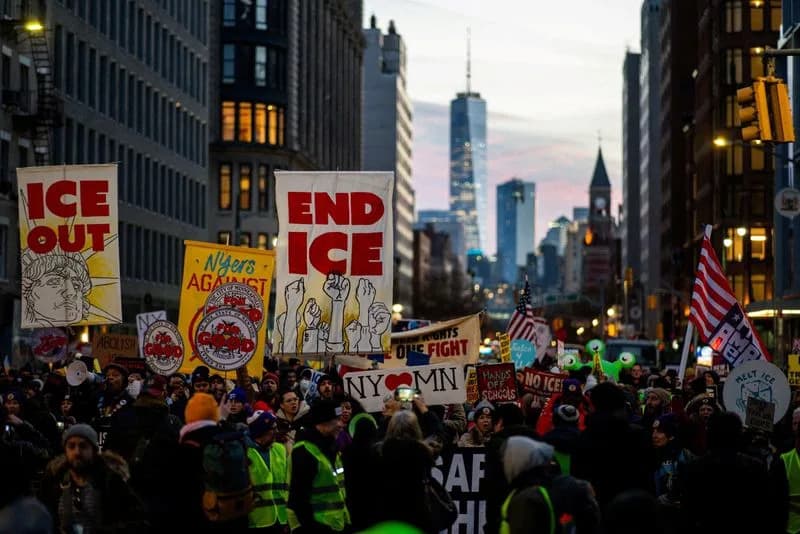
FILE PHOTO: People take part in a protest in solidarity with Minneapolis and against U.S. President Donald Trump and U.S. Immigration and Customs Enforcement (ICE), in New York City, U.S., January 23, 2026. REUTERS/Eduardo Munoz/File Photo
BOSTON, Jan 30 (Reuters) - Immigrant-rights groups on Friday filed a federal lawsuit in Boston challenging a newly revealed U.S. Immigration and Customs Enforcement (ICE) policy that, they say, permits officers to enter private homes of people suspected of unlawfully residing in the United States without obtaining a warrant from a federal judge.
The complaint, brought by the Greater Boston Latino Network and the Brazilian Worker Center, is the first legal challenge to the constitutionality of a policy described in a May 12 memorandum from Acting ICE Director Todd Lyons. The memo became public this month after it was disclosed through a whistleblower complaint filed by the civil liberties group Whistleblower Aid.
The guidance departs from past ICE practice, which generally required judicial warrants before agents entered private residences or businesses. Under the new policy, agents may rely on internal administrative warrants—commonly Form I-205s—issued by Department of Homeland Security (DHS) officials, including ICE personnel.
Plaintiffs Say Policy Violates Fourth Amendment
The Boston lawsuit argues that allowing ICE officers to execute arrests inside homes based solely on administrative warrants, even using force, violates the Fourth Amendment’s protection against unreasonable searches and seizures. Attorneys for the plaintiffs say the change eliminates an important judicial safeguard as ICE steps up enforcement in multiple states.
“The Fourth Amendment exists precisely to prevent government agents from breaking into people’s homes without any judicial process or oversight,” said Brooke Simone, an attorney for the plaintiffs with Lawyers for Civil Rights.
The complaint highlights recent controversies over aggressive enforcement tactics, noting that federal agents shot and killed two U.S. citizens in Minneapolis this month amid protests over immigration crackdowns. Plaintiffs and their lawyers contend such incidents underscore the need for judicial oversight before home entries.
Government Response
DHS did not respond directly to a request for comment on the lawsuit. A DHS spokesperson has previously asserted that individuals served with administrative warrants “have had full due process and a final order of removal from an immigration judge,” and the May 12 memo cites a DHS Office of General Counsel determination that relying on administrative warrants for these purposes is permissible under the Constitution, the Immigration and Nationality Act, and immigration regulations.
The federal lawsuit sets the stage for a legal test of whether administrative warrants can substitute for judicial warrants when ICE seeks to enter private homes to make arrests.
(Reporting by Nate Raymond in Boston; Editing by Alexia Garamfalvi and Alistair Bell)
Help us improve.