Overview: President Trump’s prolific Truth Social activity — roughly 7,500 original posts since the 2024 election — provides a detailed record of promises and proclamations. Many claims have been contradicted, exaggerated, legally impractical, or left unimplemented. Notable examples include shifting trade claims with China, a disputed executive order on women’s sports, inflated investment and tariff figures, symbolic initiatives that produced no follow-through, and proposals that exceed presidential power. As his second year in office begins, separating rhetorical flourish from enforceable policy is essential.
Trump’s 'Promises Kept'? A Year Of Boasts, Reversals And Unfulfilled Pledges
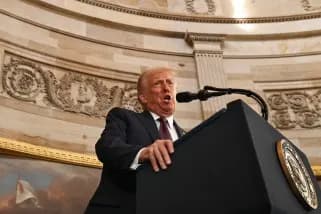
Trump brags about his ‘promises kept’ — but there’s a whole lot he didn’t deliver
President Donald Trump has been prolific on Truth Social since the 2024 election — roughly 7,500 original posts, or about 17 per day across roughly 440 days. That torrent of messages creates a public ledger of promises, proclamations and policy claims. A close review of those posts shows a pattern: many declarations are contradicted later, exaggerated, legally unworkable, or simply never implemented.
Big Claims, Changing Stories
Some posts read like policy milestones but do not survive scrutiny. On June 11, 2025, Trump celebrated that “OUR [trade] DEAL WITH CHINA IS DONE.” Yet on Sept. 19 he described a call with President Xi Jinping in which the two had “made progress on many very important issues including Trade,” suggesting the deal was still unfolding.
He has also reversed public positions. On Dec. 2, 2024, Trump criticized a proposed sale of U.S. Steel to Nippon Steel as unacceptable. By May 23, 2025, he announced that the company would “REMAIN in America” through a planned partnership with Nippon Steel. High-profile reversals like this highlight how rhetoric and outcomes can diverge.
Inflated Numbers And Misleading Headlines
Trump frequently posts large, round figures for investments or tariff receipts that exceed independent or even White House estimates. For example, he claimed on Aug. 31 that “more than 15 Trillion Dollars will be invested in the USA” as a result of his trade deals; White House figures put that number under $10 trillion. He has also alternated claims about tariff revenue — from “TRILLIONS of Dollars” to “more than 600 Billion Dollars” — while independent estimates place collections well below $300 billion.
Promises That Exceed Presidential Power
Many proclamations amount to political theatre because they cannot be enacted by executive order alone. Examples include:
- Claims of adding his name to the Kennedy Center — the center’s naming is a congressional prerogative and did not change.
- Announcements that he would “throw out” President Biden’s pardons, impose nationwide voter ID requirements, or void documents signed with an auto-pen — all actions beyond unilateral presidential authority.
- A recent call for a one-year cap on credit-card interest rates at 10% effective Jan. 20, 2026 — a proposal with no force of law unless Congress acts or regulators adopt enabling rules.
Symbolic Promises And Initiatives That Fizzled
Some high-profile, symbolic moves received fanfare but yielded little action. On Feb. 5, 2025, Trump hailed an executive order he said ended the “war on women’s sports”; by May 27 he was publicly accusing California of “illegally allow[ing] ‘men to play in women’s sports,’” indicating the order did not resolve the dispute. On Jan. 16, 2025, he named actors Jon Voight, Mel Gibson and Sylvester Stallone as “Special Ambassadors” to Hollywood — an initiative the Los Angeles Times later reported had produced no visible follow-up.
Other colorful pronouncements — renaming the Gulf of Mexico the “Gulf of America” for U.S. use, declaring Greenland not part of the U.S., or proposing Alcatraz be returned to use as a prison — were rhetorical, not policy, and produced no concrete change.
Policy Complexity: Tariffs, Spending And Diplomacy
Tariffs and trade have been a persistent theme, with frequent changes tracked externally — Reed Smith’s overview, for example, was updated more than 50 times. Promises of federal efficiency savings tied to private-sector involvement (highlighted early with Elon Musk and briefly Vivek Ramaswamy) did not translate into lower federal spending: the government spent more in 2025 than in 2024.
On foreign policy, Trump repeatedly touted progress on Russia-Ukraine and on a border dispute between Thailand and Cambodia. Those diplomatic breakthroughs remain elusive.
Crime, Courts And Constitutional Limits
Trump credited federal deployments with crime declines in Chicago and Washington, D.C., although crime fell in multiple cities in 2025 and the presence of federal forces in D.C. did not show a clear, discernible effect. He has pushed for major legal changes — revoking birthright citizenship or criminalizing flag burning with a year in prison — that are now under judicial review and face significant constitutional hurdles.
Bottom Line
Trump’s feed offers an abundance of claims that mix real accomplishments with aspirational or legally infeasible promises, shifting positions, inflated numbers and initiatives that never materialized. For readers and policymakers, the takeaway is straightforward: treat bold proclamations as starting points for verification, not as evidence that policy has been implemented.
Help us improve.