Venezuela’s opposition faces a difficult pivot: Maduro’s removal has not dismantled the authoritarian structures that enable repression. Activists call for immediate elections or the swearing-in of Edmundo González — seen by many as the 2024 vote winner — but the US has not prioritized either option. Repression persists, civil society is constrained by a new ‘‘anti-NGO’’ law, and activists stress that credible elections will require an independent electoral council, international observers and media freedom.
Dictator Ousted but Regime Intact — What Comes Next for Venezuela’s Opposition?
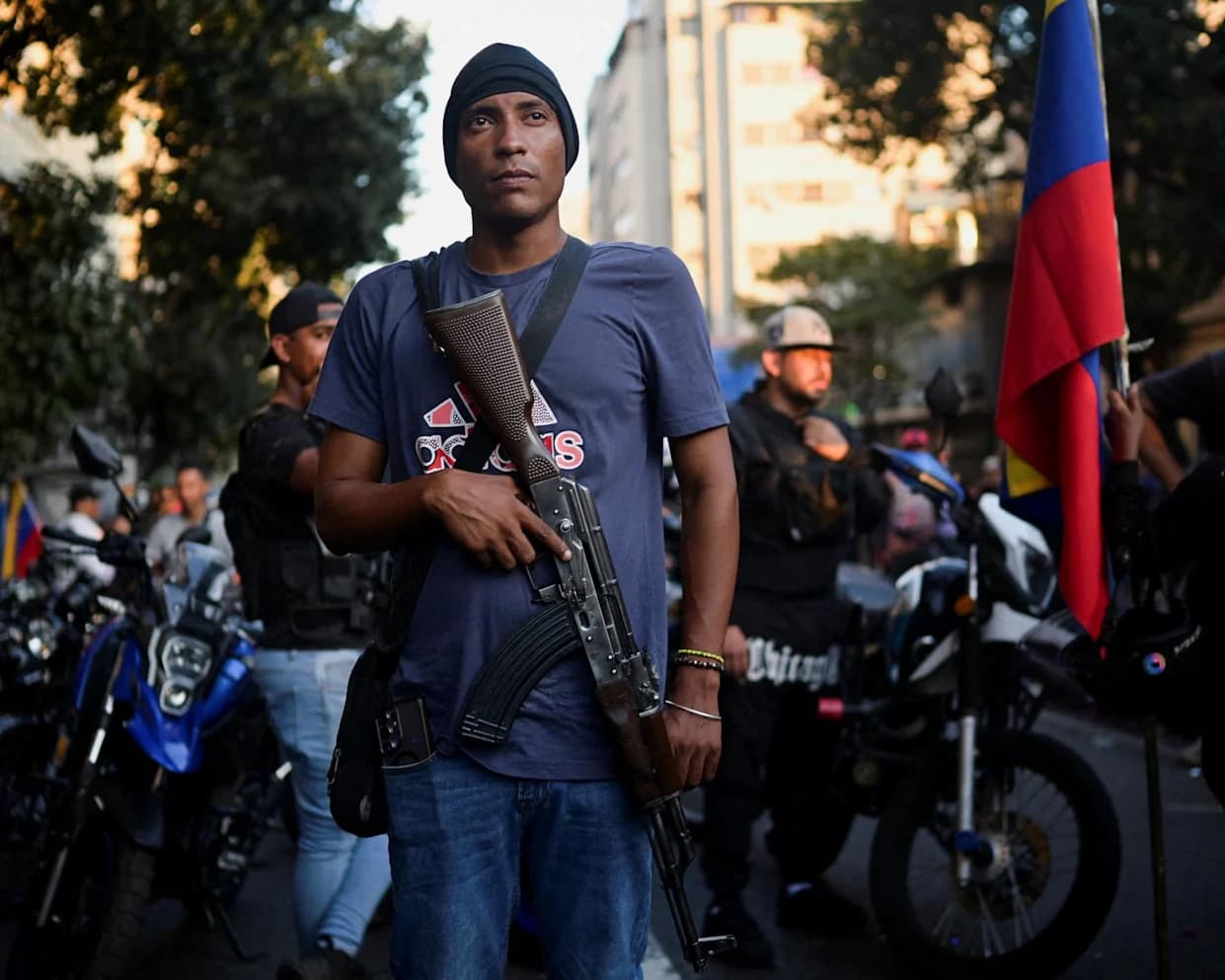
A member of a militia group known as a ‘Colectivo’ takes part in a march calling for the release of Venezuela's President Nicolás Maduro in Caracas this month.Photograph: Gaby Oráa/Reuters(Photograph: Gaby Oráa/Reuters)
As the initial hope that Nicolás Maduro’s removal would quickly restore democracy fades, Venezuelan pro-democracy activists are confronting a stark reality: the authoritarian system remains largely in place. Many opposition figures are calling either for immediate new elections or for the formal swearing-in of retired diplomat Edmundo González, widely regarded by the opposition as the true winner of the disputed 2024 vote. So far, neither option appears to be a priority for the White House.
After Maduro’s capture and reports that the United States gained control over Venezuela’s oil infrastructure, Washington could have moved to install González — whose victory the opposition has documented with collected tally sheets. Instead, the US left Maduro’s cabinet largely intact, asserting it would operate under White House oversight. Despite those assurances, repression and state control have continued.
Continuing Repression and “Chavismo 3.0”
Armed militias continue to patrol neighbourhoods and inspect people’s mobile phones. In one widely reported incident, a group of teenagers detained for allegedly celebrating Maduro’s capture were held for a week before being released. Almost 1,000 people remain imprisoned for criticizing or protesting the regime, despite promises of a broad amnesty.
Rafael Uzcátegui, a sociologist and co-director of the NGO Laboratorio de Paz, describes the current era as another evolution of the movement launched by Hugo Chávez. With Delcy Rodríguez as acting president, her brother Jorge Rodríguez influential in the national assembly, and figures such as interior minister Diosdado Cabello retaining power, Uzcátegui calls the moment “Chavismo 3.0.” He warned:
“So far, state terrorism remains in place. I still have doubts about the route towards a democratic transition. The signals are very weak.”
Civil Society Under Pressure
Many activists have fled the country to avoid arrest or worse. Human Rights Watch reports that between 2016 and 2019 security forces killed more than 19,000 people under Maduro’s rule — a figure often cited to illustrate the severity of repression. Inside Venezuela, civil society has been further constrained by the 2024 “anti-NGO law,” which requires organizations to obtain government authorization to operate. Only a handful of groups remain active inside the country, mostly providing humanitarian support such as aid to families of political prisoners.
Divisions Over Next Steps
Opposition leaders and activists broadly agree on two possible paths: hold new elections quickly under constitutional provisions, or swear in Edmundo González based on the documented 2024 results. Debate continues over the timing of new polls — whether within three months, six months, or later — and some activists fear that the Rodríguez siblings aim to remain in power until the 2030 elections, hoping that economic improvements tied to renewed US relations will strengthen their electoral prospects.
Former US President Donald Trump has argued that the US must first “rebuild” Venezuela and has said Venezuelans “wouldn’t even know how to have an election right now.” Pro-democracy campaigners counter that Venezuela’s opposition successfully mobilized and won the 2024 campaign, even if the regime later subverted the outcome.
Deborah Van Berkel of Ideas por la Democracia, speaking from exile in the United States, describes activists’ mood as a mixture of cautious hope and deep wariness:
“The regime remains in internal control of the country through repression.”
Activists stress that any credible election will require meaningful guarantees: a truly independent electoral council, full access for international observers, a free press, and post-election conditions that allow a newly elected government to govern effectively. Griselda Colina, director of the Global Observatory for Communication and Democracy, warns that almost every public institution remains dominated by Chavismo and that a genuine democratic transition will be neither quick nor easy after more than two decades of democratic erosion.
For now, the opposition’s strategy remains contested and fragile. Yet, as Colina says, Venezuelans continue to cultivate hope: “We are a people who refuse to live under dictatorship, a people who carry a democratic reserve in our minds and aspirations — and that has not disappeared.”
Help us improve.