
Isaias Medina, a former Venezuelan diplomat, says a peaceful, internationally backed transition after Nicolás Maduro's removal on Jan. 3 is essential for the nine to ten million Venezuelan exiles preparing to return. He urges restoration of the rule of law, rebuilding shattered institutions and holding free, fair elections. Analysts warn that the post‑transition stability will determine whether groups such as Hezbollah, Hamas, the ELN and FARC can continue to exploit Venezuelan territory, and they favor U.S. guidance without military occupation.
Post‑Maduro Venezuela: Risks, Opportunities and a Roadmap for Transition

People react to the news of the capture of President Nicolas Maduro, after U.S. military actions in Venezuela, in Doral, Florida, near Miami on Jan. 3, 2026.
With Nicolás Maduro removed from Caracas on Jan. 3, Venezuelans and international observers are closely watching what comes next for the country.
International Role and Immediate Challenges
In a press briefing after the operation, President Donald Trump said the United States would "go to run the country" temporarily until a safe transition can be arranged. Experts and Venezuelan exiles say a carefully managed, peaceful handover is essential to avoid further instability and to enable the return of millions living abroad.
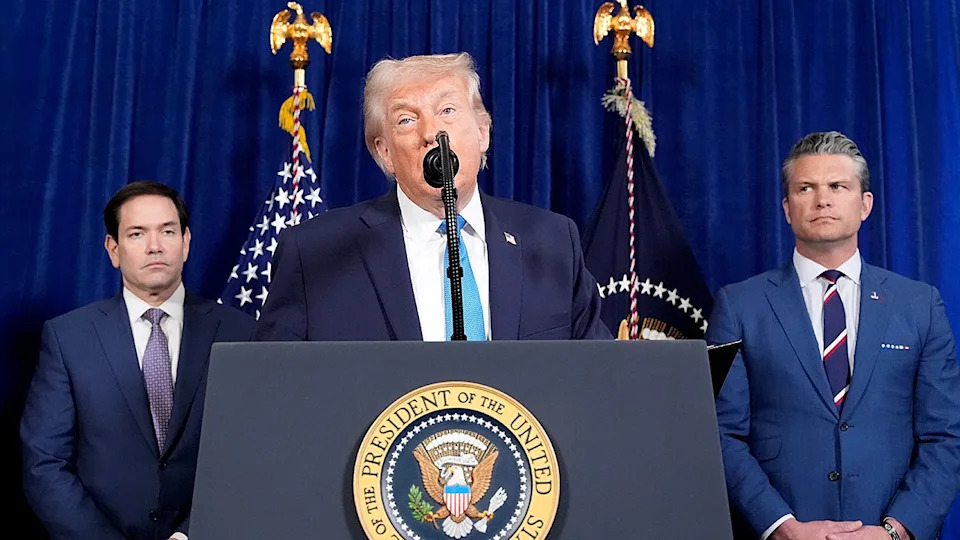
President Donald Trump speaks at his Mar-a-Lago club, Saturday, Jan. 3, 2026, in Palm Beach, Florida, flanked by Secretary of State Marco Rubio and War Secretary Pete Hegseth.
Voices From Exile
Isaias Medina, an international lawyer and former senior Venezuelan diplomat who resigned in protest of Maduro's government in 2017, stressed that a peaceful transition is critical for the nine to ten million Venezuelans displaced and living in exile. Medina told Fox News Digital that exiled Venezuelans "have been preparing ourselves to go back to rebuild our nation," and called for international backing to establish a credible transitional government.
Restoring Institutions And The Rule Of Law
Medina argued that restoring separation of powers, the rule of law and national sovereignty are immediate priorities. He said the Maduro years left institutions decimated and created conditions in which criminal and extremist groups could exploit Venezuelan resources. Medina cited groups such as Hamas, Hezbollah, the Ejército de Liberación Nacional (ELN) and the Revolutionary Armed Forces of Colombia (FARC) as examples of external and irregular actors that allegedly operated within Venezuelan territory.

Venezuelan dictator Nicolás Maduro gestures next to his wife Cilia Flores as they leave the Capitolio, home of the National Assembly, after taking the oath during the presidential inauguration in Caracas on Jan. 10, 2025.
Security, Elections And Disarmament
Medina also emphasized the need to address armed domestic groups, notably the colectivos—violent pro‑regime militias equipped with older U.S. and Russian military hardware. He proposed a disarmament approach phrased as asking these groups to "return the weapons for freedom," arguing that demilitarization could help "unite the nation under one banner of development and evolution" and enable reconstruction of education, training and employment systems.
Preferred International Approach
David Daoud, a senior fellow at the Foundation for Defense of Democracies, told Fox News Digital that if Venezuela does not pose a threat to U.S. national security, the preferred international role would be advisory and supportive rather than a military occupation. "The best we can shepherd Venezuela to be is a productive member of the family of nations, and that’s something we can help with a softer touch, without boots on the ground," he said, adding that targeted guidance combined with determined local action is ideal.
Will Extremist Groups Persist?
Both Medina and Daoud warned that the ability of groups such as Hezbollah or Hamas to continue operating in Venezuela will depend on the effectiveness of the post‑transition government. If the new authorities can secure territory, implement the rule of law and combat corruption, it would become far more difficult for foreign or irregular groups to exploit the country in the way alleged during the previous era.
Outlook: Despite uncertainty, Medina expressed cautious optimism: "What we have ahead of us is a great journey to be able to build upon the ruins of what this regime left us. But I think we’re going to become stronger, and this is the moment. The time has come."
Key next steps identified by analysts include forming a transitional government with international support, organizing free and fair elections, prioritizing security and rule‑of‑law reforms, and managing a disarmament and reintegration process for armed groups.
Help us improve.


