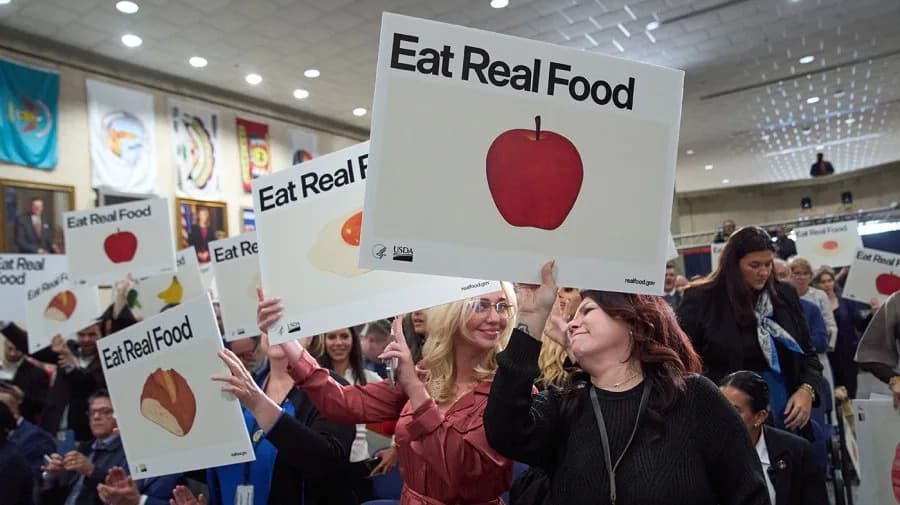
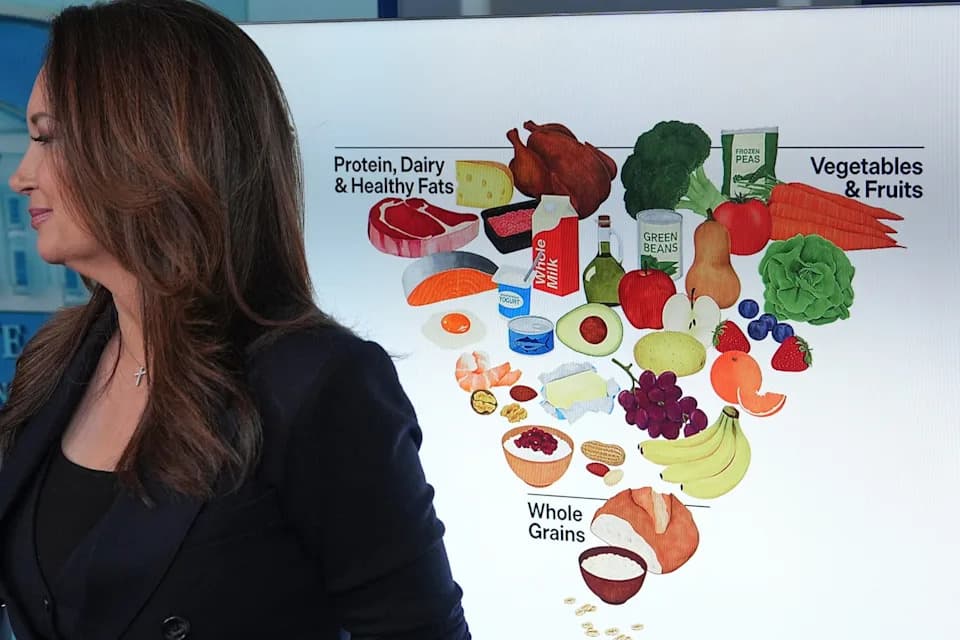
The Dietary Guidelines for Americans released under Health Secretary Robert F. Kennedy Jr. place animal proteins such as red meat and cheese prominently in a redesigned food pyramid, drawing criticism from health and environmental experts. Critics say the 10-page guidance sends mixed signals—visuals emphasizing high-saturated-fat foods conflict with a written recommendation to keep saturated fat under 10% of calories. Environmental advocates warn greater meat consumption would worsen deforestation and greenhouse-gas emissions, while public-health specialists fear the changes could increase diet-related diseases, especially among children receiving school meals.
Experts Warn RFK Jr’s Redesigned Food Pyramid May Harm Health And Environment

Robert F Kennedy Jr’s newly issued dietary guidelines would see Americans eating significantly more meat and dairy products.Composite: Bloomberg via Getty Images, Reuters(Composite: Bloomberg via Getty Images, Reuters)
The food pyramid featured in US Health Secretary Robert F. Kennedy Jr.’s newly released Dietary Guidelines for Americans (DGA) elevates animal-based proteins—most notably cheese and red meats high in saturated fat—above plant-based protein sources, prompting concern from health and environmental experts.
The redesign echoes Kennedy’s earlier signals that he intends to endorse higher saturated-fat intake as part of his “Make America Healthy Again” (Maha) initiative. Experts say the visuals in the 10-page guidance conflict with written limits on saturated fat and that the condensed document lacks the detail of previous guidelines.
Experts Say Text And Visuals Conflict
Dr. Cheryl Anderson, a member of the American Heart Association board and a professor at the University of California San Diego, said she was eager to review the guidance after its delayed release. “They came out much later than they were supposed to,” she said, noting the guidelines typically appear within six months of the advisory committee’s report.
“I think it will be a challenge to keep saturated fat intake within 10% of overall kilocalories. Now, that, to me, is a confusing message for the American public,” Dr. Anderson said, reacting to a pyramid image that places steak and cheese more prominently than plant-based proteins such as nuts.
Environmental And School-Lunch Concerns
Chloë Waterman, senior program manager at Friends of the Earth, who focuses on school meals and the diet–environment link, called the guidelines “contradictory and unclear.” She suggested the mixed messages may reflect an attempt to reconcile competing stakeholders—public health experts and supporters of the Maha movement—and added that compressing the guidance to 10 pages limits nuance and clarity.
Waterman warned that increased meat consumption would carry serious environmental costs. “Americans already eat more protein than is recommended, and we’re one of the highest meat-consuming countries in the world,” she said. Industrial animal agriculture drives deforestation to produce feed and generates greenhouse gases from livestock; beef and lamb are especially associated with high methane emissions. Methane, produced by animal digestion and manure, is substantially more potent than carbon dioxide over shorter time horizons, accelerating near-term warming.
She added that a shift toward plant-based foods and proteins would advance both health and environmental goals: “We’re fortunate that those things actually align with each other.” Critics say the new guidelines move in the opposite direction.
Implications For Children And Policy
Observers differ on how much the revised DGA will change adult eating habits, noting that past editions urging more fruits and vegetables had limited impact. Waterman is particularly worried about school meals, where children cannot opt out. The U.S. Department of Agriculture (USDA) must eventually align school-meal rules with the DGA, a process that can take years. She said adding more meat to school lunches could make it difficult to keep saturated fat under the 10%-of-calories recommendation because many menus are already dominated by animal products.
“If the USDA does somehow interpret the guidelines so that school lunches contain even more meat, we’re going to see a devastating increase in diet-related chronic diseases for children,” including diabetes and metabolic syndrome, Waterman said. Kennedy has said fighting childhood obesity is a central goal of the Maha initiative, but critics argue promoting full-fat dairy and red meat could have the opposite effect.
As policymakers, educators, and families evaluate the new DGA, experts say clearer guidance and more detailed justification will be essential for balancing nutrition goals with public-health and environmental priorities.
Help us improve.