Delcy Rodríguez has moved swiftly in the 12 days after U.S. forces captured Nicolás Maduro, installing trusted officers in economic and security roles and promising increased oil investment. Her appointment of Major General Gustavo González to lead the DGCIM is meant to blunt the influence of rival Diosdado Cabello, who retains strong ties to the security services and violent colectivos. Rodríguez must balance U.S. expectations, rein in entrenched military patronage networks, and stabilize a volatile economy amid widespread fear and uncertainty.
Delcy Rodríguez Moves to Consolidate Power in Venezuela as Rivalries Deepen
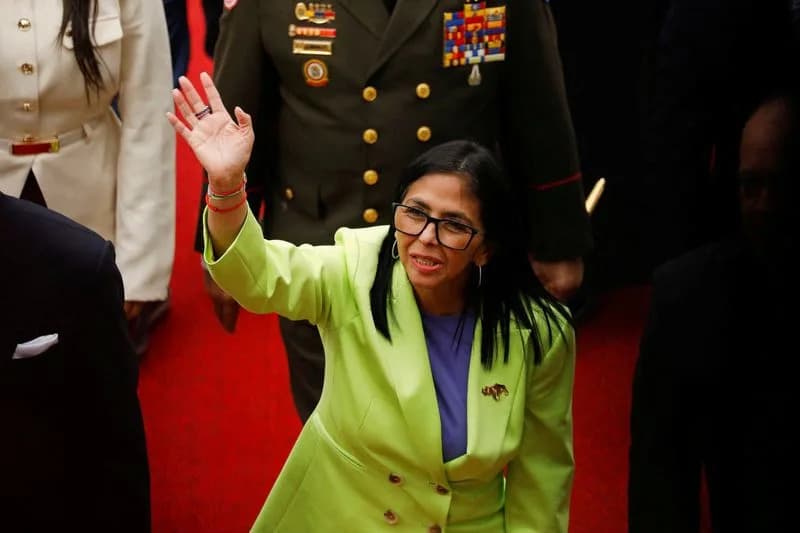
FILE PHOTO: Venezuela's interim president Delcy Rodriguez waves as she walks to deliver her first annual address to the nation at the National Assembly, following the U.S. strike in Caracas that resulted in the capture of President Nicolas Maduro and his wife, Cilia Flores, in Caracas, Venezuela, January 15, 2026. REUTERS/Leonardo Fernandez Viloria/File Photo
Twelve days after U.S. forces captured President Nicolás Maduro, interim President Delcy Rodríguez has moved quickly to consolidate authority, installing trusted officials in key economic and security posts while pledging to boost oil production to meet U.S. demands.
Key Appointments and Political Maneuvering
Rodríguez, 56, a reserved but exacting technocrat who previously served as vice president and oil minister, has appointed a central banker to help manage the economy, named a new presidential chief of staff, and—most consequentially—tapped Major General Gustavo González, 65, to lead the DGCIM, Venezuela’s military counterintelligence agency. Three government sources described González’s appointment as an early move to blunt the influence of Diosdado Cabello, the hardline interior minister who commands deep ties to security services and the colectivos.
“She is very clear that she doesn't have the capacity to survive without the consent of the Americans,” a source close to the government told Reuters. “She's already reforming the armed forces, removing people and naming new officials.”
Factional Tensions and Security Risks
Interviews with seven Venezuela-based sources—diplomats, business figures and politicians—reveal a sharp fault line at the heart of the state. Cabello, who leads the ruling PSUV party and has strong connections to security services and violent colectivos, remains the most potent internal rival. Though publicly conciliatory and photographed beside Rodríguez at a national address, Cabello retains significant informal leverage across the security apparatus.
Hours after Rodríguez was sworn in, a brief burst of anti-aircraft fire outside the presidential palace and clashes over police drones stoked fears of further violence. In some local PSUV branches, party members were reportedly instructed to monitor neighbors and report anyone celebrating Maduro’s capture—signs of the heightened anxiety across the country.
The Challenge of Reining In Military Patronage
Rodríguez faces the twin tasks of convincing party loyalists she is not merely a U.S. proxy and stabilizing an economy that saw sharp price spikes for basic goods in the immediate aftermath of Maduro’s capture. She must also confront sprawling, military-linked patronage networks that grew under decades of Chavismo: Venezuela may have as many as 2,000 generals and admirals—more than double the number in the U.S.—and senior officers control food distribution, raw materials and seats on PDVSA’s leadership and private boards.
Limits of Control Within the Security Services
González previously worked with Cabello during two stints heading a civilian intelligence agency and was promoted to a senior role at PDVSA in 2024 by Rodríguez. Sources caution, however, that González’s authority within DGCIM could be undermined by Cabello’s allies inside the agency. One source said the previous DGCIM chief, General Javier Marcano, struggled to exert real control, calling attention to the entrenched, decentralized nature of Venezuela’s security networks.
Analysts and insiders warn that Cabello’s networks and the colectivos could adopt an “anarchization” tactic—mobilizing militias and intelligence units to foment chaos—to thwart Rodríguez’s rule. Another pressure point is the pace of prisoner releases touted by the U.S. administration; families and rights groups say releases have proceeded slowly, giving opponents leverage.
International Pressure and the Path Ahead
Beyond domestic rivals, international pressure on Cabello is mounting. U.S. officials have communicated with him before and after Maduro’s capture, according to sources, and Cabello is under indictment in the U.S., with a reported $25 million reward for his capture. Rodríguez has courted U.S. backing—she recently met with CIA Director John Ratcliffe in Caracas—and President Trump has publicly described her as “very good to deal with.”
With the country on edge and institutions frayed, Rodríguez’s ability to consolidate power will hinge on balancing U.S. expectations, calming internal security factions, restoring economic stability and convincing Venezuelans and party hardliners that she can lead without surrendering national sovereignty.
(Reporting by Reuters staff; edited for clarity and flow.)
Help us improve.