Tune in tonight (Jan. 16) for a free livestream from the Virtual Telescope Project to watch interstellar comet 3I/ATLAS as it leaves the solar system. The broadcast starts at 5 p.m. EST (2100 GMT) using a 14-inch robotic telescope in Manciano, Italy. Discovered on July 1, 2025, 3I/ATLAS passed perihelion on Oct. 29 and came within 168 million miles of Earth on Dec. 19. It will fly by Jupiter in March 2026 at roughly 33.4 million miles before drifting through the Oort Cloud back into interstellar space.
Watch Interstellar Comet 3I/ATLAS Depart the Solar System — Free Livestream Tonight
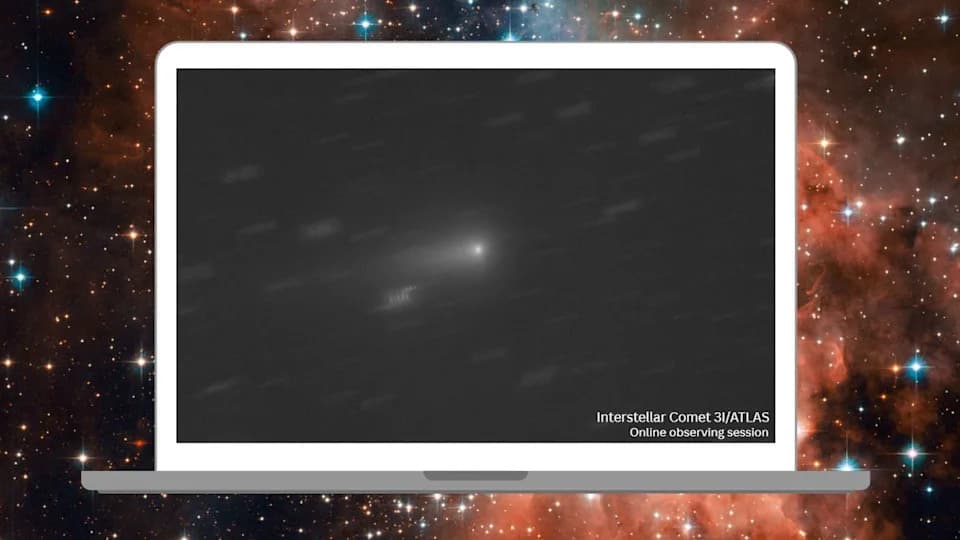
Credit: Gianluca Masi, Virtual Telescope Project, Background: NASA, ESA and the Hubble Heritage (STScI/AURA)-ESA/Hubble Collaboration. Created by Anthony Wood in Canva.
Tune in tonight (Jan. 16) to watch interstellar comet 3I/ATLAS as it continues its one-way exit from the solar system via a free livestream hosted by the Virtual Telescope Project. The broadcast will provide real-time views of this rare visitor as it recedes back into interstellar space.
The livestream begins at 5 p.m. EST (2100 GMT). Weather permitting, the feed will come from a 14-inch Schmidt-Cassegrain robotic telescope located at the Virtual Telescope Project's observatory in Manciano, Italy.
“This is a very precious opportunity to personally see, in real time, the interstellar comet 3I/ATLAS, one of the most important discoveries of the last decade,” said Virtual Telescope Project founder Gianluca Masi on the organization's website.
What We Know About 3I/ATLAS
3I/ATLAS was discovered on July 1, 2025 and quickly identified as only the third confirmed interstellar object observed passing through our solar system, based on a trajectory that is not gravitationally bound to the Sun. The comet reached perihelion (its closest point to the Sun) on Oct. 29, 2025 and brightened more than many scientists initially expected as it approached that point.
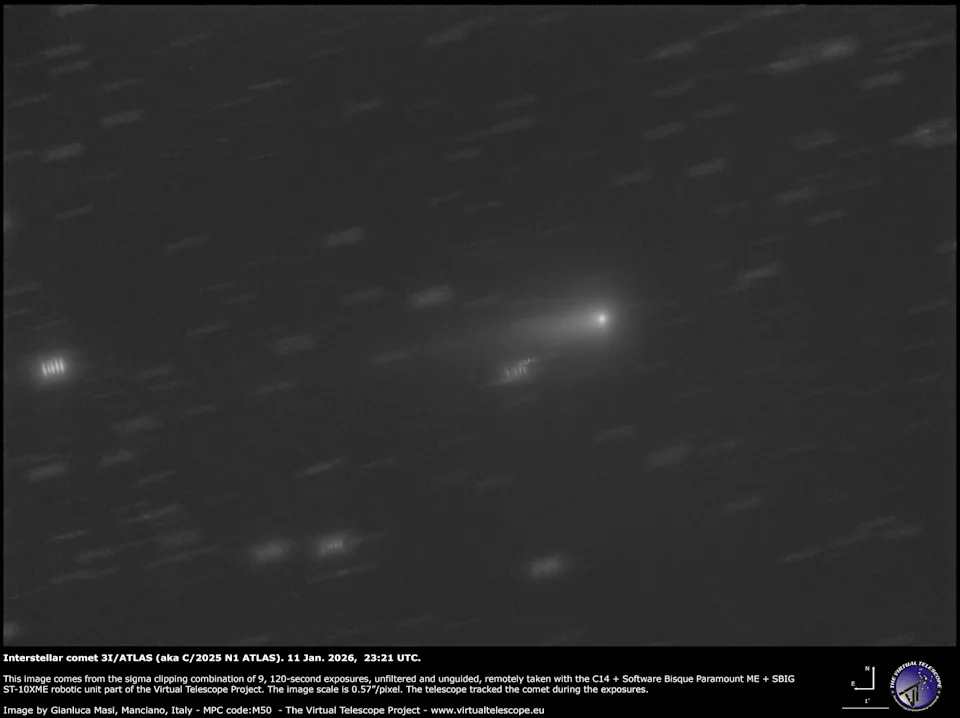
An image of interstellar comet 3I/ATLAS captured by a robotic telescope belonging to the Virtual Telescope Project on Jan. 11, 2026. | Credit: Gianluca Masi, Virtual Telescope Project.
The object disappeared from view while it passed behind the Sun around perihelion, then made its closest approach to Earth on Dec. 19, 2025, coming within about 168 million miles (270 million kilometers). Its next notable encounter will be a significantly closer flyby of Jupiter in March 2026, when 3I/ATLAS is expected to pass the gas giant at roughly 33.4 million miles (53.7 million km).
Where It's Headed
After the Jupiter encounter, 3I/ATLAS will continue outbound beyond the orbits of the outermost icy planets. Over the course of several thousand years it will traverse the distant Oort Cloud and then slip back into interstellar space, resuming its long journey between the stars.
How to watch: Look for the Virtual Telescope Project livestream on Jan. 16 at 5 p.m. EST (2100 GMT). The feed is weather dependent, so check the project's website or social channels for updates and viewing links.
Note: All times are local to the event; convert to your timezone if you plan to watch from elsewhere.
Help us improve.