
In 2025 three remarkable comets captivated astronomers and the public: the interstellar visitor 3I/ATLAS, photogenic Comet Lemmon (C/2025 A6) and the striking C/2025 R2 (SWAN). 3I/ATLAS, discovered July 1 by ATLAS in Chile, was confirmed as only the third interstellar object and may measure up to 3.5 miles (5.6 km). Lemmon and SWAN produced iconic images during October and November, while C/2025 K1 (ATLAS) fragmented after a close solar pass — highlighting both the spectacle and scientific value of comet encounters.
2025: The Year of the Comet — 3I/ATLAS, Comet Lemmon and SWAN Steal the Show

Comet Lemmon streaks across the night sky. . | Credit: Dan Bartlett
In 2025 skywatchers were treated to a rare and dramatic run of comets: an interstellar visitor and two spectacular solar-system wanderers that brightened, survived close encounters with the Sun in varying degrees, and provided both scientific insight and unforgettable images.
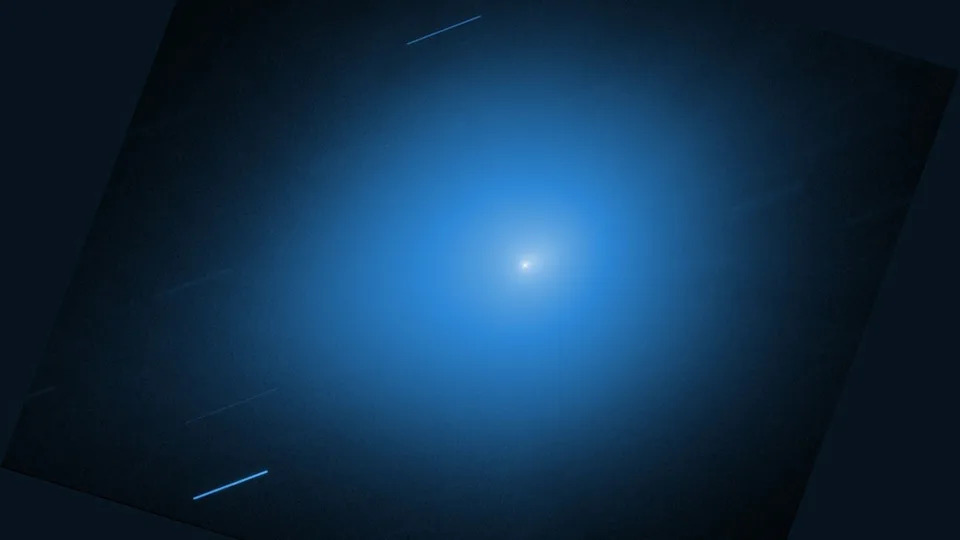
Hubble Space Telescope captured interstellar comet 3I/ATLAS in November. | Credit: NASA, ESA, STScI, D. Jewitt (UCLA). Image Processing: J. DePasquale (STScI)
Three Standout Visitors
3I/ATLAS — An Interstellar Intrigue
Discovered on July 1, 2025, by the NASA-funded ATLAS telescope in Rio Hurtado, Chile, 3I/ATLAS was quickly confirmed as only the third known interstellar object to pass through our solar system, after 1I/'Oumuamua and 2I/Borisov. Observations by the Hubble Space Telescope and other instruments suggested it could be the brightest and possibly the largest interstellar object found so far, with diameter estimates up to about 3.5 miles (5.6 km), according to NASA.
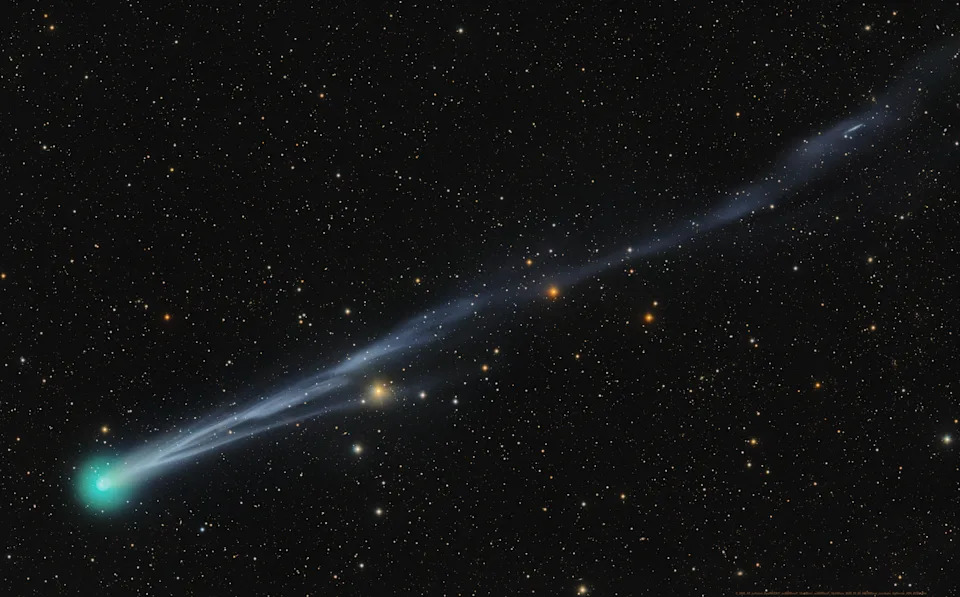
A view of Comet Lemmon on September 20th | Credit: Dan Bartlett
3I/ATLAS reached perihelion on Oct. 30, 2025, at roughly 125 million miles (202 million km) from the Sun. For a period it passed behind the Sun from Earth's viewpoint, limiting ground- and Earth-orbiting observations at peak activity; however, spacecraft elsewhere in the solar system — including orbiters near Mars and probes in interplanetary space — captured valuable data during that critical interval. When it re-emerged in early November, NASA released fresh images showing a glowing nucleus, a sun-facing jet and a growing tail. Addressing speculation that the object might be artificial, NASA Associate Administrator Amit Kshatriya said, "It looks and behaves like a comet, and all evidence points to it being a comet."
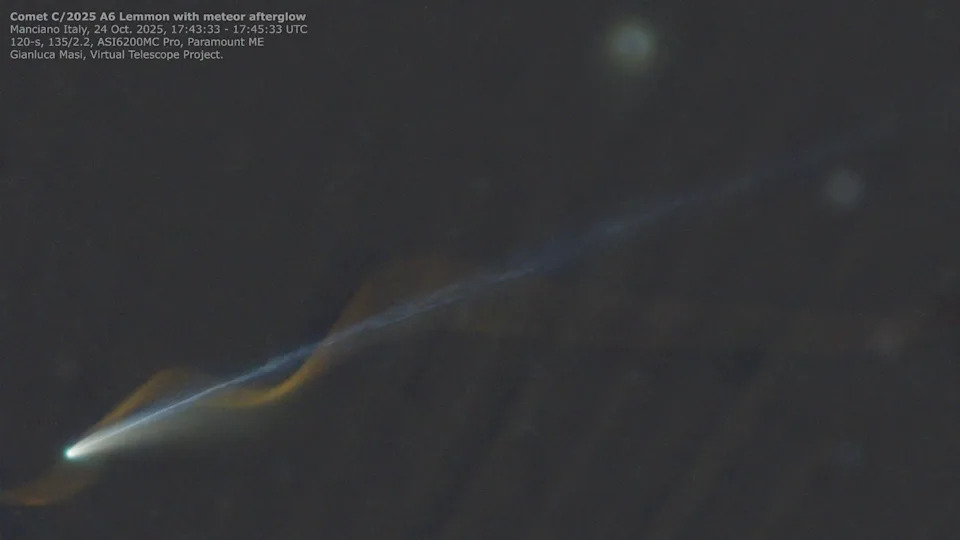
A glowing meteor trail appears to wrap around the tail of Comet Lemmon as seen by astronomer Gianluca Masi of the Virtual Telescope Project on Oct. 24. | Credit: Gianluca Masi, Virtual Telescope Project
Comet Lemmon (C/2025 A6) — A Photographic Favorite
Discovered on Jan. 3, 2025, C/2025 A6 (Lemmon) became a magnet for astrophotographers as it brightened dramatically while approaching perihelion on Nov. 8. Its reported brightening — from a faint magnitude around +21.5 to near naked-eye visibility — reflected rapid sublimation of ices in its nucleus, producing an expanding coma and sculpted tails shaped by the solar wind.
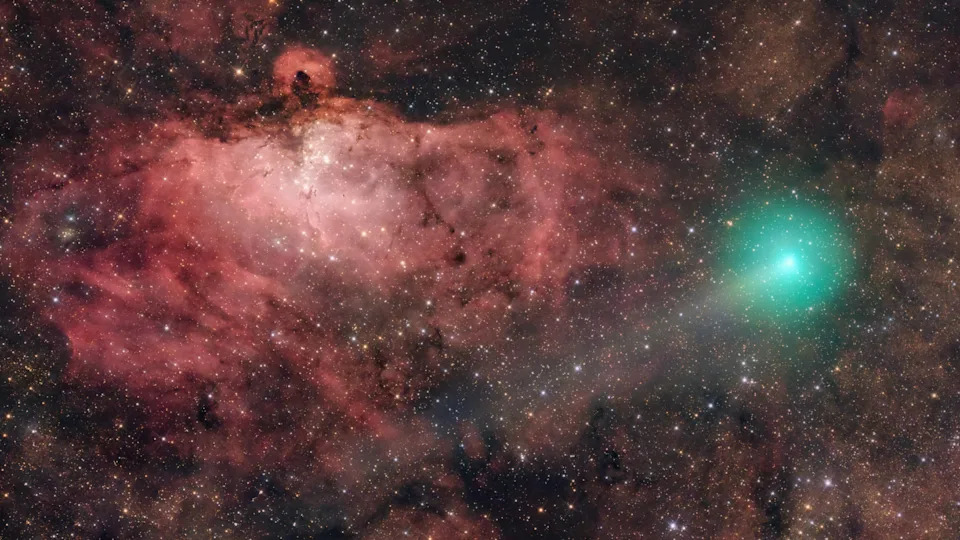
Comet C/2025 R2 (SWAN) glows alongside the Eagle Nebula. | Credit: Daniele Gasparri
A particularly rare image came on Oct. 24, when astronomer Gianluca Masi photographed a glowing meteor trail in Earth’s upper atmosphere that, by perspective, appeared to wrap around Lemmon’s distant tail — a striking example of how foreground and deep-sky phenomena can combine to create memorable frames.
Celestron NexStar 8SE
Comet SWAN (C/2025 R2) — Comet Meets Nebula
C/2025 R2 (SWAN) offered another visual highlight when, on Oct. 17, it passed in front of the Eagle Nebula (Messier 16) in the constellation Serpens. Daniele Gasparri captured a vivid image of SWAN’s green coma set against the nebula’s emission glow and the famous "Pillars of Creation," producing one of the season’s most iconic astrophotographs.
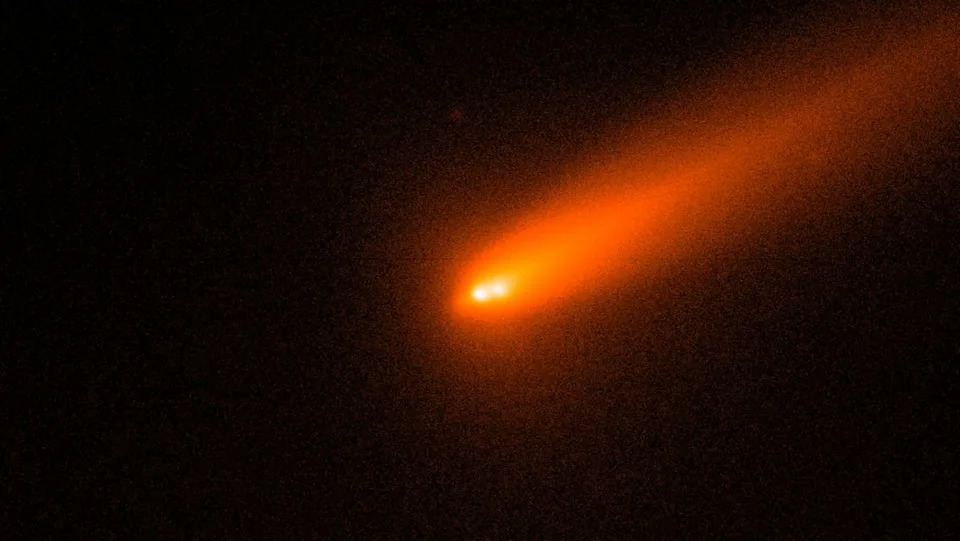
Comet C/2025 K1 (ATLAS) caught fragmenting by the 1.82 m Copernicus telescope at the Asiago Observatory in Italy | Credit: F. Ferrigno/INAF/Univ. Parthenope
Fragmentation: C/2025 K1 (ATLAS)
Not all visitors survived their solar close-ups. On the night of Nov. 11 observers recorded the nucleus of C/2025 K1 (ATLAS) breaking into three large fragments after a close passage to the Sun on Oct. 8. Astronomers believe thermal stresses and rapid outgassing during perihelion — common risks for first-time arrivals from the distant Oort Cloud — likely undermined the comet’s integrity, causing the dramatic breakup.
Why These Comets Matter
Beyond their striking photographs, these comets offered scientists a chance to study primitive materials from the outer solar system — and in the case of 3I/ATLAS, material that originated beyond our solar neighborhood. They also illustrated how public interest can mix with misinformation; some conspiracy theories claimed interstellar objects were engineered, but careful observations and spectroscopy remain the basis for scientific conclusions.
How Observers Captured Them
Astrophotographers used a variety of equipment — from wide-field setups to medium-sized telescopes with sensitive cameras — to track evolving comae and tails. While we removed product promotions from this article, serious observers typically recommend stable mounts, long exposures, and good tracking for the best results during comet apparitions.
Share Your Photos: If you captured images of these comets and would like to share them with Space.com readers, send your photo(s), a short description, and your name and location to spacephotos@space.com.
Editor's note: This article compiles observations, professional measurements and community photography to summarize the most notable cometary events of 2025.


