
New analyses of hadrosaur fossils suggest repeated fractures near the bases of tails were likely caused by mating, when one heavy dinosaur mounted another and applied intense downward force. Researchers examined hundreds of specimens across continents and found a consistent injury pattern lacking bite marks, which argues against predation. The 2022 discovery of a cloacal opening in Psittacosaurus supports the need for close cloacal contact during copulation, and additional evidence—communal display scrapes and ornate ornaments—underscores that courtship and visual signaling were important in dinosaur reproduction.
Inside Dinosaurs’ Bone-Crushing Mating Rituals: How Broken Hadrosaur Tails Reveal Courtship

An Olorotitan dinosaur fossil with fractured tail vertebrae has resurrected a theory around how dinosaurs mated.Stocktrek Images, Alamy
Whatever befell that duck‑billed dinosaur left its tail in tatters. Many of the neural spines on vertebrae near the base of the tail were fractured in a pattern inconsistent with accidental injury. Paleontologists identified the specimen as Olorotitan, and the type of breakage suggested heavy downward pressure applied close to the hips—consistent with a second, large hadrosaur mounting the first.
Evidence From Broken Tails
Filippo Bertozzo of the Institute of Natural Sciences in Brussels first noticed the unusual injuries while studying fossils at the Paleontologic Museum in Blagoveshchensk, Russia, in 2019. Bertozzo recognized vertebral fractures he had seen in previous research and in the literature. In 1989 Darren Tanke suggested similar breaks could result from mating—one dinosaur mounting another—but too few specimens then existed to confirm a pattern.
After examining hundreds of injured hadrosaur fossils from North America, Europe, and Russia, Bertozzo, Tanke, and colleagues argued in a Science paper that mating is the most plausible cause of the recurring tail fractures. Several details strengthen this interpretation: the breaks cluster near the hips across species and regions, lack bite marks or embedded teeth (making predation unlikely), and in large hadrosaurs the bottom animal’s tail would have been bent down by thirty degrees or more under the weight of a mounting partner—consistent with substantial downward force focused at the tail base.
Cloaca and Copulation Mechanics
Part of why hadrosaurs probably had to press together so forcefully lies in soft‑tissue anatomy recently revealed by exceptionally preserved fossils. In 2022 Phil Bell and colleagues described a well‑preserved small ceratopsian, Psittacosaurus, that preserved skin impressions including what appears to be a cloacal opening: a vertical slit just behind the hips similar to that seen in modern crocodilians.
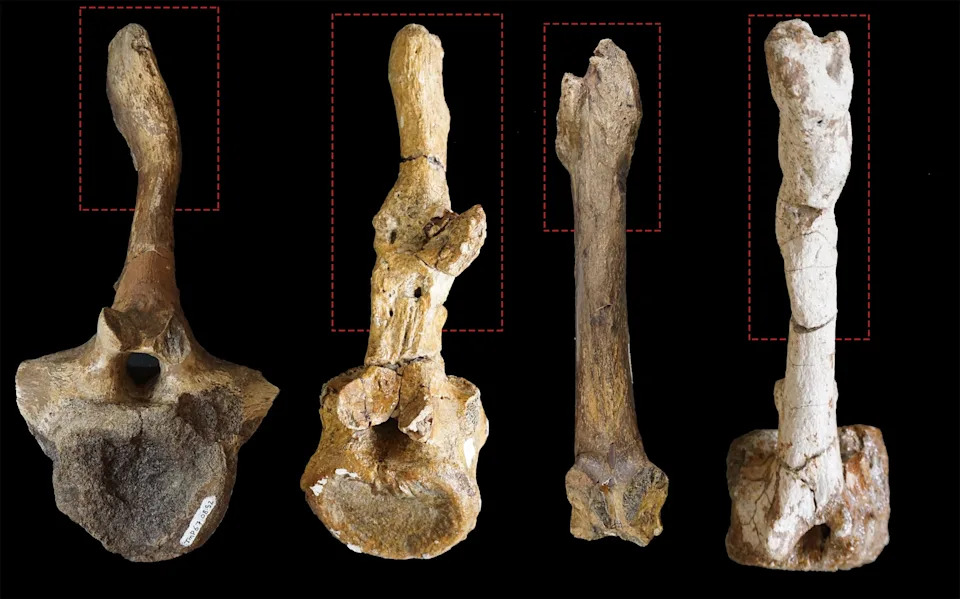
These tail vertebrae from various hadrosaur fossils show healed fractures in their neural spines, pieces of bone that stick out from the vertebrae.Filippo Bertozzo
Like birds and crocodiles, dinosaurs likely had a cloaca—a single external opening for excretory, urinary, and reproductive tracts. During copulation two individuals would need to bring their cloacae into close contact, which for animals with long, muscular, horizontally held tails could require awkward postures and strong downward pressure, explaining the observed tail‑base injuries.
Display, Courtship, and Sexual Signaling
Reproductive behavior extends beyond mechanics. Ornamental features—horns, crests, plates, spines, and feathers—likely served visual display roles as well as defense. The diversity of these structures across species suggests sexual signaling and species recognition were important selective forces.
Additional fossil evidence supports complex courtship behavior: scratch marks clustered in arenas across multiple Colorado sites were reinterpreted by Martin Lockley and colleagues as display scrapes—analogous to lek sites used by some modern birds—where large theropods gathered to advertise nesting ability or fitness.
Limits of the Record and Future Directions
Soft tissues like cloacae are rarely preserved, and internal reproductive organs (phallus or clitoral structures) remain unknown in non‑avian dinosaurs. Even among living crocodilians and birds, external reproductive anatomy can be subtle and variable, so determining sex or exact mechanics from fossils will be challenging.
Nevertheless, the convergence of evidence—consistent tail fractures, absence of predation marks, cloacal fossil evidence, and display arenas—builds a persuasive case that some dinosaurs mated in ways that could injure partners. Bertozzo hopes this work will prompt researchers to reexamine museum collections for additional mating‑related pathologies. From ground scrapes to shattered tail bones, rock and bone increasingly preserve intimate glimpses of dinosaur courtship.
“Reconstructing courtship and mating behaviors is inherently challenging because these activities were brief, seasonal, and left few durable traces in the fossil record,” says Ignacio Díaz‑Martínez (Universidad de Cantabria).


