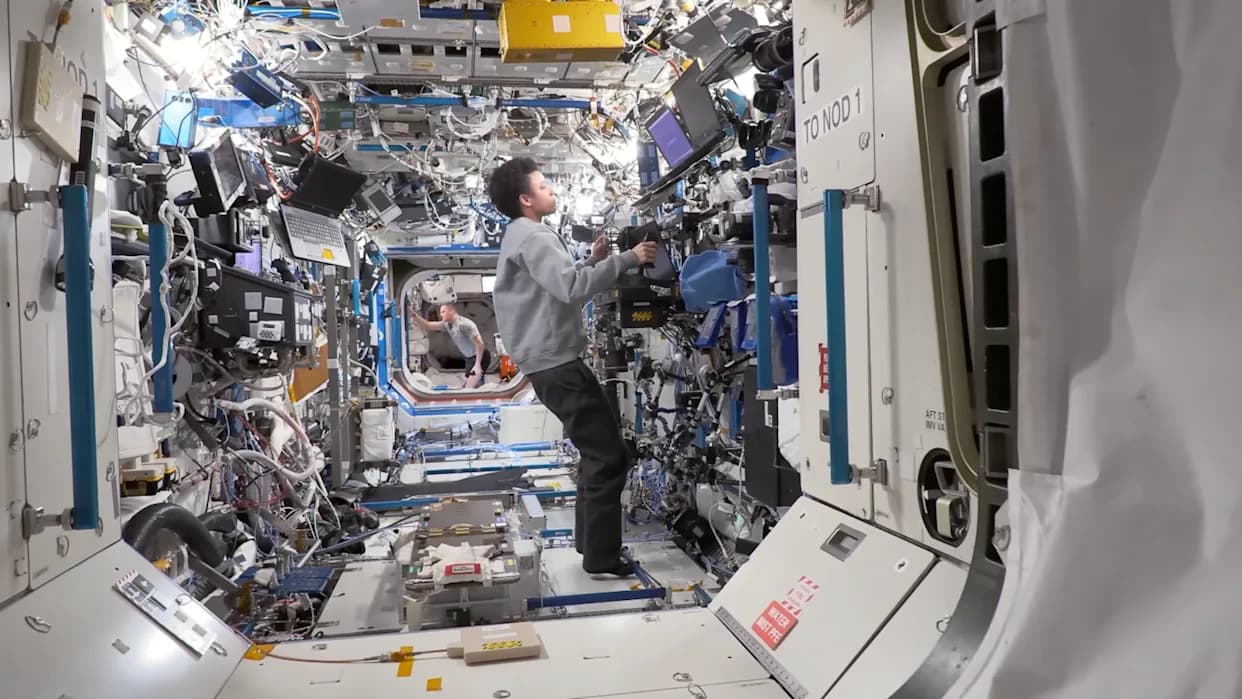
Space technologies—from satellite imaging to global navigation—now underpin agriculture, city planning, communications and commerce, injecting hundreds of billions into the global economy. A "natural-history" view links spaceflight to the evolution of intelligence and the physical challenge of escaping a planet's gravity well. Rather than focusing solely on planetary colonization, a more scalable future may favor engineered habitats in orbit or on small bodies, leveraging vast solar and asteroid resources to support expansion on an unprecedented scale.
How Space Exploration Is Reshaping Life on Earth — And What Comes Next

Lead image: Sergey Nivens / Shutterstock
We rarely think of space exploration as something that directly shapes daily life, yet its reach now extends into nearly every corner of Earth's biosphere. From satellite imagery that guides agriculture to navigation systems that change how we move, space technologies have become infrastructure for modern civilization.
Satellites and Data: Remote sensing and satellite imaging produce hundreds of petabytes of data used to optimize farming, manage water, plan cities and respond to disasters. Those data streams enable better decisions at local and global scales and have helped channel hundreds of billions of dollars into the global economy by transforming commercial, governmental and scientific activities.
Communications and Navigation: Space-based communications and global navigation systems enable near-instant information exchange and precise positioning across the planet. Applications such as Google Maps, global mobile connectivity and logistics networks rely on this infrastructure, altering commerce, travel and social interactions.
Ecological Effects: Decisions informed by space-collected data reorganize landscapes and ecosystems. Orbital monitoring of vegetation health, water availability and land use guides choices about river management, conservation boundaries and agricultural practices, which in turn change habitats and the evolutionary pressures experienced by organisms large and small.
Spaceflight as Natural History
Popular histories often emphasize geopolitical drivers—World War II and the Cold War—but a broader "natural-history" perspective emphasizes physics, biology and the evolution of intelligence. Life on Earth operates at relatively low power density: biology produces modest, distributed energy flows, while escaping a planet's gravity well requires large, concentrated bursts of energy. Overcoming that gap depended on a cognitive leap—the evolution of sustained intelligence and engineering—that allowed humans to build machines and master physical laws.

NATURAL HISTORIAN:Astrobiologist Caleb Scharf argues that a “natural history” of space exploration would “capture the true story of humanity’s effort to break away from its planetary origins.”
Viewed this way, space exploration reads less like a narrow geopolitical caper and more like a paradigm-shifting voyage—comparable in spirit to Darwin's trip on the Beagle: a convergence of ideas, technologies and planetary conditions that reshaped our species' trajectory.
The architecture of our solar system—distances, sizes and compositions of planets and small bodies—has also steered technological choices. Orbital mechanics dictate spacecraft designs, communication networks and trajectory models. In short, the cosmos we inhabit has shaped the way we go about exploring it.
Beyond Planetary Surfaces
Planetary surfaces like Mars can look familiar in photographs, but they remain hostile to organisms evolved for Earth's conditions. A more resilient, scalable strategy may be to build engineered habitats away from planetary surfaces: artificial space stations, or settlements constructed from small bodies such as asteroids, with controlled gravity, air and water and orbits optimized for safety, solar energy harvesting and transportation.
These concepts are old and increasingly practical. Konstantin Tsiolkovsky sketched ring-like stations in the early 20th century, and Gerard O'Neill popularized large cylindrical habitats in the 1970s. Today, with launch cadence increasing and commercial space infrastructure maturing, the engineering foundation for large-scale orbital construction is beginning to appear.
Resources and Scale: The solar system contains vast stores of energy and material—enormous solar flux and millions of asteroids rich in metals and volatiles. If humanity (or post-human descendants) aims to expand well beyond planetary limits, distributing habitats across orbits and small bodies may be far more efficient than concentrating investment on a few planetary surfaces. That shift could enable population dispersal at unprecedented scale: from billions to potentially trillions of individuals distributed across the solar system.
Such a future would demand cognitive and technological leaps comparable to those that first placed us into orbit. Practical challenges—designing habitats, managing resources at solar-system scale, and defining new ethical and legal frameworks—must be addressed now, because many of the enabling trends are already underway.
The ideas above draw on themes explored in the book The Giant Leap and were originally featured in an excerpt published by Nautilus.
Help us improve.