
Scientific American’s top interviews of 2025 span astronomy, AI, medicine, language and more. Highlights include Edward Ashton’s discovery of 192 additional moons of Saturn and 17-year-old Hannah Cairo’s refutation of a decades-old mathematical conjecture. Other conversations probe whether chatbots should provide therapy, how CO2 shapes habitability, and the real prospects for longer human lifespans.
12 Must-Read Scientific American Interviews From 2025

An image of the cover of the first edition of Caleb Scharf's book, The Giant Leap
Scientific American spent 2025 conducting in-depth conversations with authors, researchers and experts to illuminate the stories behind major discoveries and debates. These 12 interviews cover topics from the surprising number of Saturn’s moons to the ethics of AI and whether chatbots belong in therapy. Below are the standout conversations that shaped the year.
How Many Moons?
Astronomer Edward Ashton and his team revealed that Saturn has 192 more moons than previously cataloged. Ashton explained to Scientific American how the team used a technique called shifting and stacking—aligning and combining many images to reveal faint, moving satellites that would otherwise be lost in noise.
The Story of CO2
Senior Desk Editor for Physical Science Lee Billings spoke with science writer Peter Brannen about his book The Story of CO2 Is the Story of Everything. Brannen framed carbon dioxide as both a dangerous pollutant and the chemical that makes Earth uniquely habitable, tracing CO2’s central role in Earth’s climate history and future.
Life’s Journey in Space
Author Caleb Scharf described his concept of the “Dispersal”: the idea that as humanity ventures into space, life will follow increasingly divergent evolutionary trajectories. Scharf argued that the space age could represent a new kind of evolutionary leap, with long-term implications for biology and culture.
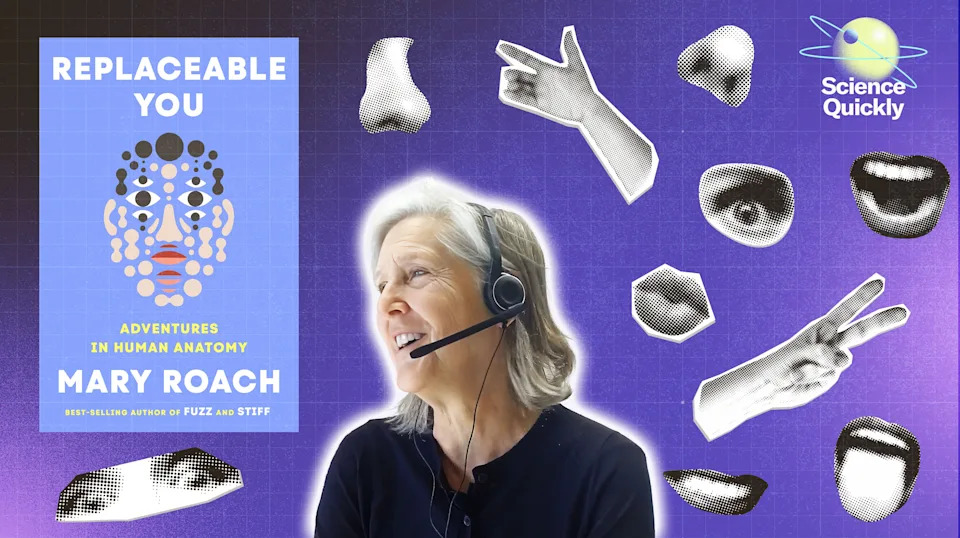
Mary Roach has a new book about body parts.Book cover: W.W. Norton & Company; Alona Horkova/Getty Images; Illustration byScientific American
Seeing Auroras From Space
In April, four passengers aboard a commercial SpaceX flight traveled pole to pole, offering potentially unprecedented views of Earth’s auroras. Senior Reporter Meghan Bartels interviewed space physicist Katie Herlingshaw of the University Centre in Svalbard about the Fram2 mission and how pole-to-pole observations can deepen our understanding of auroral dynamics.
What Is “Personhood”?
Mary Ziegler, author of Personhood: The New Civil War over Reproduction, explained how shifting legal and philosophical definitions of personhood are shaping reproductive policy, including debates over IVF guidelines proposed during the Trump administration. Ziegler traced how contested personhood concepts affect medicine, law and public discourse.
Where Is the Headache Cure?
Science Quickly host Rachel Feltman spoke with Tom Zeller Jr., editor in chief of Undark and author of The Headache, about why common and severe headaches—especially cluster headaches—remain poorly understood and difficult to cure. Zeller outlined the biological complexities and research gaps that continue to frustrate patients and clinicians.
How Do You Replace a Body Part?
Feltman also interviewed Mary Roach about her book Replaceable You, named one of Scientific American’s best nonfiction picks of the year. Roach discussed the curious inspirations behind the book and the technical, ethical and social challenges involved in replacing human body parts.

Algospeak book cover
How Long Can We Live?
Health and Medicine editor Lauren Young talked with cardiologist and genomics professor Eric Topol, author of Super Agers, about the fascination with biological clocks and longevity. Topol reviewed the evidence for claims that humans will live substantially longer and clarified which advances are realistic versus speculative.
Leave Therapy to Humans
Mind and Brain editor Allison Parshall interviewed licensed psychologist C. Vaile Wright, Senior Director at the American Psychological Association’s Office of Health Care Innovation, about the pitfalls of using chatbots as personal therapists. Wright warned that bots can sound convincing yet lack clinical judgment and the ethical safeguards that real clinicians provide.
Do You Speak “Internet”?
Linguist and TikTok creator Adam Aleksic, author of Algospeak: How Social Media Is Transforming the Future of Language, explained how social-platform algorithms fuel rapid slang cycles—terms like “brain rot” or meme-driven jokes such as Skibidi Toilet—and how those shifts affect offline speech and cultural norms.
An AI Epic
Karen Hao, author of Empire of AI: Dreams and Nightmares in Sam Altman’s OpenAI, discussed the realities and possible futures of artificial intelligence. Hao defended her use of the “empire” metaphor to describe dominant AI firms and highlighted both the risks and promising directions she sees in AI development.
Debunking a Mathematical Conjecture Before High School Graduation
At 17, Hannah Cairo overturned the four-decade-old Mizohata–Takeuchi conjecture, a remarkable achievement for a pre-college mathematician. In the interview she described her lifelong passion for math and her belief that mathematics is an art, a view that resonated with her interviewers.


