The opposition around Robert Kyagulanyi (Bobi Wine) has turned Uganda’s national flag into a prominent symbol of protest ahead of this week’s election, in which President Yoweri Museveni is widely expected to secure a seventh term. Police have warned against casual use of the flag, and supporters report intimidation by security forces, according to the UN Human Rights Office. Analysts say the flag provides the opposition a visible, non-violent emblem of unity that authorities view as threatening, prompting fierce debate about patriotism and freedom of expression.
Waving Resistance: How Uganda's Opposition Recast the National Flag as a Protest Symbol
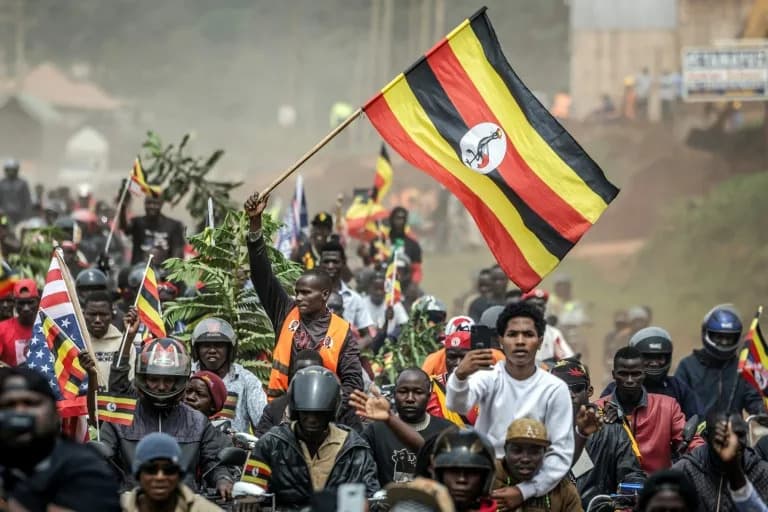
Bobi Wine supporters wave the flag at a rally this week (Luis TATO)(Luis TATO/AFP/AFP)
Hundreds of supporters erupted in cheers as opposition leader Robert Kyagulanyi, known as Bobi Wine, passed a recent rally where a sea of Ugandan flags waved in unison — a powerful image that has turned the national flag into a politicised emblem in the run-up to this week’s election.
Analysts say President Yoweri Museveni, 81, is widely expected to win a seventh term, given his dominant control of state institutions in the East African country. But Kyagulanyi, 43, has framed the vote as a protest ballot and deliberately repurposed the national flag as a visible, non-violent symbol of resistance and unity.
Police last month warned against using the flag "casually and inappropriately," and supporters report repeated intimidation by security forces during the campaign, according to the United Nations Human Rights Office and other observers. Yet attempts to restrict the flag’s use appear to have only amplified its political visibility.
Flag As A Symbol
Uganda’s flag, adopted when the country gained independence from Britain in 1962, carries three colours: black for Africa, yellow for sunshine and red for African brotherhood, centered on a grey crowned crane. After the 2021 clampdown on the National Unity Platform’s (NUP) red berets — ruled illegal as military attire — the flag emerged as a safer, more ubiquitous emblem for the movement.
Voices From The Campaign
"The flag is the only weapon we have," said 31-year-old woodworker Conrad Olwenyi at a rally. "We cannot fight the security, because they have a gun. We only have the flag. If they shoot you when you have the flag, they are shooting the country."
Uganda expert Kristof Titeca called the flag’s adoption a way of "reclaiming patriotism," and said the move appeared to catch the government off guard. Prominent cartoonist Jimmy Spire Ssentongo argued authorities are more alarmed by the visibility of opposition support than by any literal misuse of the flag: "They are threatened by the visibility of the support towards NUP," he said.
From the ruling National Resistance Movement, Israel Kyarisiima, the party’s national youth coordinator, said: "Everyone has a right to use the national flag, but it depends on the context. I believe the opposition is politicising it." Supporters counter that their use of the flag is a peaceful expression of national identity and solidarity.
Despite warnings and reports of security targeting flag-bearers at rallies, Kyagulanyi has urged followers to defend anyone assaulted for carrying the flag. Many supporters see attempts to prohibit flag-waving as an effort to curb freedom of expression.
"Now we've got something that can really show our unity as Ugandans, and they are trying to make it criminal," said Ruth Excellent Mirembe, 25, who waved a flag at a recent rally. "Stopping the flag's use is oppression in the highest form. This represents us as Ugandans."
The unfolding contest highlights how national symbols can be repurposed in political struggles: a unifying emblem for citizens can become a contested sign of dissent when the political stakes are high.
Help us improve.