
NIST physicists have computed that clocks on Mars run about 477 microseconds per day faster than identical clocks on Earth, primarily because Mars has lower surface gravity and sits farther from the Sun. Mars' eccentric orbit makes the offset vary by roughly ±266 microseconds across its 687-day year. These relativistic differences—though small—matter for high-precision navigation, communications and future human missions; the study outlines a framework for interoperable, off-Earth timekeeping.
Time Runs Faster on Mars — NIST Physicists Pin It Down: ~477 Microseconds Per Day

This image shows the globe of Mars set against a dark background. The disc of the planet features yellow, orange, blue and green patches, all with an overall muted grey hue, representing the varying composition of the surface.
Researchers at the U.S. National Institute of Standards and Technology (NIST) have calculated that clocks on the surface of Mars tick faster than identical clocks on Earth by about 477 microseconds per day on average. Though tiny, this discrepancy becomes important for high-precision navigation, communication and timekeeping across Earth, the Moon and Mars.
Why Time Differs Between Worlds
Einstein's general relativity predicts that gravity affects the passage of time: clocks deeper in a gravitational well run more slowly compared with clocks in weaker gravity. Mars' weaker gravity and its greater distance from the Sun produce a shorter Martian second when viewed from Earth.

Time is affected by gravity, and gravity is affected by mass. (J. Wang/NIST)
For context, atomic clocks aboard GPS satellites run about 38 microseconds per day faster than identical clocks on Earth's surface because of a combination of weaker gravity at orbital altitude and relativistic effects from their motion.
How NIST Calculated the Martian Offset
NIST physicists Neil Ashby and Bijunath Patla extended their prior work on a lunar time standard to develop a precise framework for Mars. Their calculations account for gravitational potentials from the Sun, Earth, Moon and Mars as well as orbital motions — a more complex problem than the Moon because it effectively becomes a four-body problem.

Subscribe to ScienceAlert's free fact-checked newsletter
Key physical facts used: Mars has roughly 0.107 times Earth's mass and a surface gravity of about 0.38 g (roughly 2.6 times lower than Earth's). Mars orbits at an average distance of ~1.5 astronomical units (AU) from the Sun, so the Sun's gravitational potential there is weaker by the inverse-square law. Mars also follows a significantly more eccentric orbit than Earth, producing larger seasonal swings in gravitational potential.
Numbers to Remember
Using mission data and relativistic modeling, Ashby and Patla report that:
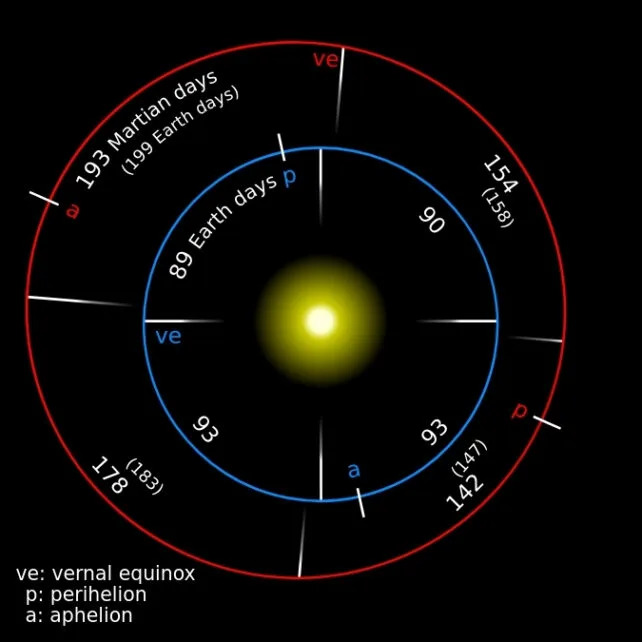
The orbits of Mars and Earth, with the seasons in red and blue, respectively. (Areong/Wikimedia Commons/CC BY-SA 4.0)
- Martian surface clocks run about 477 microseconds per day faster than identical clocks on Earth, on average.
- Because of Mars' orbital eccentricity, that offset varies by roughly ±266 microseconds per day over a Martian year.
- By comparison, clocks on the Moon run about 56 microseconds per day faster than on Earth, and GPS satellite clocks run about 38 microseconds per day faster than Earth-surface clocks.
Implications for Space Operations
Precise, scalable time standards beyond Earth are essential for interplanetary navigation, autonomous spacecraft operations and coordinated communications. The kind of framework proposed by Ashby and Patla would support the Deep Space Network, future Mars surface operations and ultimately human missions that require split-second synchronization across large distances.
"It may be decades before the surface of Mars is covered by the tracks of wandering rovers, but it is useful now to study the issues involved in establishing navigation systems on other planets and moons,"
— Neil Ashby.
The research helps advance a goal the authors call "autonomous interplanetary time synchronization." Their work appears in The Astronomical Journal.


