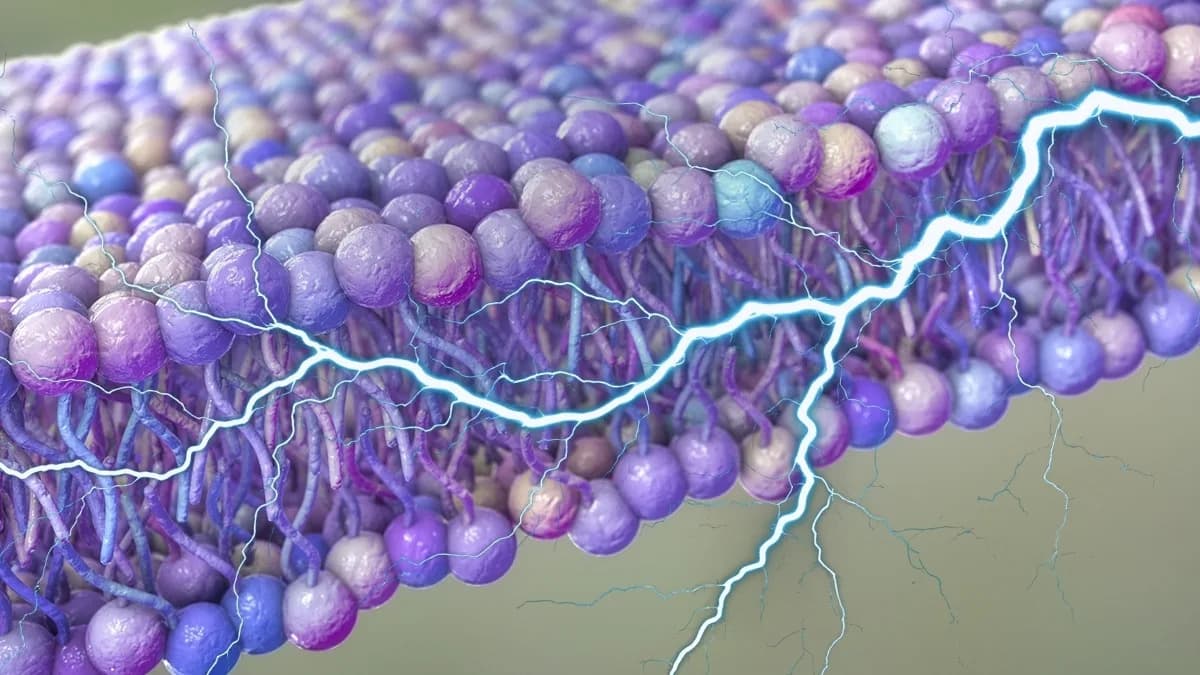
Researchers from the University of Houston and Rutgers report in PNAS Nexus that nanoscale, active fluctuations of cell membranes can generate transmembrane voltages of about 90 mV—a level capable of triggering neuronal firing. The effect stems from flexoelectricity, which converts mechanical deformation into electrical signals, and is amplified because membranes are driven out of equilibrium by protein activity and ATP hydrolysis. The work links mechanical membrane dynamics to bioelectric processes and points to potential applications in neuroscience and neuromorphic computing.
Cells May Harvest Electricity From Membrane Motion — Flexoelectricity Could Produce Biologically Meaningful Voltages

Experts Found a Hidden Energy Source In Our Cellsimaginima - Getty Images
Our bodies are full of energy, and cells have evolved to tap into a wide variety of sources. Beyond well-known metabolic pathways such as cellular respiration and ATP production, new research suggests that routine mechanical motions of cell membranes can be converted into electrical signals by a phenomenon called flexoelectricity.
What the Study Found
Published in PNAS Nexus, a team from the University of Houston and Rutgers University reports that active, nanoscale fluctuations of cell membranes can generate transmembrane voltages on the order of ~90 millivolts — a magnitude large enough to influence neuronal firing and ion transport. The work was led by Pradeep Sharma of the University of Houston.
How Flexoelectricity Works In Cells
Flexoelectricity converts mechanical deformation into electrical polarization. It is related to, but distinct from, piezoelectricity: whereas piezoelectric materials produce charge under macroscopic stress, flexoelectric effects arise from curvature or bending at the nanoscale and can appear in ordinary materials when they are deformed locally.
The researchers argue that cell membranes are promising sites for flexoelectric generation because they exist in a driven, non-equilibrium state. Protein dynamics, ATP hydrolysis and other active molecular processes continually agitate the membrane so that fluctuations do not simply cancel out as they would in thermal equilibrium. When these active motions couple to flexoelectric properties, they can produce steady transmembrane voltages and, under some conditions, drive ion transport.
Living cells constantly experience nanoscale membrane fluctuations due to molecular motion and activity. Can these fluctuations produce electricity? We show that these active fluctuations, when coupled with the universal electromechanical property of flexoelectricity, can generate transmembrane voltages and even drive ion transport.
Why This Matters
If routine membrane motion can generate biologically relevant voltages, it expands the ways cells might harness energy to support electrical signaling and transport. The finding links mechanical work and bioelectricity at the molecular scale and suggests new directions for research in neuroscience, membrane biophysics and bio-inspired technologies. The authors also highlight potential applications for neuromorphic computing and materials that mimic biological information processing.
While the study provides compelling theoretical and modeling support, further experimental work will be needed to quantify flexoelectric contributions in living tissues and to determine how cells might exploit them in physiology.
Help us improve.