Researchers have improved fluorescent glutamate sensors (iGluSnFR variants) to detect the faint, rapid chemical signals that arrive at neurons. From 70 variants screened in mouse brain tissue, two highly sensitive sensors were identified and validated across the neocortex, thalamus, hippocampus and midbrain. Combined with methods that record outgoing electrical activity, these sensors give a more complete view of neural information flow and could accelerate research into disorders linked to glutamate dysfunction such as Alzheimer’s, schizophrenia and autism.
New Glutamate Sensors Reveal the Brain’s Incoming Signals in Real Time
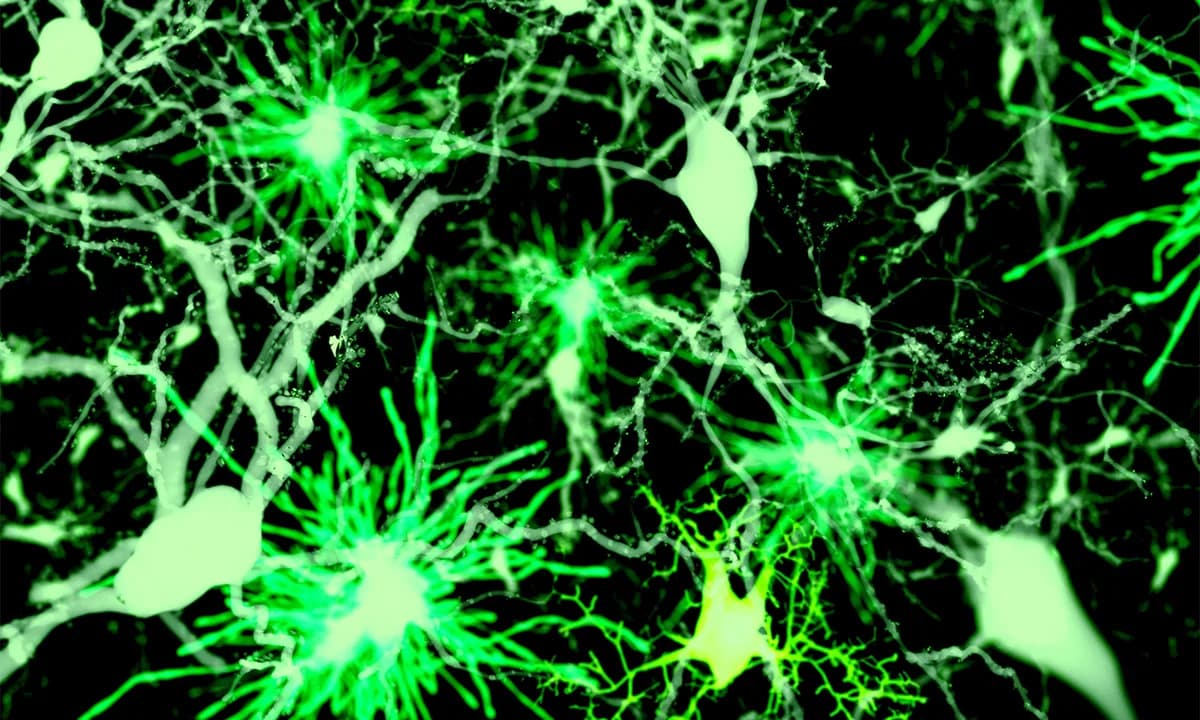
Lead image: Juan Gaertner / Shutterstock
One of the biggest obstacles in neuroscience has been the ability to visualize the chemical messages that arrive at neurons as the brain processes information. While techniques such as electrophysiology reliably record outgoing electrical activity, the incoming chemical signals — rapid, brief bursts of neurotransmitters — have been too faint and fast to capture consistently. A new study published in Nature Methods describes improved fluorescent sensors that make those incoming signals visible.
How The New Sensors Work
Researchers led by Kaspar Podgorski at the Allen Institute in Seattle engineered dozens of variants of a fluorescent glutamate indicator called iGluSnFR. Glutamate is the primary excitatory neurotransmitter involved in learning, memory and emotion. iGluSnFR changes its fluorescence in response to glutamate, so refining its sensitivity and speed lets scientists detect neurotransmitter transients at synapses in living brain tissue.
What The Study Found
From a library of 70 iGluSnFR variants tested in mouse brain, the team identified two improved versions that are sensitive and fast enough to register even faint incoming glutamate signals. The sensors were validated across multiple brain regions — including the neocortex, thalamus, hippocampus and midbrain — and in different neuronal types, revealing patterns of information flow that were previously difficult to observe.
“What we have invented here is a way of measuring information that comes into neurons from different sources, and that’s been a critical part missing from neuroscience research,” said lead author Kaspar Podgorski.
Why This Matters
When paired with existing methods for recording outgoing electrical activity, these improved glutamate sensors provide a more complete picture of how information is transmitted through neural circuits. That fuller view can help researchers decode circuit dynamics underlying cognition and behavior.
The advance also has translational potential: disrupted glutamate signaling is implicated in disorders such as Alzheimer’s disease, schizophrenia and autism. Being able to visualize synaptic activity in real time may accelerate studies of disease mechanisms and the screening or design of drugs that restore normal synaptic function.
Study Context: The work was carried out by an international team spanning the United States, Germany, Italy, the U.K. and Austria, and the results are reported in Nature Methods.
Help us improve.