A theoretical study by researchers at the University of Houston and Rutgers University proposes that active ripples in cell membranes can couple with flexoelectricity to generate transmembrane voltages up to 90 mV. These voltages are predicted to appear on millisecond timescales, comparable to signals in neurons, and could influence ion transport and rapid biological processes. The results are theoretical and require experimental validation; the authors also note possible applications in bio‑inspired materials and computational networks.
Hidden Electrical Ripples in Cell Membranes Could Power Biological Signals — Theoretical Study
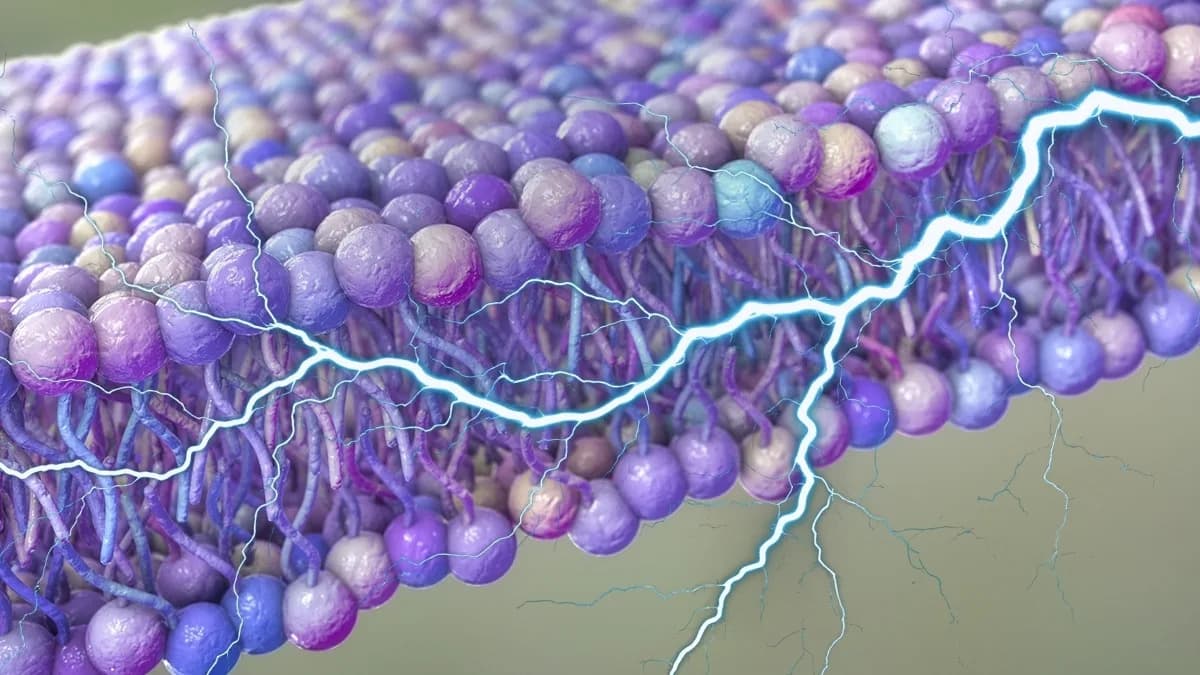
membrane and electrical current
Tiny, active ripples in the fatty membranes that surround our cells may do more than buff and bend — a new theoretical study suggests they could generate usable electrical voltages that help drive biological processes.
Researchers at the University of Houston and Rutgers University present a mathematical model showing how active membrane fluctuations, driven by embedded proteins and the breakdown of adenosine triphosphate (ATP), can couple with a material property called flexoelectricity to produce transmembrane voltages. Flexoelectricity describes how varying mechanical strain across a membrane can create an electric potential.
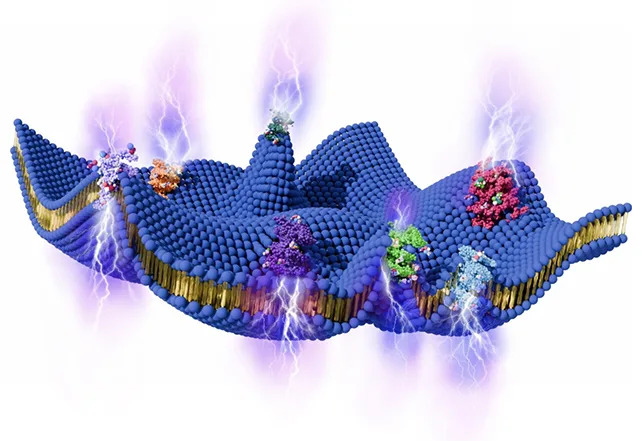
Cell activity causes fluctuations in the membrane that can produce a charge. (Khandagale et al.,PNAS Nexus, 2025)
Unlike purely thermal bending, which averages out in systems at equilibrium, living cell membranes are constantly driven out of equilibrium by biochemical activity. The authors show that these active fluctuations can be organized and amplified so that the usual cancellation no longer applies.
Using analytic calculations, the team estimates that flexoelectric coupling could generate voltage differences between a cell's interior and exterior of up to 90 millivolts, and that these voltages could appear on millisecond timescales. For context, such magnitudes and timing are comparable to the electrical changes that underlie neuronal firing and other fast signaling events.

Subscribe to ScienceAlert's free fact-checked newsletter
"Cells are not passive systems — they are driven by internal active processes such as protein activity and ATP consumption. We show that these active fluctuations, when coupled with the universal electromechanical property of flexoelectricity, can generate transmembrane voltages and even drive ion transport."
If validated experimentally, membrane-generated voltages could assist ion movement, influence muscle contraction and sensory signaling, and coordinate electrical effects across tissues. The authors also highlight potential technological applications, suggesting flexoelectric, membrane-inspired designs might inform new bio‑inspired materials and computational networks.
Importantly, the findings are theoretical: the predicted voltages and ion flows remain to be tested in living cells and tissues. The study calls for targeted experiments to measure flexoelectric responses in active membranes and to evaluate whether the effect is strong and consistent enough to play the roles proposed. The work is published in PNAS Nexus.
Takeaway: The study offers a plausible physical mechanism by which active membrane bending could produce meaningful electrical potentials, bridging molecular electromechanics and possible biological and synthetic applications — but experimental confirmation is required.
Help us improve.