
Scientists propose Europa's spider-like pattern formed like terrestrial "lake stars," when salty brine seeped up through a crack and created dendritic dark channels. Laboratory experiments reproduced similar branching shapes, supporting the upwelling hypothesis for the feature now named Damhán Alla. The finding links Europa's pattern to Martian araneiform terrain and could help guide the Europa Clipper mission in the search for subsurface brines and potential habitability.
Europa's 'Spider' Explained: Scientists Recreate Mysterious Dendritic Feature and Name It Damhán Alla

NASA's Galileo spacecraft first photographed a bizarre spider-like structure lurking within a large crater on Europa during a close flyby of the moon on March 29, 1998. . | Credit: NASA/JPL/University of Arizona
A striking spider-like dark pattern on Jupiter's icy moon Europa — seen nearly 30 years ago — may finally have a convincing explanation and a formal name. The branching feature sits inside Manannán Crater and has puzzled researchers since it was first imaged by NASA's Galileo spacecraft in 1998.
Lab Experiments Suggest a 'Lake Star' Process
In a study published Dec. 2 in The Planetary Science Journal, researchers propose that the dendritic pattern formed by fluid upwelling in a way analogous to terrestrial "lake stars." On Earth, lake stars appear when meltwater pushes up through small holes in snow-covered ice and spreads outward, carving dark, branching channels in the surface. The team reproduced similar branching morphologies in laboratory experiments that simulated fluid flow through porous icy surfaces, producing shapes that partially match the Manannán structure.
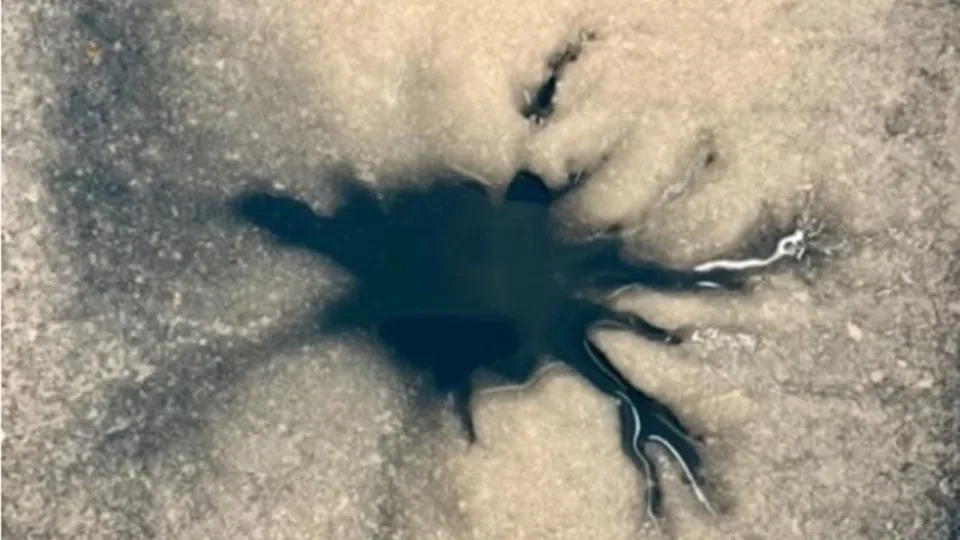
Researchers partially recreated the spider-like pattern in the lab, using a technique that mimics how lake stars form on Earth. | Credit: Prof. Lauren Mc Keown
A New Name: Damhán Alla
Researchers have formally named the feature Damhán Alla, an Irish phrase meaning "spider" or "wall demon," echoing the Celtic inspiration behind the surrounding Manannán Crater. The structure occupies a deep pit near the center of the roughly 13.7-mile-wide (22-kilometer) impact basin that Galileo mapped during its March 1998 flyby of Europa.
Proposed Formation Mechanism
Rather than requiring extreme tidal fracturing or direct hydrothermal eruptions from Europa's subsurface ocean, the new explanation envisions a two-step process: an impact event produced a small crack in Europa's ice shell, and salty brine subsequently seeped upward through that opening. As the brine spread across the surface, it stained and carved dendritic channels that produced the spider-like pattern. The team suggests the impact that allowed brine upwelling likely occurred after the Manannán Crater itself formed.
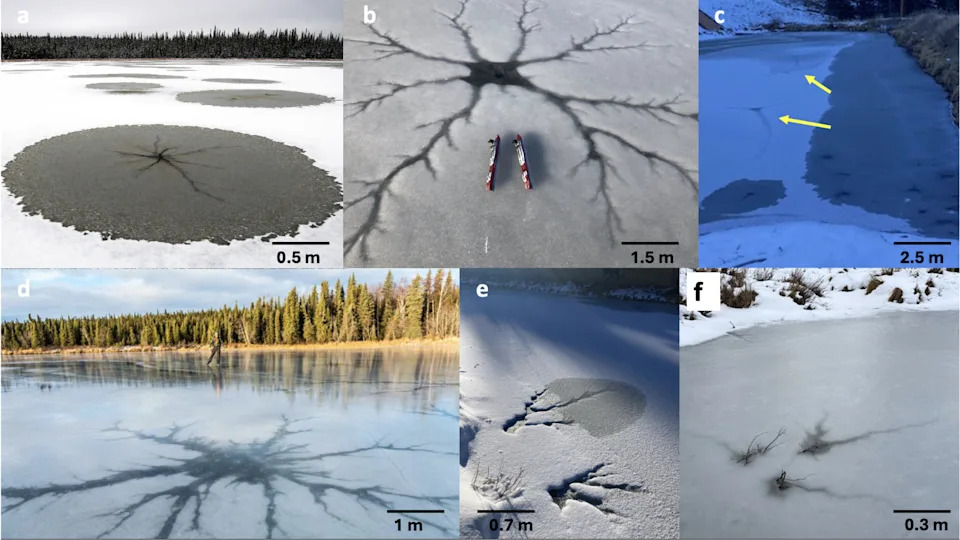
"Lake stars" form when water seeps up through small holes in lakes and spreads through a layer of snow or slush at the surface. Similar processes could be happening on icy water worlds throughout the solar system. | Credit: Mc Keown et al. 2025
"Lake stars are really beautiful, and they are pretty common on snow- or slush-covered frozen lakes and ponds. It is wonderful to think that they may give us a glimpse into processes occurring on Europa," said study lead author Laura McKeown, a planetary scientist at the University of Central Florida.
Connections to Mars and Other Icy Worlds
The researchers draw parallels between Damhán Alla and Mars' so-called "spiders" (araneiform terrain), which are branching patterns formed when buried carbon dioxide ice sublimates and forces gas through porous ground. According to McKeown's team, the visual similarities arise from common physical rules governing fluid or gas flow through porous surfaces. By the same mechanics, similar dendritic features could form on other icy bodies such as Saturn's moon Enceladus, Jupiter's moon Ganymede, or even dwarf planet Ceres.
Why This Matters for Exploration
Understanding how these surface patterns form can help interpret what lies beneath Europa's ice. Damhán Alla and similar features could indicate local brine pools or recent surface–subsurface exchange — promising targets in the search for habitability. McKeown is establishing a new laboratory program to study how spider-like features develop under varying conditions, work that may help prioritize observations for NASA's Europa Clipper mission, launched in October 2024 and scheduled to begin intensive studies of Europa after its arrival in the Jupiter system in 2030.
Bottom line: Laboratory experiments support a brine upwelling model for Europa's spider-like feature Damhán Alla, connecting it to familiar Earth and Martian processes and highlighting new ways to interpret Europa's icy surface and potential subsurface habitats.


