
James Webb observations indicate the super-Earth TOI-561b may host a substantial atmosphere despite an apparently molten surface. NIRSpec measured a dayside temperature near 3,200°F (≈1,760°C), far cooler than the ~4,900°F (≈2,700°C) expected for an airless world. Researchers say a volatile-rich atmosphere or reflective silicate clouds — and a magma-atmosphere exchange — best explain the data; further analysis of Webb's 37+ hour dataset aims to map temperatures and probe composition.
Wet Lava Ball? Webb Data Suggests Super-Earth TOI-561b May Host a Thick Atmosphere

An artist's concept shows what the hot super-Earth exoplanet TOI-561 b and its star could look like based on observations from NASA's James Webb Space Telescope and other observatories. / Credit: NASA, ESA, CSA, Ralf Crawford (STScI)
New observations from NASA's James Webb Space Telescope suggest that the ultra-hot rocky exoplanet TOI-561b — a so-called "super-Earth" — may be surrounded by a substantial atmosphere despite a molten surface and extreme stellar heating.
Discovered in 2020, TOI-561b is roughly 1.4 times the diameter of Earth and completes an orbit around its sun-like host star in about 11 hours. The planet orbits extremely close to its star — roughly 40 times closer than Mercury is to our Sun — and is believed to host a global magma ocean.
What Webb Measured
Using Webb's Near-Infrared Spectrograph (NIRSpec), researchers measured the planet's dayside temperature. Models predict that an airless, rock-dominated world at this distance would reach about 4,900°F (≈2,700°C). Instead, NIRSpec recorded a dayside temperature near 3,200°F (≈1,760°C) — substantially cooler than expected for a bare rock.
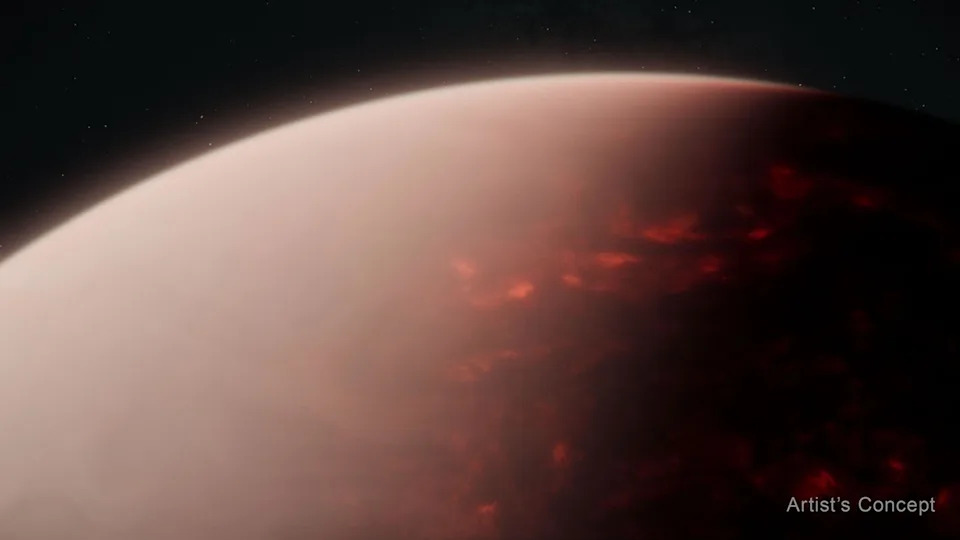
An artist's concept shows what a thick atmosphere above a vast magma ocean on exoplanet TOI-561 b could look like. / Credit: NASA, ESA, CSA, Ralf Crawford (STScI)
How Scientists Interpret the Difference
NASA and the study authors caution that a lower-than-expected temperature alone is not definitive proof of an atmosphere. Heat redistribution within a global magma ocean or a thin envelope of rock vapor could partially reduce surface temperatures. However, researchers argue those mechanisms are unlikely to explain the full discrepancy between the predicted and observed temperatures.
“We really need a thick volatile-rich atmosphere to explain all the observations,” said Anjali Piette of the University of Birmingham, a co-author of the study.
Piette and colleagues suggest that a volatile-rich atmosphere containing gases such as water vapor could absorb and reprocess certain wavelengths of light, altering the thermal signature Webb detects. Bright silicate clouds are another possible cooling agent: they could reflect incoming starlight and lower the observable dayside temperature.
“At the same time that gases are coming out of the planet to feed the atmosphere, the magma ocean is sucking them back into the interior,” said Tim Lichtenberg of the University of Groningen. “This planet must be much, much more volatile-rich than Earth to explain the observations. It's really like a wet lava ball.”
Next Steps
Webb observed TOI-561b for more than 37 hours, and researchers will continue to analyze that data set to build temperature maps of the planet and search for spectral signatures that would directly indicate atmospheric composition. Future observations and modeling will test whether volatiles, silicate clouds, or magma-atmosphere cycling best explain the unusual measurements.
Bottom line: TOI-561b challenges expectations for ultra-hot rocky worlds. Current Webb data favor the presence of a thick, volatile-rich atmosphere or highly reflective clouds that cool the dayside, producing a surprising “wet lava ball” scenario.


