
Antimatter is the charge-reversed counterpart of ordinary particles: well understood, rare today, and annihilates with matter on contact (used in PET scans). Dark matter is invisible mass inferred from gravitational effects such as galaxy rotation curves and gravitational lensing; it appears to outmass ordinary matter by roughly five to one. Antimatter has been produced and studied in labs; dark matter has not yet been directly detected and remains one of astronomy’s biggest mysteries.
Antimatter vs. Dark Matter: What’s the Difference?

Spiral galaxies, like Messier 77 shown here, helped astronomers learn about the existence of dark matter.NASA, ESA & A. van der Hoeven,CC BY
Namrata, age 13, from Ghaziabad, India asked: What are dark matter and antimatter, and are they the same? The short answer is: they sound similar but are completely different. Here’s a clear, friendly explanation.
Imagine a Video Game
Think of a video game where your hero is the character you control. A mirror-image twin shows up sometimes and destroys things on contact. Meanwhile, an invisible hive of minions hides around every corner, changing how the game behaves but never appearing on screen. In this analogy:
- Ordinary (Regular) Matter is the hero — everything we can see: you, the Earth, stars and planets.
- Antimatter is the mirror-image twin — it looks like ordinary matter but with reversed electric charge and annihilates on contact.
- Dark Matter is the invisible swarm — we don’t see it directly, but its gravity affects the motion of galaxies and light.
What Is Antimatter?
All particles have opposites called antiparticles. An electron’s antiparticle is the positron (a positively charged electron), and a proton’s antiparticle is the antiproton. Put together, antiparticles can form anti-atoms that mirror ordinary atoms but with opposite electric charges. When a particle meets its antiparticle, they annihilate each other in a burst of energy — usually gamma-ray photons.
Antimatter is rare in today’s universe, but physicists understand it well. We can make and trap small amounts in laboratories and study their properties. Some radioactive atoms produce positrons when they decay — for example, potassium-40 can do this in tiny quantities. Medical imaging uses positron-emitting isotopes (such as fluorine-18) in PET scans: the annihilation flashes help doctors make detailed pictures of the body.
What Is Dark Matter?
Dark matter is a name for unseen mass that reveals itself only through gravity. About 50 years ago, astronomer Vera Rubin measured how stars orbit far from the centers of spiral galaxies and found they were moving much faster than expected from the visible matter alone. If only the stars and gas we can see were present, the outer stars should fly off — but they don’t.
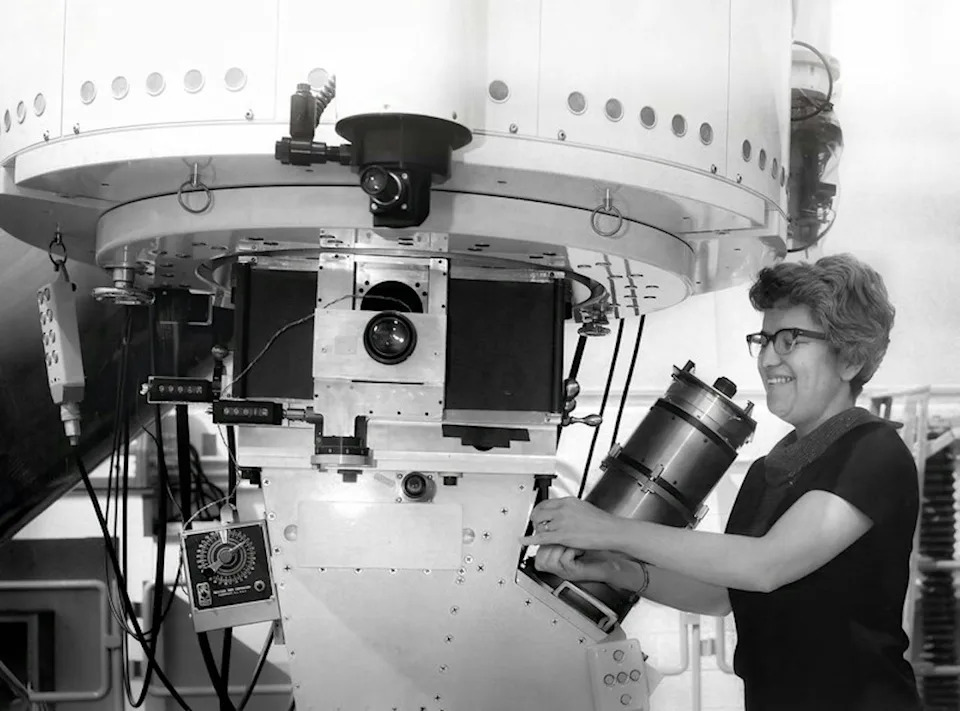
The astronomer Vera Rubin discovered a strong mismatch in spiral galaxies that scientists now understand as dark matter.Carnegie Institution for Science,CC BY
To explain this, scientists infer a halo of invisible mass — dark matter — surrounding galaxies. Additional signs come from galaxy clusters and gravitational lensing, where light from distant objects is bent more than the visible matter can account for. Taken together, observations indicate there is roughly five times more dark matter than ordinary matter in the universe.
Unlike antimatter, dark matter has not been directly detected in the lab. Physicists search for candidate particles (such as WIMPs or axions) and run experiments deep underground or in accelerators, but so far those searches have not produced a confirmed discovery.
How Are They Different?
- Nature: Antimatter is the well-understood charge-reversed partner of ordinary particles. Dark matter is unknown mass inferred from gravity.
- Interaction: Antimatter interacts electromagnetically (so it annihilates with matter). Dark matter appears not to interact — or interacts extremely weakly — with light and ordinary matter, except via gravity.
- Abundance: Antimatter is scarce in today’s universe. Dark matter is abundant — about five times more than normal matter.
Why This Matters
Antimatter helps us test physics and provides medical tools. Dark matter shapes the structure and evolution of the cosmos and remains one of the biggest unsolved puzzles in modern science. Solving the dark matter mystery would change our understanding of the universe.
Want to Ask a Question? If you have another question, ask an adult to send it to CuriousKidsUS@theconversation.com with your name, age and city.
Author: Dipangkar Dutta, Mississippi State University. Funding acknowledged from the U.S. Department of Energy and the National Science Foundation. This article is adapted from The Conversation.


