The U.S. Treasury circulated designs for a $1 commemorative coin featuring President Trump while rejecting Citizens Coinage Advisory Committee recommendations to honor Frederick Douglass, suffragists and Ruby Bridges for the nation’s 250th anniversary. Early reverse art reportedly included the words “FIGHT FIGHT FIGHT,” though later designs were toned down to feature a bald eagle. Lawmakers introduced the Change Corruption Act to bar living presidents from appearing on U.S. currency, reviving debates about how America should commemorate its history.
Treasury Floats Trump Commemorative Coin as Douglass, Suffragists and Ruby Bridges Are Rejected

For America’s 250th birthday, Trump plans to celebrate himself
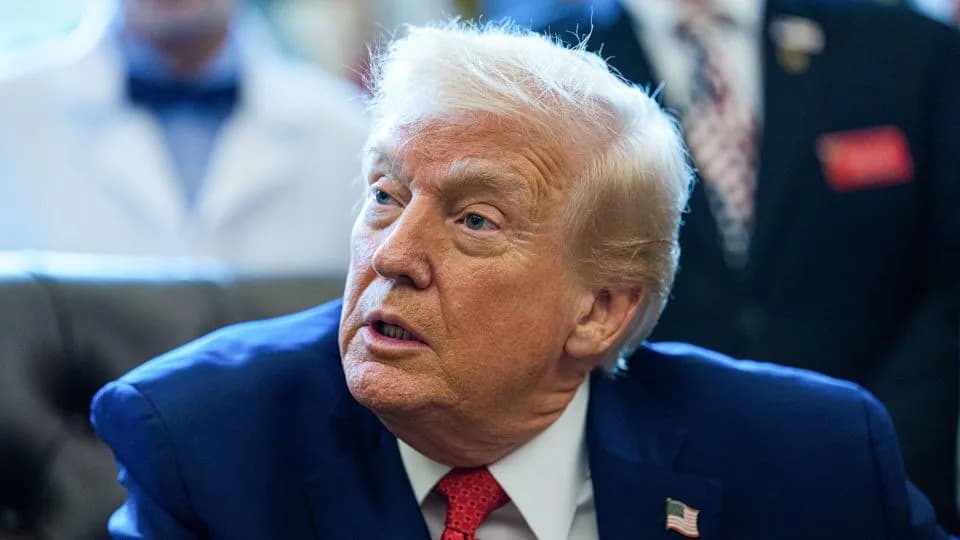
The U.S. Treasury circulated preliminary designs for a $1 commemorative coin that would feature President Donald Trump, while rejecting Citizens Coinage Advisory Committee recommendations to honor figures such as Frederick Douglass, suffragists and Ruby Bridges for next year’s semiquincentennial, The New York Times reported.
The Citizens Coinage Advisory Committee proposed a set of designs meant to broaden the stories told by official currency beyond the Revolutionary era — highlighting abolition, women’s suffrage and the Civil Rights Movement. Those recommendations included a Douglass quarter and designs recognizing suffragists and Ruby Bridges, the six-year-old who integrated William Frantz Elementary School in New Orleans in 1960.
Instead, Treasury circulated images that once included a reverse showing Mr. Trump with his fist raised in front of an American flag and the words “FIGHT FIGHT FIGHT”. Later versions were scaled back: each proposed reverse now features a bald eagle, either alone, with the Liberty Bell or with the U.S. flag.
“Frederick Douglass is an example of somebody who’s done an amazing job and is being recognized more and more, I notice.” — President Donald Trump, Feb. 1, 2017
Historically, placing presidents on circulating U.S. coins is a relatively modern practice. Abraham Lincoln first appeared on the penny in 1909 (the centennial of his birth), and George Washington’s portrait was added to the quarter in 1932. Washington reportedly refused such honors while serving as president, saying that putting a leader’s likeness on coins was more fitting for monarchs than republics.
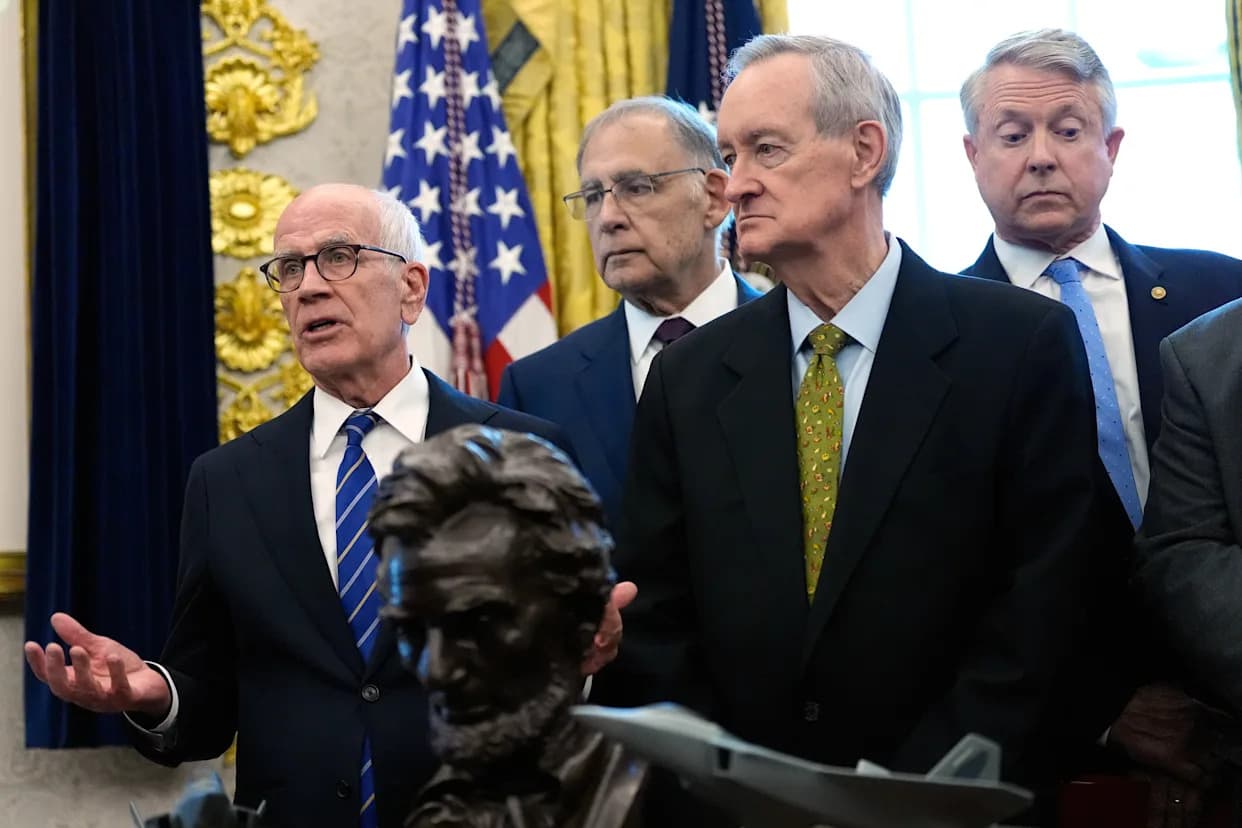
Sen. Jeff Merkley (D-Ore.), joined by Senators Catherine Cortez Masto (D-Nev.), Ron Wyden (D-Ore.) and Richard Blumenthal (D-Conn.), introduced the Change Corruption Act, which would bar living or sitting presidents from appearing on U.S. currency. “President Trump’s self-celebrating maneuvers are authoritarian actions worthy of dictators like North Korea’s Kim Jong Un, not the United States of America,” Merkley said after filing the bill.
U.S. Treasurer Brandon Beach defended the administration’s actions, telling The Times that Democrats sponsoring the bill are “so triggered by the proposed coin celebrating our nation’s 250th anniversary that they are trying to recklessly change law to block it.” Critics dismiss that response as a distraction, arguing that minting a coin with a living president is self-aggrandizing and inappropriate for a national commemoration.
The debate echoes earlier disputes over currency design. In 2019, the Trump administration halted an Obama-era plan to place abolitionist Harriet Tubman on the $20 bill in place of Andrew Jackson — an effort Mr. Trump derided as “pure political correctness.” Advocates for Tubman’s placement on currency have since revived the push, and descendants continue to press for her inclusion on paper money.
Whether Americans will see circulating twenties that no longer feature Andrew Jackson, or commemorative coinage that highlights a wider cross-section of the country’s history, remains uncertain. With the nation’s 250th anniversary approaching, the controversy raises questions about how the United States chooses to honor its past and who gets to represent that story on its money.
Key facts: The advisory panel recommended honoring Douglass, suffragists and Ruby Bridges; the Treasury circulated Trump-centric $1 designs (initially including “FIGHT FIGHT FIGHT”); lawmakers proposed new legislation to ban living presidents from currency; the administration previously blocked plans to put Harriet Tubman on the $20 bill.
Help us improve.