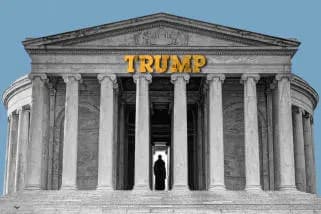
As Donald Trump completes the first year of his second term, his name has been attached to a growing number of public and private projects — from the U.S. Institute of Peace and a Kennedy Center venue to a class of battleships and a 4-mile Florida road to Mar-a-Lago. Critics, including historians and Sen. Bernie Sanders, call the practice unprecedented for a sitting president and warn it may encourage access-seeking behavior. Supporters and some lawmakers say the tributes are deserved; several bills have been introduced to expand or to restrict such namings.
Trump’s Name Goes Up Now: An Unprecedented Wave Of Naming While He’s In Office
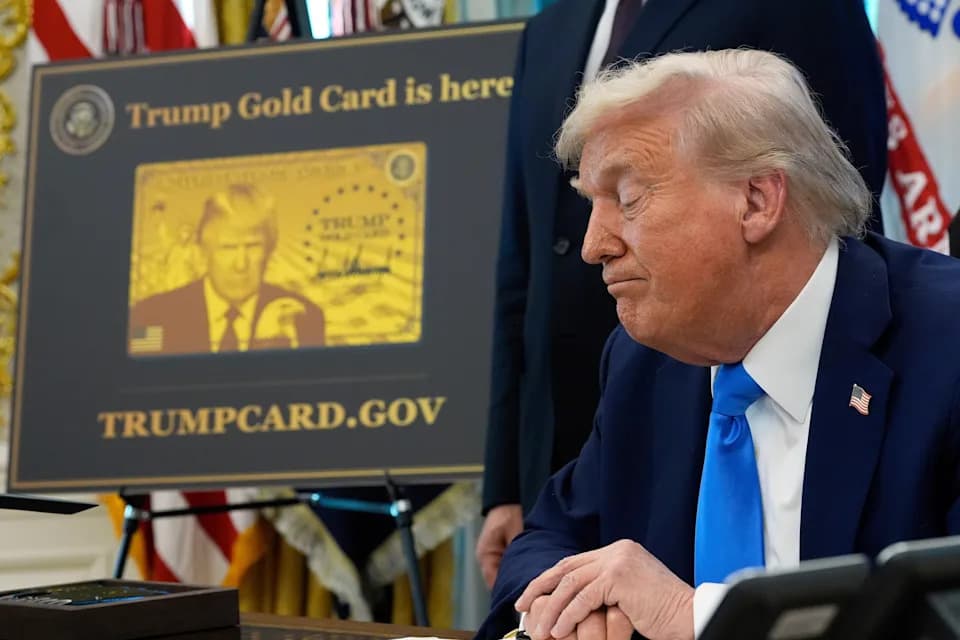
FILE - A poster showing the Trump Gold Card is seen as President Donald Trump signs executive orders in the Oval Office of the White House, Sept. 19, 2025, in Washington. (AP Photo/Alex Brandon, file)(ASSOCIATED PRESS)
WASHINGTON — As Donald Trump completes the first year of his second term, his administration, allies and local officials have repeatedly affixed his name to an expanding list of public projects, cultural venues and commercial ventures. The pace and scale of those namings — ranging from a federal institute and a Kennedy Center venue to a class of warships and a Florida roadway — have prompted fresh debate about precedent, propriety and politics.
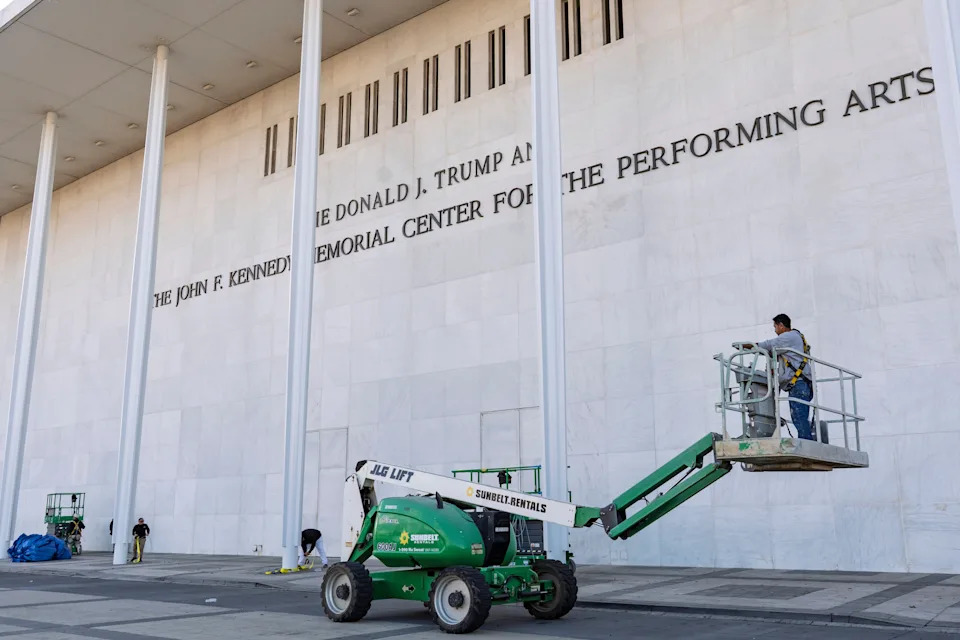
FILE - Workers add President Donald Trump's name to the John F. Kennedy Memorial Center for the Performing Arts, after a Trump-appointed board voted to rename the institution, in Washington, Dec. 19, 2025. (AP Photo/J. Scott Applewhite, File)(ASSOCIATED PRESS)
What Has Been Named So Far
Recent examples include the U.S. Institute of Peace and a performance space at the Kennedy Center that now bear the Trump name, a newly classed group of battleships, and a 4-mile (6-kilometer) stretch of road in Palm Beach County that local officials plan to dedicate as President Donald J. Trump Boulevard. The White House and allies also promote branded initiatives and products such as the “Trump Accounts” for tax-deferred investments, the TrumpRx government website set to offer direct prescription sales, and the $1 million-plus Trump Gold Card Visa.
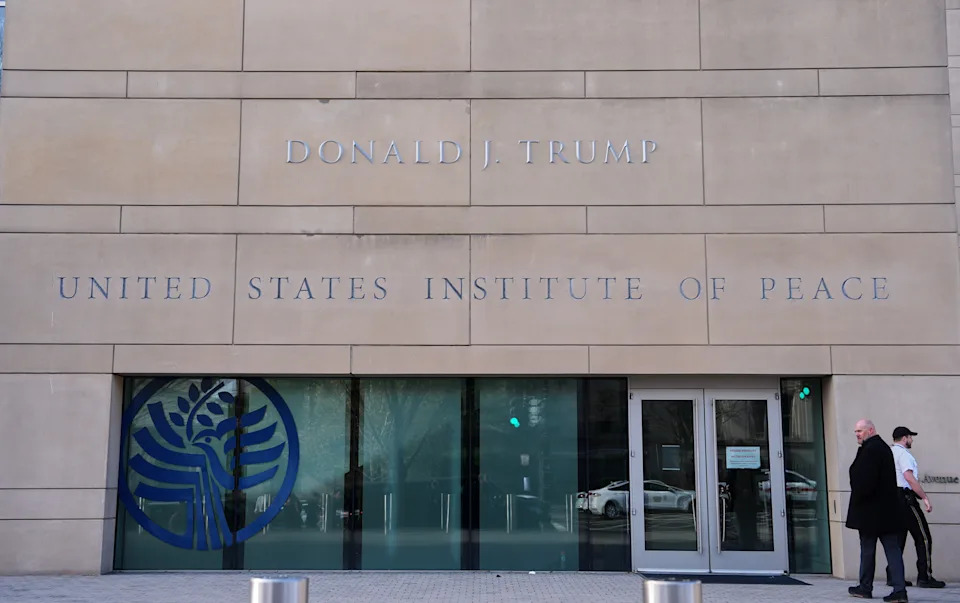
FILE - President Donald Trump's name is seen on the U.S. Institute of Peace building, Dec. 4, 2025, in Washington. (AP Photo/Evan Vucci, file)(ASSOCIATED PRESS)
Private ventures tied to the Trump brand continue as well: watches, fragrances, Bibles, and gold high-top sneakers sold during the 2024 campaign; a planned Trump Mobile phone and a gold-colored smartphone; and a memecoin called $TRUMP. Officials have also discussed a government-issued coin bearing the president’s likeness, a plan U.S. Treasurer Brandon Beach said the U.S. Mint is preparing.
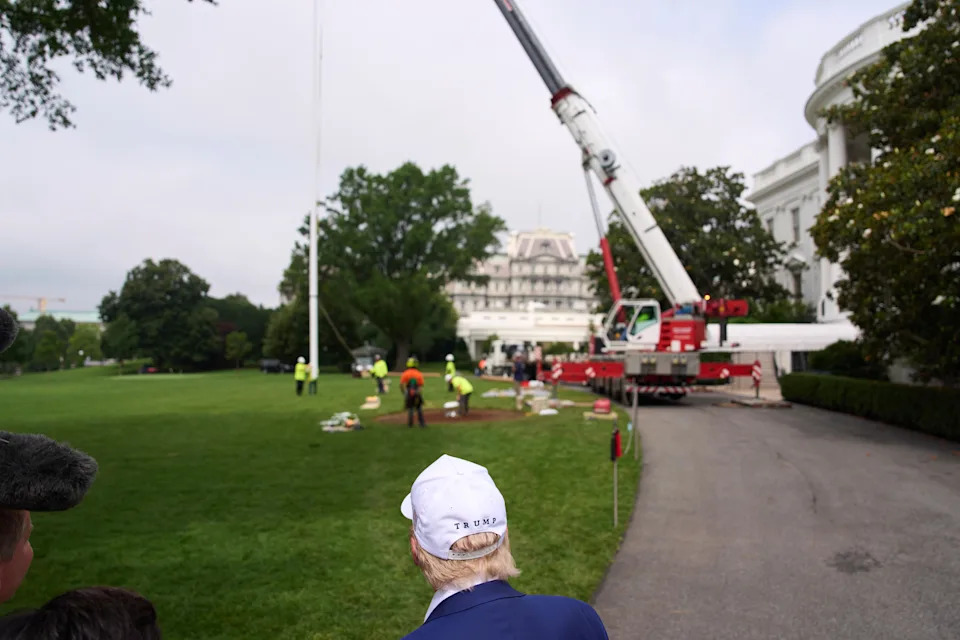
FILE - President Donald Trump speaks with reporters as a flag pole is installed on the South Lawn of the White House, June 18, 2025, in Washington. (AP Photo/Evan Vucci, File)(ASSOCIATED PRESS)
How Trump Has Responded
President Trump has publicly welcomed the tributes. At a White House dinner, he praised the naming of the “Trump Route for International Peace and Prosperity,” which the administration says was proposed by Armenian officials as part of a brokered transit corridor. Trump has also reportedly expressed a desire to have his name on the Washington Commanders’ rebuilt stadium; team ownership, which controls naming rights, has not commented publicly.
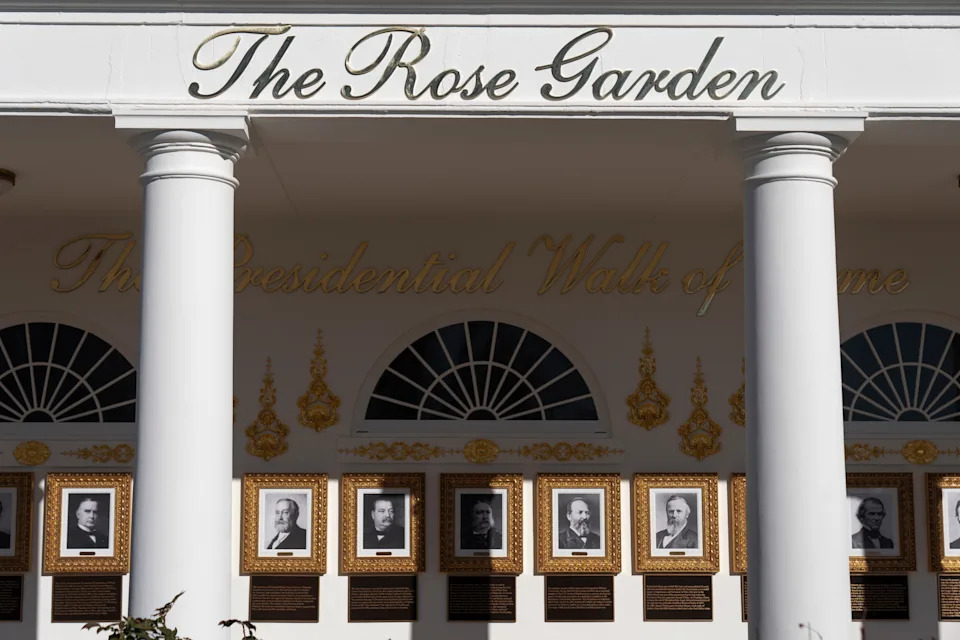
FILE - A sign for the Rose Garden is seen near the Presidential Walk of Fame on the Colonnade at the White House, Jan. 13, 2026, in Washington. (AP Photo/Mark Schiefelbein, File)(ASSOCIATED PRESS)
Reactions And Criticism
“At no previous time in history have we consistently named things after a president who was still in office,” said Jeffrey Engel, director of the Center for Presidential History at Southern Methodist University. “One might even extend that to say a president who is still alive. Those kind of memorializations are supposed to be just that — memorials to the passing hero.”
Independent Sen. Bernie Sanders introduced legislation to ban the naming or renaming of federal property for a sitting president, a provision he said should apply retroactively to the Kennedy Center and the U.S. Institute of Peace. Sanders said the practice resembles vanity or authoritarian-style aggrandizement and argued that federal assets should not be used for personal promotion.
Historians warn the practice may encourage access-seeking behavior. As Engel put it, honoring a sitting leader can signal that the fastest route to influence is to flatter or commemorate that leader publicly.
Support And Legislative Proposals
Supporters — including some Republican members of Congress and local officials — defend the honors as fitting recognition. Proposed bills range from renaming major transportation assets (Rep. Greg Steube’s bill to call the Washington-area Metro the “Trump Train” and Rep. Addison McDowell’s proposal to rename Dulles Airport) to designating June 14 as “Trump’s Birthday and Flag Day” (Rep. Claudia Tenney). Florida lawmakers are pursuing measures to rename airports and other local sites, and municipalities such as Hialeah have already renamed streets for the president.
Why It Matters
The controversy raises normative and legal questions about the role of federal naming conventions, the symbolic use of public space, and the difference between private branding and government commemoration. While the White House points to historical precedents — such as Washington, D.C., being named for George Washington — historians say systematic, widespread naming of federal assets for a living, sitting president is historically uncommon.
Whether these actions will prompt new laws or administrative rules limiting such namings remains uncertain. For now, the debate underscores a rare overlap of presidential branding and public honors that many commentators find unusual in a modern U.S. presidency.
Notable Quotations
White House spokeswoman Liz Huston: “The Administration’s focus isn’t on smart branding, but delivering on President Trump’s goal of Making America Great Again.”
Sen. Bernie Sanders: “If the American people want to name buildings after a president who is deceased, that’s fine. That’s what we do.”
Help us improve.