Pedro Sánchez has taken a public pro‑immigration stance while many EU leaders adopt tougher rhetoric amid rising far‑right pressure. Spain credits immigrants with helping fuel its recent economic growth and easing labor shortages, yet some reforms have stalled and critics blame policies for migrant fatalities, including 23 deaths in Melilla in 2022. The government says its migration policy is responsible and is pledging more public housing while cooperating with African partners to curb dangerous sea crossings.
Spain’s Sánchez Defends Pro‑Immigration Policy as EU Leaders Take a Harder Line

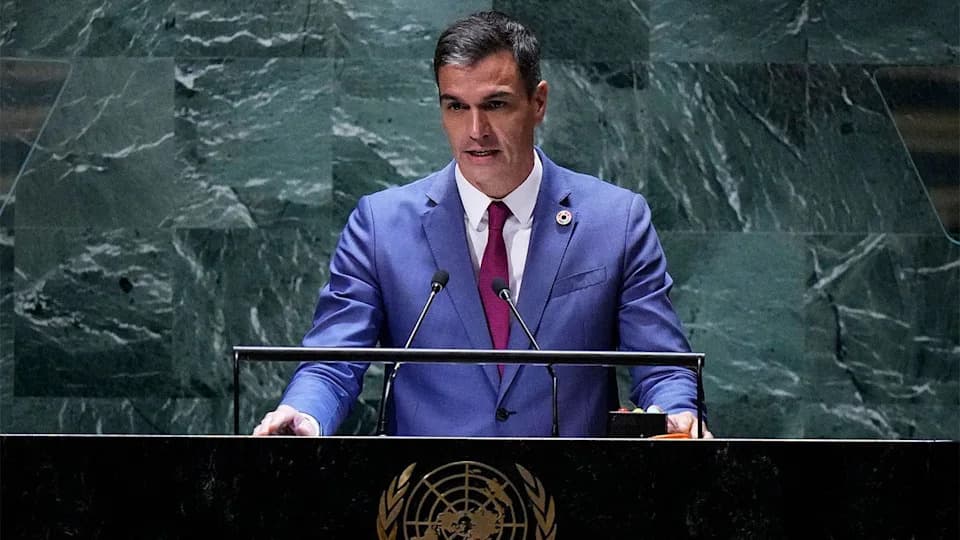
FILE - Spain's Prime Minister Pedro Sanchez speaks with the media as he arrives for an EU summit at the European Council building in Brussels, Thursday, March 23, 2023. (AP Photo/Geert Vanden Wijngaert, File)(ASSOCIATED PRESS)
Madrid — Spanish Prime Minister Pedro Sánchez has stood out in Europe by openly defending legal immigration as a net benefit to Spain, even as many other EU leaders adopt tougher rhetoric amid the rise of far‑right movements and heightened political pressure on migration issues.
Sánchez, whose country has welcomed millions from Latin America and Africa in recent years, frequently emphasizes the economic and social contributions immigrants make to the eurozone’s fourth‑largest economy. “Spain must choose between being an open and prosperous country or a closed and poor one,” he has said.
Why Spain’s Approach Differs
Spain’s pro‑immigration stance is consistent with the positions of previous progressive governments, analysts say. Anna Terrón Cusi, a senior fellow at the Migration Policy Institute who worked on immigration policy for several Spanish administrations, notes continuity in Spain’s approach even as domestic politics shift.

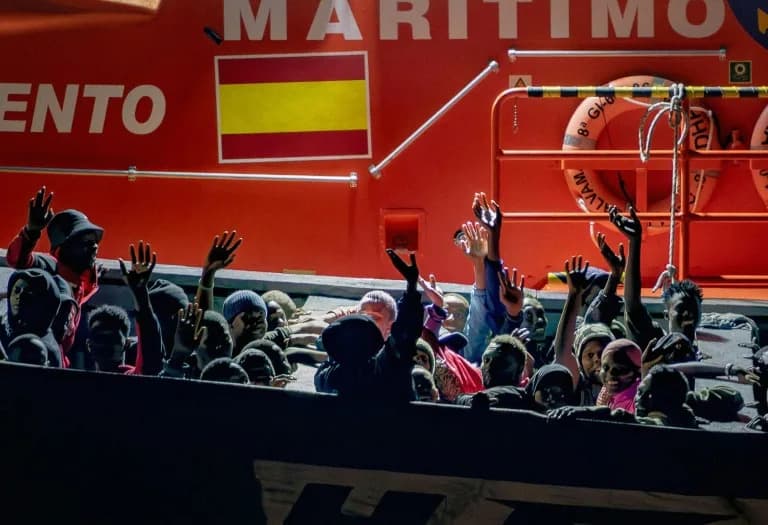
FILE - Migrants disembark at the port of "La Estaca" in Valverde at the Canary island of El Hierro, Spain, Monday, Aug. 26, 2024. (AP Photo/Maria Ximena, File)(ASSOCIATED PRESS)
“What has changed a lot internally is that there is now very anti‑immigration rhetoric from Vox, especially against Muslim immigrants,” Terrón Cusi said. “But Sánchez, unlike other European leaders, responds by directly and strongly confronting this narrative.”
Across Europe, centrist leaders are pivoting to tougher language and policies in response to gains by far‑right parties. In France, President Emmanuel Macron has framed migration as a problem that needs addressing to prevent further right‑wing gains; in Germany, Chancellor Friedrich Merz campaigned on tougher migration policy and his government has recently stepped up border controls and increased deportations of rejected asylum‑seekers.
Economic Effects and Policy Challenges
Spanish officials and economists point to immigration as an important factor behind Spain recording the fastest economic growth in the EU for a second consecutive year. Newcomers have helped bolster an aging workforce and contributed to tax revenues and consumption.
Spain’s central bank has projected a long‑term need for roughly 24 million working‑age immigrants over the next 30 years to maintain the balance between workers and retirees plus children — a striking figure that underscores demographic pressures facing the country.
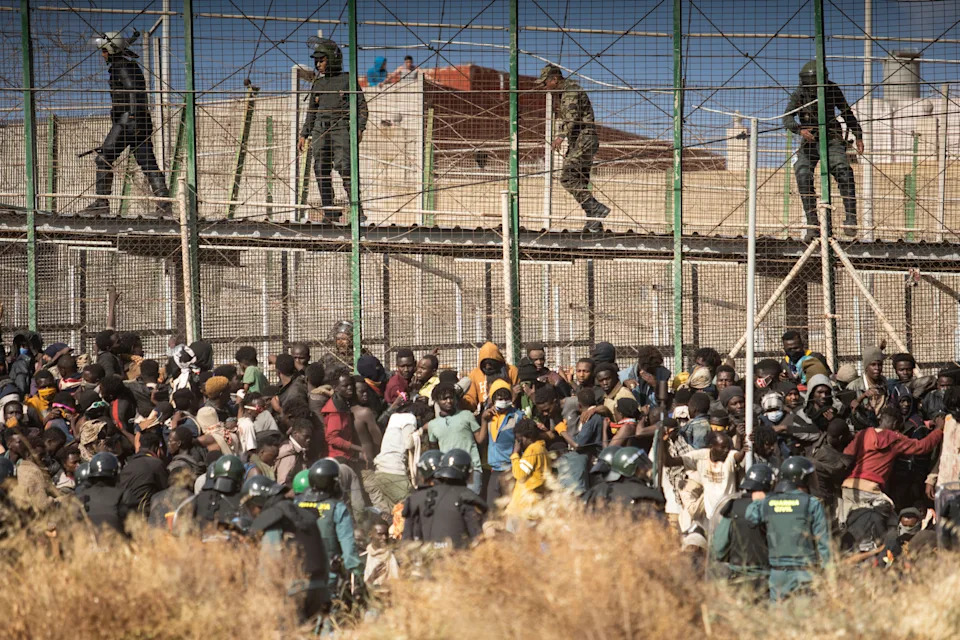
FILE - Riot police officers cordon off the area after migrants arrive on Spanish soil and crossing the fences separating the Spanish enclave of Melilla from Morocco in Melilla, Spain, on June 24, 2022. (AP Photo/Javier Bernardo, File)(ASSOCIATED PRESS)
Domestically, Sánchez’s government has moved to ease residency and work permits for hundreds of thousands of people living in Spain illegally. Migration Minister Elma Saiz has argued the country may need as many as 300,000 taxpaying foreign workers each year to sustain pensions, health care and unemployment benefits. However, critics say the legislative changes contained shortcomings and, in some cases, hurt the migrants they aimed to help. A more ambitious amnesty proposal later stalled in Parliament amid political sensitivities.
Efforts To Curb Dangerous Sea Crossings
To reduce deaths and dangerous crossings by boat, Spain has worked with the EU to provide funding and support to African governments. In response to a surge in crossings to the Canary Islands, Sánchez traveled to Mauritania with European Commission President Ursula von der Leyen; the EU pledged €210 million to help curb departures. Spanish officials report arrivals to the Canary Islands are down about 60% this year, a decline many observers attribute to stepped‑up enforcement by African governments.
Nevertheless, human‑rights groups have criticized aspects of Spain’s migration policy, saying some measures contributed to deadly outcomes. They point to the 2022 incident in Melilla — a Spanish enclave in North Africa — where clashes at the border fence resulted in the deaths of 23 migrants. Sánchez defended the actions of Moroccan and Spanish police at the time, calling the mass attempt to breach the enclave “an attack on Spain’s borders.” A spokesperson for the prime minister later described the government’s migration policy as “effective and responsible.”

FILE - Spain's Prime Minister Pedro Sanchez arrives for an EU summit at the European Council building in Brussels, Thursday, June 29, 2023. (AP Photo/Virginia Mayo, File)(ASSOCIATED PRESS)
Integration Pressures: Housing and Social Policy
Spain is home to a large Latin American community — more than 4 million people from Latin America were living in Spain legally in 2024, according to government figures — and many integrate more easily due to language and cultural ties. The top countries of origin for immigrants currently include Morocco, Colombia and Venezuela.
Economists warn that the country’s housing shortage, driven in part by overtourism and short‑term rentals, complicates integration. “If you integrate so many people, but you don’t build more housing, there could be problems,” said José Boscá, an economist at the University of Valencia. In response, Sánchez’s government has pledged additional funding for construction — focusing on public housing — and proposed measures to curb wealthy foreigners buying second homes.
Where Things Stand
Sánchez’s pro‑immigration argument continues to clash with hardening sentiments elsewhere in Europe and with vocal domestic opponents such as the far‑right Vox party. While some policy steps have produced measurable declines in irregular arrivals and appear to support economic growth, the debate remains politically fraught — balancing humanitarian obligations, integration needs and public concerns about housing and services.
Associated Press reporters Kirsten Grieshaber in Berlin, Sylvie Corbet in Paris and Renata Brito in Barcelona contributed to this report.
Help us improve.