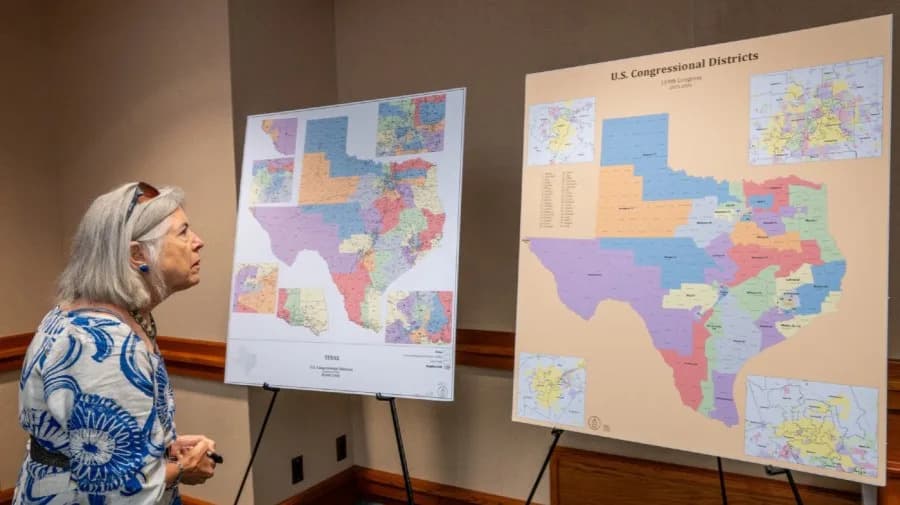
The Wisconsin Supreme Court has sent two redistricting lawsuits to rarely used three-judge panels, with initial hearings set to establish timetables. One side proposed a potential trial in February 2027, while other plaintiffs are pressing for new maps in time for the 2026 midterms. Both suits challenge the 2011 congressional maps as an unconstitutional gerrymander that favors Republicans; rulings by the panels can be appealed to the state supreme court.
Rare Three-Judge Panels to Hear Wisconsin Redistricting Lawsuits — Schedules, Stakes and Targets

FILE - This Wisconsin State Capitol is seen on Dec. 31, 2020, in Madison, Wis. (AP Photo/Morry Gash, File)
MADISON, Wis. — For the first time in state history, two separate three-judge panels will convene to hear lawsuits seeking to redraw Wisconsin’s congressional map, with initial hearings set for Friday to establish how each case will move forward.
Last month the Wisconsin Supreme Court directed that both cases be routed to the three-judge panels — a review mechanism created by Republican lawmakers in 2011 but never before used. The Friday sessions are intended to set schedules, discovery timetables and other procedural deadlines for each matter.
In one suit, attorneys submitted a proposed timeline that contemplates a possible trial in February 2027. Plaintiffs in the other case are pressing for faster relief so new maps could be in place before the 2026 midterm elections. Each three-judge panel will set its own calendar, and the two panels are not required to use the same deadlines.
Any final decision by a three-judge panel on the merits can be appealed to the Wisconsin Supreme Court, which currently has a 4-3 liberal majority.
What The Lawsuits Say
Both lawsuits challenge congressional maps first adopted in 2011, alleging the boundaries amount to an unconstitutional gerrymander that benefits Republicans. Republicans now hold six of Wisconsin’s eight U.S. House seats.
One case was brought by a bipartisan coalition of business leaders, known as Wisconsin Business Leaders for Democracy. Law Forward and the Election Law Clinic at Harvard Law School represent that coalition; they argue the map is an unlawful, anti-competitive gerrymander and note that the median margin of victory across the state’s eight districts since 2011 is nearly 30 percentage points.
“In a 50-50 state, it makes no sense that 75% of Wisconsin seats in the House of Representatives are controlled by one party,” Law Forward said in a summary of the complaint.
The other case, filed on behalf of Democratic voters by the Elias Law Group, contends the map discriminates against Democrats by packing large numbers of Democratic voters into two districts while dispersing other Democratic-leaning areas across six districts that favor Republicans. That complaint alleges violations of the state constitution’s guarantees of equal protection, separation of powers, the promise to maintain a free government, and rights to free speech and association.
Political Context And Targets
The legal fight in Wisconsin is unfolding amid a nationwide contest over redistricting as President Donald Trump and national Republican allies seek to preserve a narrow House majority next year. Democrats have identified two Wisconsin targets where they hope new maps could improve their chances: the western 3rd District, held by Republican Rep. Derrick Van Orden, and the southeastern 1st District, held by Republican Rep. Bryan Steil.
By way of context, in 2010 — the year before the 2011 maps were drawn — Democrats held five U.S. House seats and Republicans three. Since then, Republicans have expanded their advantage to six of eight seats, though only two are generally considered competitive.
The congressional plan at issue was derived from maps drawn in 2011 and was previously upheld by a state Supreme Court when conservatives controlled the court. In March 2022 the U.S. Supreme Court declined to block the maps from taking effect.
Friday’s hearings are procedural but consequential: they will determine how quickly judges can consider evidence that may reshape Wisconsin’s districts and influence control of U.S. House seats in 2026 and beyond.
Help us improve.