The Carreras Pampa surface in Bolivia’s Torotoro National Park contains nearly 18,000 dinosaur traces from about 70 million years ago, including 16,600 three‑toed prints across 1,321 trackways and 1,378 swim tracks. A carbonate-rich lakeshore sediment (oval calcium carbonate grains plus ~35% fine silicates) enabled exceptional preservation of footprints, claw marks, tail drags and swim scratches. Most prints are theropod in origin, ranging from under 10 cm to over 30 cm; the team identified 11 track types and evidence of running, sharp turns and sinking behavior. Researchers propose Carreras Pampa is an ichnologic Lagerstätte because of its abundance, preservation quality and behavioral record.
Nearly 18,000 Dinosaur Tracks Found at Bolivia’s Carreras Pampa — The World’s Largest Tracksite

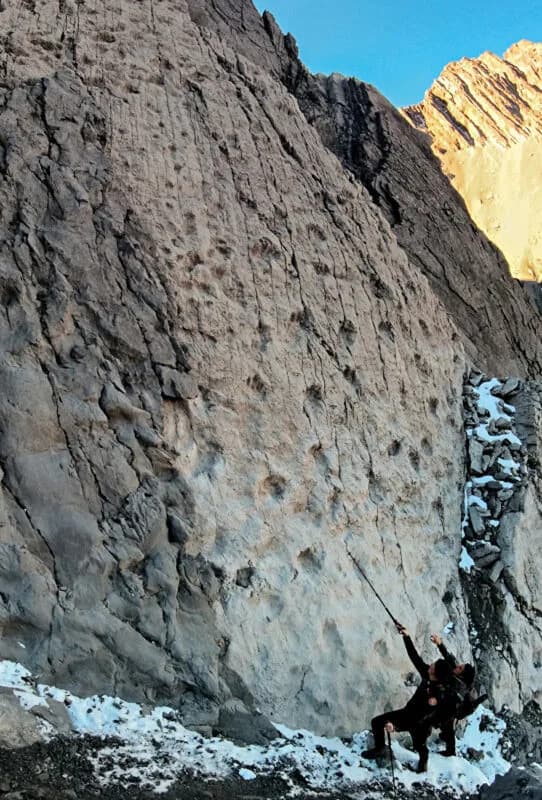
An expansive outcrop in Torotoro National Park, on the eastern slopes of the Andes in Bolivia, has been identified as the largest dinosaur tracksite on record. Paleontologists cataloging the Carreras Pampa surface counted nearly 18,000 individual traces left roughly 70 million years ago, during the final chapter of the Age of Dinosaurs.
The team documented a record-shattering 16,600 three-toed footprints distributed across 1,321 trackways plus 289 isolated prints, together with 1,378 swim tracks organized in 280 swim trackways. All of the traces are attributed to theropods — the group that includes the carnivorous dinosaurs and modern birds.
The Carreras Pampa tracksite in Torotoro National Park is "an extraordinary assemblage of dinosaur and avian ichnites, theropod swim tracks, tail traces, and various invertebrate burrows," write the US–Bolivian research team led by paleontologist Raúl Esperante.
What makes Carreras Pampa exceptional is not just the sheer number of footprints but the uncommon environmental conditions that preserved them so well. The surface was once the shoreline of a shallow freshwater lake. The sediment layer that captured the impressions consisted mainly of oval calcium carbonate grains — nested ostracod shells and ooids — with the remaining roughly 35% composed of fine-grained silicate minerals.
That carbonate-rich mud, when wet but not fully submerged, was soft enough to accept deep, clear impressions yet firm enough to hold them long enough for a subsequent sediment layer to bury and fossilize the prints. Critically, many of these bedding surfaces were not extensively overprinted by later animal traffic, allowing multiple track types to remain visible for millions of years.
Beyond conventional footprints, the site preserves claw impressions, tail-drag traces and shallow scratch marks produced as animals swam or waded across the lakebed. Footprint sizes range from under 10 cm to more than 30 cm; many feet measure between 16 and 29 cm, consistent with small- to medium-sized theropods — animals often comparable in height to an adult human.
The researchers recognized 11 distinct track types and documented behaviors such as running, sharp turns and episodes where animals apparently sank into soft substrate and used their tails for balance. "Theropod footprints with tail-drag traces are abundant and well preserved," the authors note, adding that the tail marks occur across shallow, deep and very deep trackways and likely reflect locomotive responses to soft ground.
Because Carreras Pampa preserves the largest known number of theropod footprints, the greatest number of swim tracks, and a diversity of preservation styles that reveal behavior, the team argues the site qualifies as an ichnologic concentration and conservation Lagerstätte — an exceptionally preserved window into a once-thriving ecosystem.
The study detailing these findings has been published in PLOS One.
Help us improve.