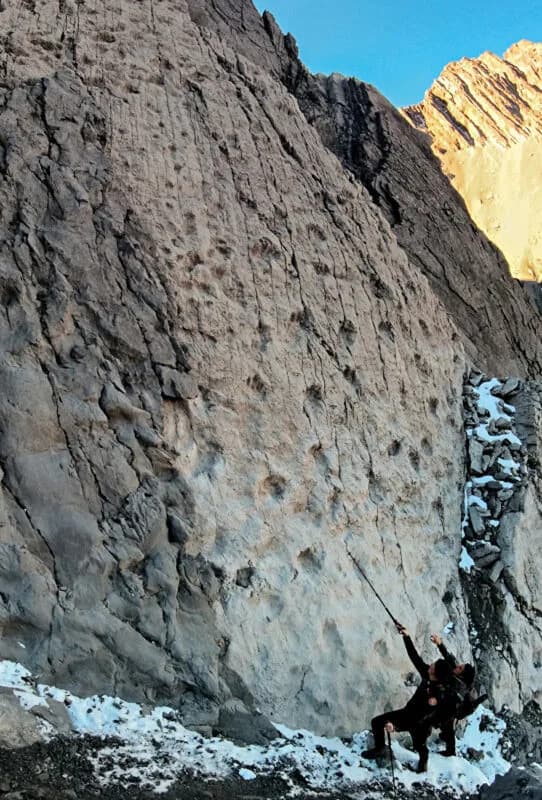
The Carreras Pampa site in Torotoro National Park, Bolivia, preserves a record-setting assemblage of more than 16,000 dinosaur tracks across over 80,000 sq ft of Upper Cretaceous rock. Researchers documented nine study areas and identified 11 track categories—most likely made by small-to-medium theropods—showing shoreward movement, overlapping visits, stops and turns. The site also includes running traces, tail drags and 280 swim grooves identified by alternating curved scratch sets. Together, the traces provide an unusually detailed behavioral snapshot of dinosaurs near an ancient lake.
Record Dinosaur Tracksite in Bolivia Reveals More Than 16,000 Footprints and Dynamic Behaviour

Researchers have documented a new global record of dinosaur trace fossils at Carreras Pampa in Torotoro National Park, Bolivia. The team mapped more than 16,000 individual footprints, continuous trackways, tail marks and swimming traces across an exposed surface exceeding 80,000 square feet—preserving a snapshot of life on an Upper Cretaceous lakeshore roughly 66 million years ago.
"It's amazing working at this site, because everywhere you look, the ground is covered in dinosaur tracks," said paleontologist Raúl Esperante of the Geoscience Research Institute, the study's lead author.
The researchers surveyed nine study areas and used the size, shape and orientation of prints to infer behaviour. Most trackways trend northwest–southeast, consistent with groups of animals walking along an ancient lakeshore. Overlapping and intersecting prints show repeated visits across time, while abrupt impressions reveal stops and turns. The assemblage contains a higher-than-usual proportion of long-stride impressions compared with many other sites, suggesting a prevalence of particular sizes or gaits among the trackmakers.
Although the study did not assign tracks to named species, the majority of prints display three-toed, bipedal morphology that points to theropod makers—relatives of modern birds. By analyzing heel and toe proportions and orientations, the team sorted the prints into 11 distinct morphological categories. Most tracks came from small to medium individuals, with foot lengths up to about 11 inches (roughly a men's size 14 shoe) and estimated hip heights between approximately 26 and 49 inches—ranging in size from dog-like to human-height animals with relatively large feet.
Beyond simple walking traces, the site preserves a range of behaviours: running prints, tail-drag marks and traces interpreted as swimming. The authors identified 280 elongated grooves they interpret as swim traces produced by alternating kicking motions. For these identifications they applied established criteria, including the occurrence of three or more sets of alternating curved scratch marks.
Why this matters
This extraordinary concentration of trace fossils offers a rare, behaviorally rich window into a single landscape at the end of the Cretaceous. Rather than isolated prints, the dense, diverse assemblage allows researchers to reconstruct movement patterns, group behavior and activity along an ancient shoreline—information rarely preserved at such scale.
The findings were published in PLOS One and are led by Raúl Esperante and collaborators from the United States and Bolivia.
Help us improve.