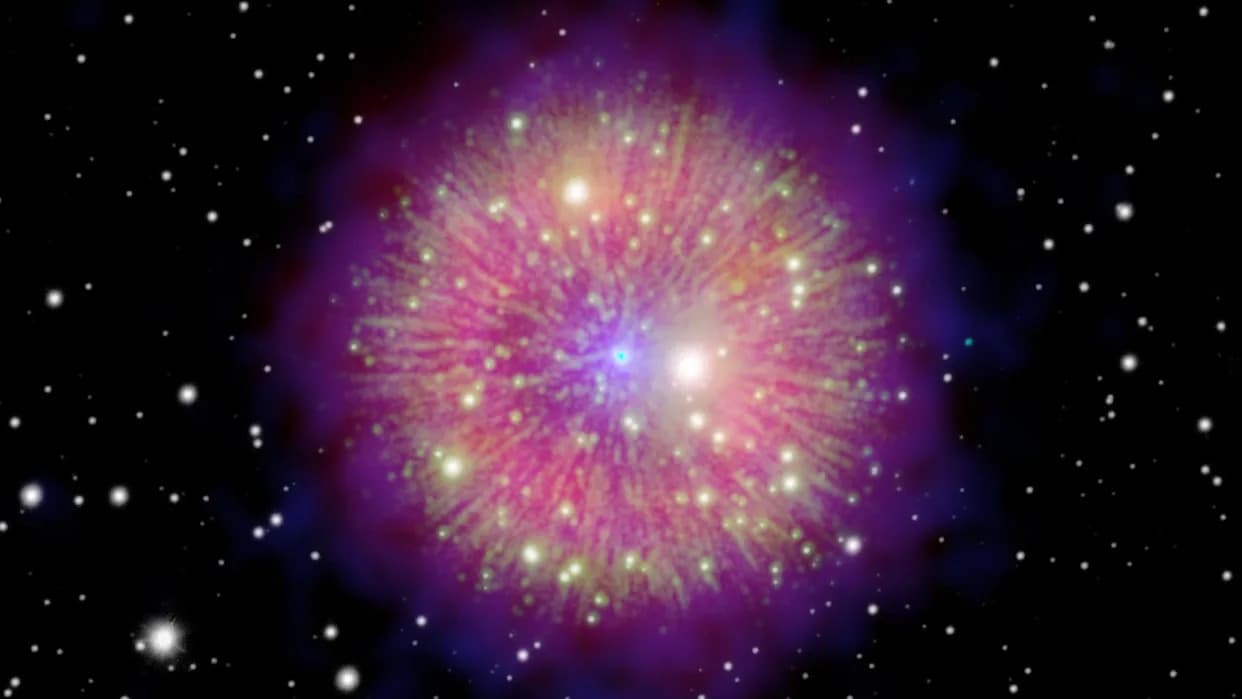
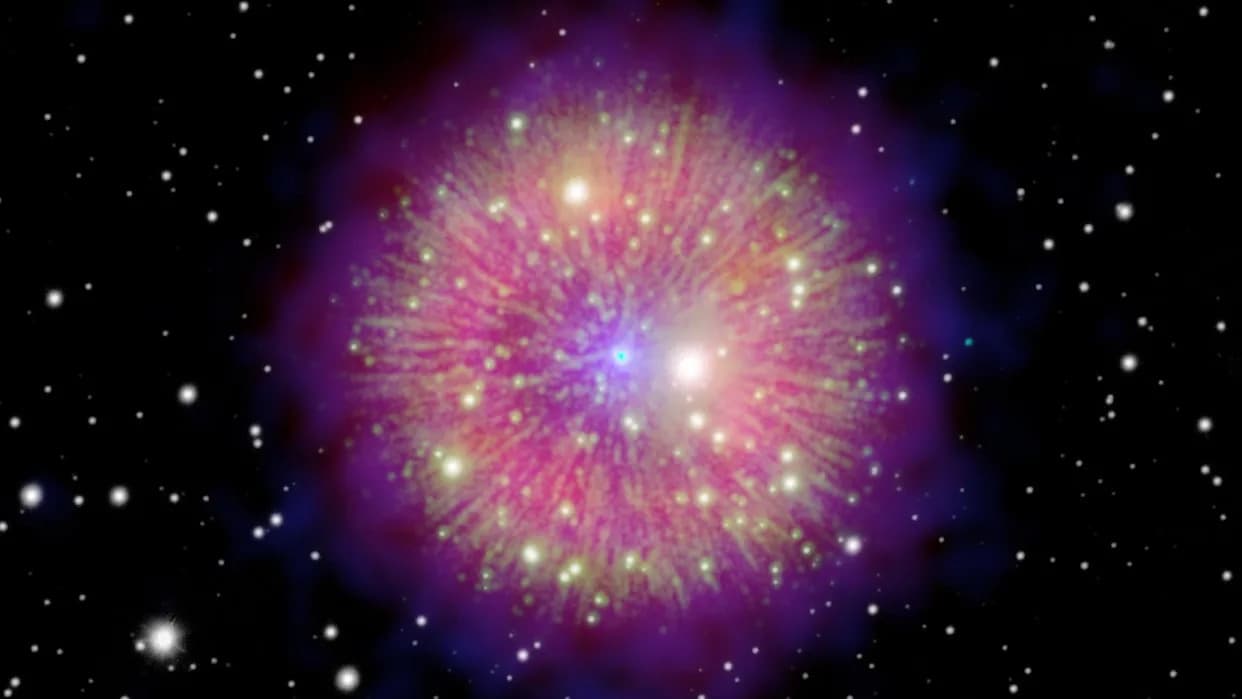
Key points: A team called the “Texas Mafia” directly observed the instant a blast broke through the surface of star SN 2024ggi, revealing an asymmetric, oblong explosion. Quick action by lead author Yi Yang and a last-minute ESO telescope redirect made the early, repeated observations possible. The data illuminate iron-core collapse, neutron-star formation, and how supernovae produce elements like calcium and iron.
Astronomers Capture Star’s Final Seconds, Reveal Hidden Shape of Supernova SN 2024ggi

For the first time, astronomers have directly observed the moment a blast tore through a massive star’s surface and transformed it into a supernova. The event — designated SN 2024ggi and described in a new paper in Science Advances — was captured thanks to a rapid, last-minute telescope redirect that caught the explosion at an exceptionally early stage.
How the observation unfolded
The observing team, informally known as the “Texas Mafia,” tracked SN 2024ggi from the moment the surface was breached. Lead author Yi Yang, newly returned from an overnight flight, contacted European Southern Observatory operators and secured immediate telescope time. That quick action allowed repeated observations that revealed how the explosion evolved over hours and days.
“We have had hints going back 30 years that when these massive stars — roughly 10 to 20 times the mass of the Sun — blow up, they are not spherical,” said J. Craig Wheeler of the University of Texas at Austin, a co-author of the study. “This event was unprecedentedly early, and we followed it frequently so we could see how it changed shape as it expanded.”
What the team found
The observations show the explosion was asymmetric: material shot upward and downward before the final blast, stretching the star into an oblong shape. This early asymmetry provides new constraints on how the shockwave propagates through the star’s outer layers and the physical processes that shape the explosion.
Why this matters
Very massive stars build heavier elements by fusing successively heavier nuclei — hydrogen to helium, helium to carbon and oxygen, and on through silicon — until they produce an iron core. Iron cannot release fusion energy, so once an iron core forms it absorbs energy and the star’s internal pressure collapses. The inner core falls inward and can compress into a neutron star only a few miles across, releasing an enormous amount of energy and driving the supernova.
Understanding these earliest moments helps scientists learn how elements essential to life — such as calcium in our bones and iron in our blood — are forged and distributed across the cosmos.
The team plans to secure more rapid-response telescope time to catch other supernovae at similarly early stages. Because these explosions are unpredictable, success depends on fast coordination and flexible observing schedules like the one that captured SN 2024ggi.
Source credits: Quotes and findings attributed to Yi Yang and J. Craig Wheeler; study published in Science Advances.
Help us improve.