This ISS photo (3 May 2023) shows three dark sandstone mesas northwest of Guérou, Mauritania, rising about 300–400 meters above the plain. Rock varnish — a thin, manganese- and iron-rich coating, sometimes stabilized by microorganisms — gives the mesas their black sheen. To the east, rare climbing dunes and downstream barchan dunes spill away from the mesas; to the west, wind-scour vortices keep the plain largely dune-free. These mesas likely trace back to a single Paleozoic rock formation and echo other regional and planetary mesa features.
Three Black Mesas in Mauritania Sculpt Rare Dune Patterns — ISS Photo

An astronaut aboard the International Space Station captured a striking image on May 3, 2023, showing three dark, flat-topped mesas rising from the Sahara near Guérou in southern Mauritania (16.930575400, -11.759622605). The circular sandstone mesas stand roughly 8 miles (13 km) northwest of the town of Guérou and tower approximately 1,000–1,300 feet (300–400 meters) above the surrounding plain.
Why the mesas look black
The mesas' dark appearance comes from a thin coating known as rock varnish: a clay-rich film packed with manganese and iron oxides that accumulates on exposed arid rock over thousands of years. Studies and observations from NASA's Earth Observatory and scientific literature such as ScienceDirect note that this varnish often forms in micrometer-thick laminations and may be partly stabilized by surface microorganisms.
Unusual dune patterns
The photo shows a striking contrast in sand distribution around the mesas. To the east, sand collects against the mesas to form two distinct dune types: rare climbing dunes — ridge-like deposits that build up against steep slopes — and downstream barchan dunes, the crescent-shaped dunes that create a stripy tail extending eastward. The dunes display a reddish-yellow hue against the dark rock.
To the west, however, the plain is surprisingly free of sand. NASA's Earth Observatory explains this as a wind-scour effect: fast, squeezed wind and vortices that form in narrow gaps between the mesas remove and redistribute sand, preventing accumulation on the upwind side.
Geologic context
Geologically, these mesas are relics of much older terrain. During the Paleozoic era (about 541–252 million years ago) they were likely part of a larger, contiguous rock formation later dissected by millions of years of water and wind erosion. The resulting isolated plateaus resemble other regional features such as the Richat Structure (the "Eye of the Sahara"), located roughly 285 miles (460 km) to the north.
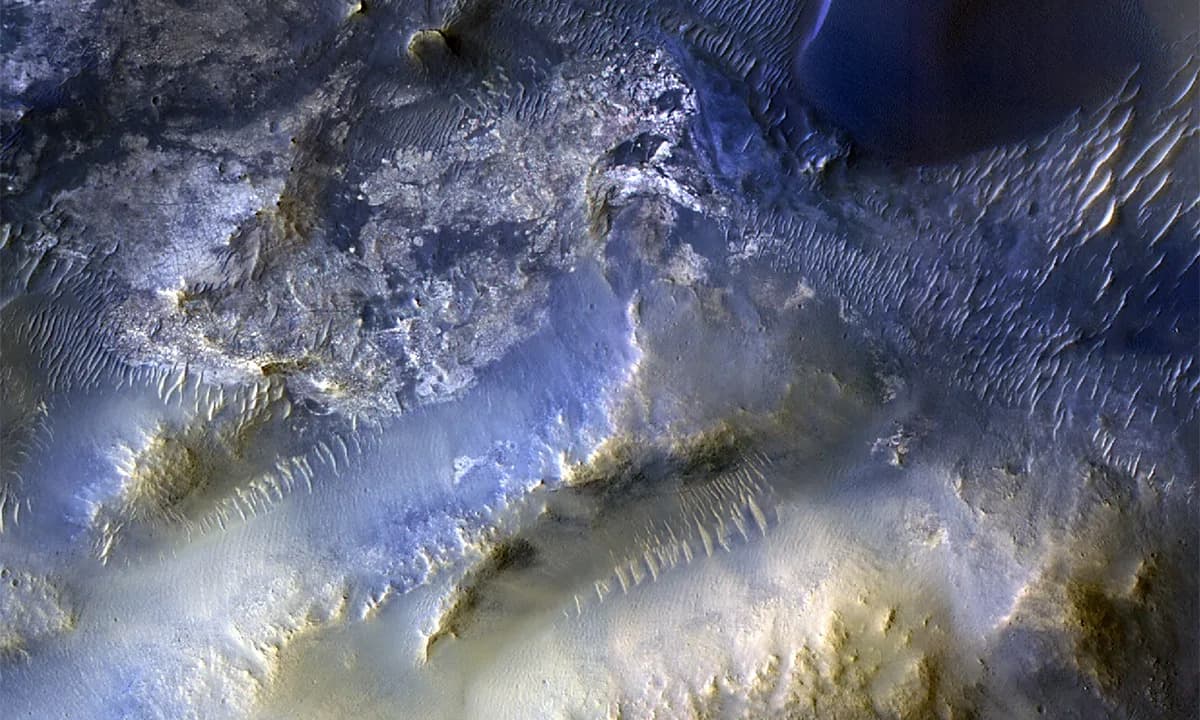
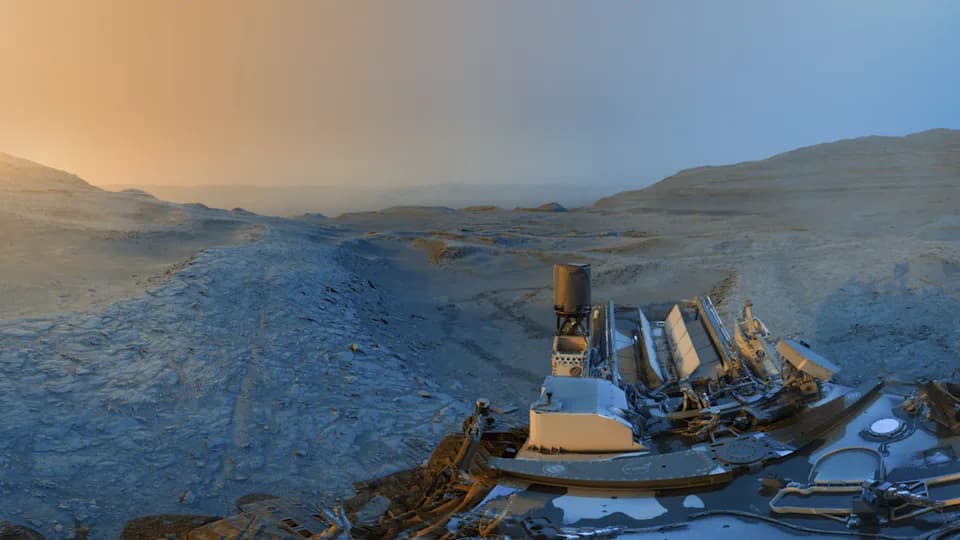
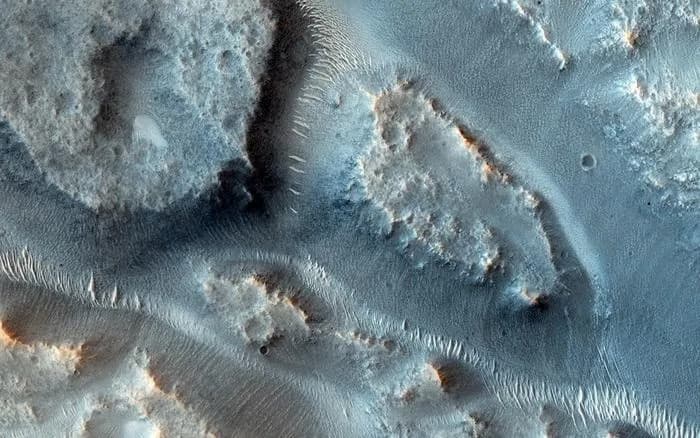
Mesas are common worldwide — abundant across the Sahara and in parts of the western United States (Colorado, New Mexico, Utah, Arizona) — and similar flat-topped landforms are prominent on Mars, where long-term wind erosion has carved comparable structures.
This astronaut photograph, together with earlier images (including a wider-area shot from 2014), offers a vivid example of how rock composition, wind direction, and local topography combine to shape rare and beautiful desert landforms.
Help us improve.